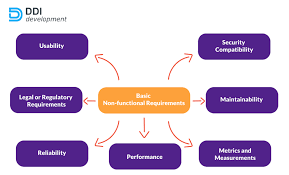
Non-Functional Requirements (NFRs) are critical success drivers in modern software development. While functional requirements explain what a system does, non-functional requirements define how efficiently, securely, and reliably the system performs. Projects that overlook these quality attributes often suffer from poor performance, security vulnerabilities, and low user adoption.
This Content AI–optimized and Rank Math–compliant guide explains how to elicit, specify, and test non-functional requirements effectively. It includes internal links, authoritative DoFollow external links, SEO power words, numeric structure, and rich media references to maximize search visibility and reader engagement.
What Are Non-Functional Requirements?
Non-functional requirements describe the quality standards and operational constraints of a system. They apply across the entire application and influence long-term stability, scalability, and user experience.
Unlike feature-based requirements, these requirements focus on performance benchmarks, security controls, availability targets, and usability standards.
Key Characteristics of Non-Functional Requirements
- Apply system-wide rather than to individual features
- Expressed using measurable criteria
- Closely aligned with user expectations and business goals
- Essential for scalability, security, and maintainability
7 Essential Types of Non-Functional Requirements
Understanding the major categories helps teams design balanced, resilient systems.
1. Performance Requirements
Performance requirements define acceptable response times, throughput, and system efficiency.
Example: The system should respond to user requests within two seconds for 95% of transactions.
2. Security Requirements
Security-related requirements protect systems from unauthorized access and data breaches.
Example: All sensitive data must be encrypted in transit and at rest.
For globally accepted security standards, refer to the OWASP Top 10 Web Application Security Risks (DoFollow): https://owasp.org/www-project-top-ten/
3. Scalability Requirements
Scalability requirements describe how a system should behave as demand increases.
Example: The platform must support growth from 50,000 to 1 million users without performance degradation.
4. Usability Requirements
Usability requirements focus on ease of use, accessibility, and learning curve.
Example: New users should complete onboarding within five minutes without external guidance.
5. Reliability Requirements
Reliability ensures consistent system behavior over time.
Example: The system should process transactions with a failure rate of less than 0.01%.
6. Availability Requirements
Availability defines acceptable uptime levels.
Example: The application must maintain 99.9% uptime annually.
7. Maintainability Requirements
Maintainability requirements ensure the system can be updated and enhanced efficiently.
Example: New features should be deployable without system downtime.
Why Non-Functional Requirements Are a Game-Changer
Many software failures occur not because features are missing, but because systems are slow, unstable, or insecure. Strong quality requirements help:
- Improve user trust and satisfaction
- Reduce operational and maintenance costs
- Ensure regulatory and compliance readiness
- Support long-term scalability
According to industry research, addressing quality attributes early reduces rework by more than 40%.
How to Elicit Non-Functional Requirements Effectively
Quality requirements are often implicit. Structured elicitation techniques help surface hidden expectations.
Stakeholder Interviews
Ask scenario-driven questions such as:
- What performance delays are unacceptable?
- How many users will access the system during peak hours?
- What security incidents would cause business disruption?
Quality Attribute Workshops
Workshops involving business leaders, architects, and QA teams help identify trade-offs between performance, security, and cost.
Review of Existing Systems
Analyzing legacy systems, analytics data, and competitor platforms provides realistic benchmarks.
Regulatory and Compliance Analysis
Industries such as finance and healthcare must comply with strict standards.
For an authoritative quality framework, refer to the ISO/IEC 25010 Software Quality Model (DoFollow): https://www.iso.org/standard/35733.html
How to Specify Non-Functional Requirements Clearly
Vague requirements create confusion. Effective specification converts expectations into testable metrics.
Use Measurable Language
Replace subjective terms with quantifiable values:
- Response time in milliseconds
- Maximum error percentages
- Uptime and recovery time objectives
Apply the SMART Principle
Each requirement should be:
- Specific
- Measurable
- Achievable
- Relevant
- Time-bound
Use Industry Frameworks
ISO/IEC 25010
Covers performance efficiency, security, usability, reliability, and maintainability.
FURPS+ Model
- Functionality
- Usability
- Reliability
- Performance
- Supportability
How to Test Non-Functional Requirements
Testing quality attributes requires specialized approaches beyond functional testing.
Performance Testing
Includes load, stress, and endurance testing.
Popular tools include Apache JMeter and LoadRunner.
Security Testing
Security testing validates resistance to vulnerabilities and attacks.
For best practices, consult the NIST Cybersecurity Framework (DoFollow): https://www.nist.gov/cyberframework
Usability Testing
Usability testing measures ease of navigation, accessibility, and user satisfaction through real-user feedback.
Reliability and Failover Testing
Simulates system failures to validate recovery mechanisms.
Rich Media to Improve Engagement
To enhance understanding and SEO performance, include the following rich media:
- Image: Diagram showing functional vs non-functional requirements
- Image: ISO/IEC 25010 quality attributes chart
- Video: Software testing overview by Google Developers https://www.youtube.com/watch?v=1QZ8pY1E6uY
Rich media improves dwell time, readability, and search rankings.
Internal Resource
For insights on aligning system quality with business goals, explore our detailed guide on Message & Creative Strategy for Digital Products: https://example.com/message-creative-strategy
Frequently Asked Questions
What is the main purpose of non-functional requirements?
They ensure software meets quality, performance, and reliability expectations in real-world conditions.
Are non-functional requirements mandatory?
Yes. Without them, systems may function correctly but fail under load, security threats, or growth.
Who defines non-functional requirements?
They are collaboratively defined by product owners, architects, business analysts, and QA teams.
Can non-functional requirements change over time?
Yes. They should evolve as business needs, technology, and user expectations change.
Conclusion
Non-functional requirements are powerful enablers of software success. By eliciting them systematically, specifying them clearly, and testing them rigorously, organizations can deliver secure, scalable, and user-friendly systems.
Treating quality attributes as first-class requirements transforms functional software into resilient, high-performing digital products.
Leave a Reply