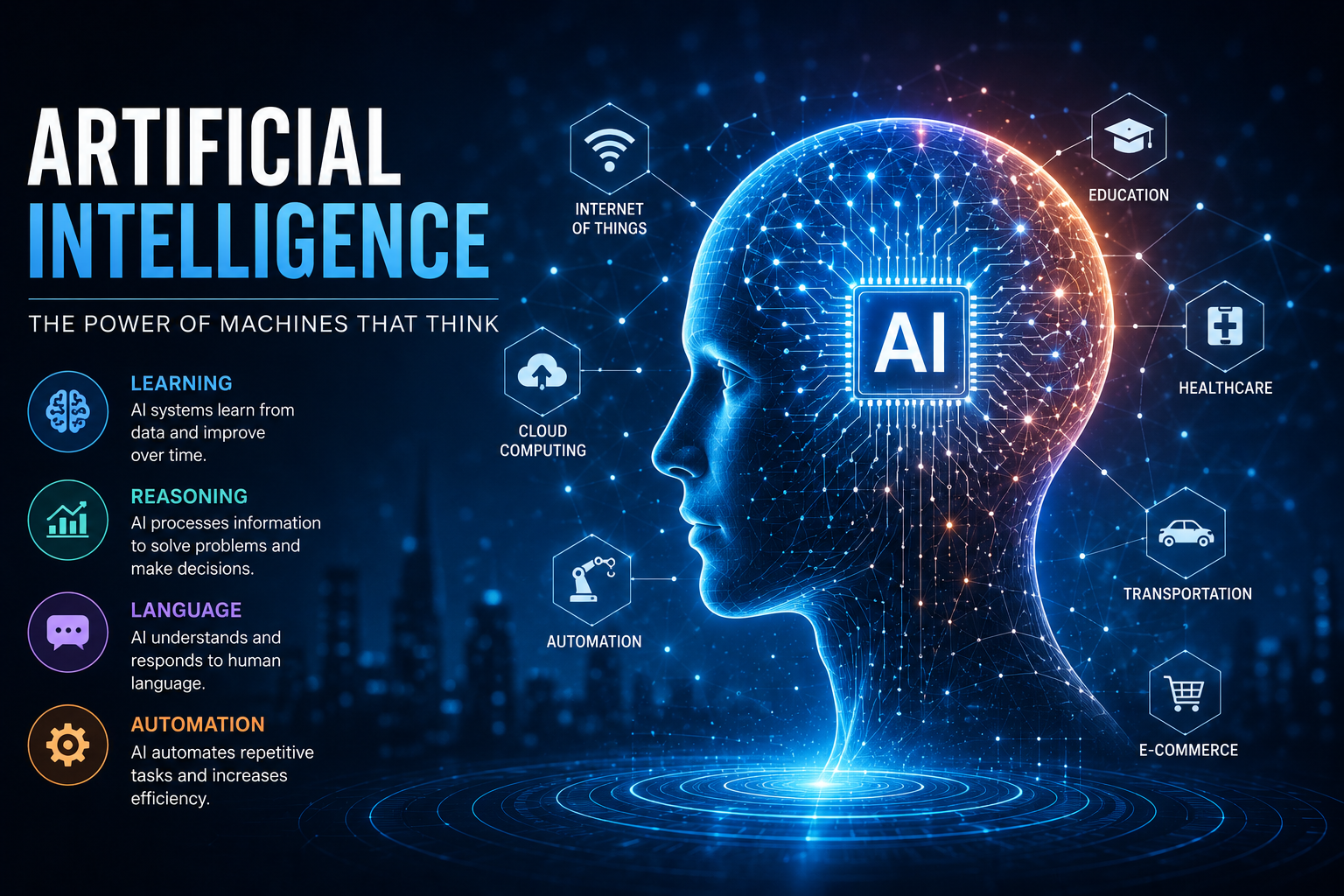
Tag: AI

  • Artificial Intelligence: The Technology That Slowly Became Part of Our Everyday Routine

    Artificial Intelligence: The Technology That Slowly Became Part of Our Everyday Routine

    Introduction

    A lot of people still hear the words Artificial Intelligence and imagine something futuristic.

    Robots.
    Science fiction movies.
    Machines taking over the world.

    But real-life AI doesn’t usually look dramatic.

    In fact, most of the time, it looks completely normal.

    It looks like:

    • Your phone unlocking with your face
    • Netflix suggesting a movie you actually enjoy
    • Google Maps helping you avoid traffic
    • Instagram somehow knowing what you’ll probably scroll for hours

    That’s AI.

    Quietly working in the background.

    And honestly, that’s what makes Artificial Intelligence so interesting. It didn’t suddenly arrive one day and announce itself to the world. It slowly blended into everyday life until using it became completely natural.

    Most people don’t even realize how often they interact with AI anymore.

    We’ve reached a point where technology is no longer just responding to us—it’s learning from us.

    And whether we notice it or not, that changes everything.


    What is Artificial Intelligence? :

    Let’s keep this simple and real.

    Artificial Intelligence is technology designed to learn from information and improve over time.

    Traditional software follows instructions exactly as they are programmed.

    AI is different.

    Instead of only following commands, AI studies:

    • Patterns
    • Behavior
    • Choices
    • Data

    Then it uses that information to make smarter decisions in the future.

    A simple example?

    When Spotify recommends songs that perfectly match your taste, it’s not guessing randomly. The system has learned what you enjoy listening to.

    The more you use it, the more accurate it becomes.

    That’s essentially how AI works.

    Learning through experience.


    Why AI Feels So Personal Today :

    Sometimes AI feels strangely accurate.

    You search for running shoes once… and suddenly every app seems to know you’re interested in fitness.

    You watch one cooking video… and now your feed is full of recipes.

    It can feel a little creepy sometimes, honestly.

    But AI isn’t “watching” you in the human sense.

    It’s studying patterns.

    It notices:

    • What you click
    • What you ignore
    • What you spend time watching
    • What you search repeatedly

    Over time, those patterns help AI predict what you’ll probably like next.

    And because modern systems process huge amounts of data so quickly, the recommendations often feel surprisingly good.

    That’s why technology today feels much more personalized than it did a few years ago.


    How Artificial Intelligence Actually Works :

    A lot of people assume AI is too technical to understand.

    But the core idea is actually pretty human.

    AI Learns from Examples :

    Think about how humans learn.

    We observe things.
    We practice.
    We improve after making mistakes.

    AI works in a very similar way.

    For example:

    • Show AI thousands of photos of cats → it learns how cats look
    • Show AI spam emails → it learns how to identify spam
    • Show AI shopping behavior → it learns customer habits

    The more information it receives, the smarter it becomes.

    Not because it’s “alive,” but because it becomes better at recognizing patterns.


    Machine Learning :

    Machine Learning is one of the most important parts of AI.

    Instead of manually teaching every single rule, developers allow machines to learn from data.

    This is what powers:

    • Recommendation systems
    • Search engines
    • Smart assistants
    • Social media algorithms

    And honestly, this is one of the biggest reasons technology feels smarter today than it did ten years ago.


    Deep Learning :

    Deep Learning is a more advanced type of AI inspired by the human brain.

    It helps systems:

    • Recognize faces
    • Understand speech
    • Translate languages
    • Analyze images

    This is why AI tools today can understand voices, photos, and conversations much more naturally.


    Natural Language Processing (NLP) :

    Natural Language Processing helps machines understand human language.

    Without it:

    • Chatbots would sound robotic
    • Voice assistants wouldn’t understand questions properly
    • AI writing tools wouldn’t exist

    NLP is what makes communication between humans and machines feel smoother and more natural.


    The Different Types of AI :

    Not all AI works the same way.

    Narrow AI :

    This is the type of AI we currently use every day.

    It focuses on one specific task and performs that task extremely well.

    Examples include:

    • Siri
    • Google Assistant
    • Netflix recommendations
    • Face recognition systems

    This AI is smart—but only within its assigned role.


    General AI :

    General AI refers to systems that could think and learn across multiple tasks like humans.

    This level of AI doesn’t fully exist yet, although researchers continue exploring it.


    Super AI :

    Super AI is the idea of machines becoming more intelligent than humans.

    Right now, it remains theoretical, but it’s one of the biggest discussions surrounding the future of technology.


    Where We Use AI in Everyday Life :

    One of the most fascinating things about AI is how normal it has become.

    Most people use it constantly without even noticing.


    AI in Smartphones :

    Your smartphone likely uses AI all the time.

    For example:

    • Face unlock
    • Camera improvements
    • Predictive typing
    • Voice assistants

    Even photo enhancement tools often rely on AI.


    AI in Social Media :

    Social media platforms use AI to decide:

    • What appears on your feed
    • Which videos get recommended
    • Which ads match your interests

    That’s why everyone’s feed feels different.

    AI personalizes content for each person.


    AI in Online Shopping :

    Online stores use AI to:

    • Recommend products
    • Predict customer interests
    • Improve user experiences

    That’s why shopping online often feels unusually personalized.


    AI in Healthcare :

    AI is helping doctors:

    • Detect diseases earlier
    • Analyze medical reports faster
    • Improve patient care

    In many cases, AI helps save time during critical situations.


    AI in Education :

    AI is also changing how students learn.

    It supports:

    • Personalized lessons
    • Smart tutoring systems
    • Faster learning feedback

    Education is becoming more flexible and interactive because of AI.


    The Biggest Benefits of Artificial Intelligence :

    There’s a reason businesses everywhere are investing heavily in AI.

    It Saves Time :

    AI can automate repetitive tasks much faster than humans.


    It Improves Accuracy :

    Machines can process large amounts of information with fewer mistakes.


    It Creates Personalized Experiences :

    From playlists to shopping recommendations, AI adapts to individual users.


    It Works Continuously :

    Unlike humans, AI systems don’t need breaks or sleep.


    The Concerns Around AI :

    Even though AI is exciting, it also raises important questions.

    Privacy Concerns :

    AI depends heavily on user data.

    Naturally, people worry about:

    • Data collection
    • Privacy protection
    • How information is being used

    Job Automation :

    Some repetitive jobs may become automated in the future.

    At the same time, AI is also creating entirely new industries and career opportunities.


    Bias in AI :

    AI learns from human-created data.

    So if the data contains bias, the AI can unintentionally reflect those same problems.

    That’s why ethical AI development matters so much.


    The Future of Artificial Intelligence :

    The future of AI feels exciting because we’re still only seeing the beginning.

    Over time, we’ll likely experience:

    • Smarter assistants
    • Better automation
    • More personalized technology
    • Faster innovation across industries

    Eventually, AI may become so normal that people stop thinking about it as “AI.”

    It will simply become part of everyday life—just like the internet did.


    Why Understanding AI Matters :

    You don’t need to become a software engineer to understand AI.

    But understanding the basics genuinely matters now.

    Because AI is already shaping:

    • Businesses
    • Careers
    • Communication
    • Technology
    • Everyday experiences

    And the people who understand these changes will adapt much faster in the future.


    Internal Links :


    External Links :


    Rich Media Suggestions :

    Images :

    Videos :


    Frequently Asked Questions (FAQ) :

    Q1: What is Artificial Intelligence in simple words? :

    Artificial Intelligence is technology that allows machines to learn from information and make smart decisions.


    Q2: Is AI already part of everyday life? :

    Yes. AI is used in smartphones, apps, social media, online shopping, healthcare, and many other technologies we use daily.


    Q3: Can AI replace humans completely? :

    No. AI can automate certain tasks, but human creativity, emotions, and judgment are still extremely important.


    Q4: Is learning AI difficult? :

    Not necessarily. Anyone can begin by understanding basic concepts and gradually exploring more advanced topics.


    Q5: Why is AI important for the future? :

    AI is improving efficiency, automation, healthcare, education, and many industries shaping modern life.


    Conclusion :

    Artificial Intelligence no longer feels distant or futuristic.

    It has quietly become part of how we live, work, shop, communicate, and consume information every day.

    And while AI will continue evolving, one thing is becoming very clear:

    The future won’t just belong to people who use technology.
    It will belong to people who understand how technology is changing the world around them.

    ☎️ 919967940928

    🌐 https://aibuzz.net/

  • 11 Powerful Ways AI Will Transform the Future in 2025 and Beyond

    11 Powerful Ways AI Will Transform the Future in 2025 and Beyond

    Introduction: A Future Built on Intelligence

    Artificial Intelligence is no longer a futuristic concept — it is the driving force behind modern innovation. From healthcare and education to marketing, finance, and smart cities, AI is reshaping how we live, work, and solve problems. As we move into 2025 and beyond, AI is becoming more intelligent, more intuitive, and more accessible, unlocking opportunities that were once unimaginable.

    In this blog, we explore 11 powerful ways AI will transform the future, offering a clear vision of what lies ahead for businesses, societies, and individuals.


    1. AI Will Power Fully Automated Businesses

    The future belongs to companies that can automate tasks end-to-end. AI-driven systems will handle customer support, data entry, scheduling, billing, and even strategic decision-making.
    Businesses will run with fewer errors, lower costs, and faster speed.
    Automation won’t replace humans completely — instead, it will allow employees to focus on creativity, innovation, and high-level work.


    2. AI-Driven Healthcare Will Save Millions of Lives

    From early disease detection to robotic surgeries and personalized treatments, AI is set to revolutionize healthcare.
    Future hospitals will use:

    • AI diagnostic tools
    • Predictive medical analytics
    • Smart monitoring devices
    • Virtual doctor assistants

    AI will drastically reduce treatment delays and help doctors treat with precision and confidence.


    3. Smarter Cities Will Operate on AI Infrastructure

    Traffic systems, electricity grids, waste management, and surveillance networks will all be powered by AI.
    Cities will become safer, cleaner, and more efficient as algorithms analyze data in real time to optimize public services.


    4. Education Will Become Personalized with AI Tutors

    No two students learn the same way. AI-powered platforms will customize lessons based on a learner’s speed, strengths, and weaknesses.
    Imagine virtual tutors available 24/7, helping students master any topic instantly.
    AI will make education more accessible globally, bridging the gap between cities and remote areas.


    5. AI Will Transform Marketing and Advertising

    AI-powered advertising will deliver hyper-personalized content.
    Brands will use predictive analytics to understand customer behavior even before they take action.
    Future marketing campaigns will be more creative, more precise, and more impactful.


    6. AI Will Strengthen Cybersecurity

    Cyber attacks are becoming more advanced — but so is AI.
    AI systems will detect threats in milliseconds, stopping them before they spread.
    Future cybersecurity will rely on:

    • AI threat detection
    • Automated incident response
    • Behavioral pattern recognition

    Companies will finally be able to protect their data with confidence.


    7. AI and Robotics Will Redefine Manufacturing

    Smart factories will use AI-powered robots for production, quality testing, and inventory management.
    This will result in:

    • Faster manufacturing cycles
    • Lower operational costs
    • Higher-quality products

    Robotics and AI will push industries into a new era of precision.


    8. AI Will Change the Way We Use the Internet

    Search engines, mobile apps, and digital platforms will evolve into intelligent assistants.
    You won’t “search” for information — AI will deliver answers instantly, personalized to your context.
    The future internet will feel more human-like, intuitive, and conversational.


    9. AI Will Make Finance More Predictable

    Banks and fintech companies will use AI to detect fraud, assess credit risks, and predict market movements.
    Investors will receive predictive insights with higher accuracy, helping them make safer decisions.
    Financial systems will become more secure and transparent.


    10. AI Will Enhance Creativity, Not Replace It

    AI-generated art, music, writing, and design tools will empower creators instead of replacing them.
    Humans will collaborate with AI to produce ideas faster and better.
    The future creative industry will be a blend of human imagination and machine intelligence.


    11. AI Will Become a Part of Everyday Life

    From smart homes and autonomous cars to personalized digital assistants, AI will integrate into every moment of daily living.
    The future world will be more intelligent, more connected, and more convenient.


    About AiBuzz Technoventures Pvt. Ltd.

    AiBuzz Technoventures Pvt. Ltd. is a leading digital innovation company helping businesses embrace the future with powerful technology solutions. Their expertise includes:

    AiBuzz is committed to helping organizations scale with innovation and digital excellence.
    Visit: www.aibuzz.net


    Conclusion: The Future of AI Is the Future of Human Progress

    Artificial Intelligence will redefine industries, accelerate innovation, and enhance human capability. The future is not about humans vs. machines — it’s about humans empowered by machines.

    At AiBuzz Technoventures Pvt. Ltd., we help companies harness the full potential of AI to innovate, automate, and grow with confidence. Whether it’s AI adoption, automation, or digital transformation — AiBuzz is your trusted partner for the intelligent future ahead.

    📞 Contact: 919967940928
    🌐 Visit: www.aibuzz.net
    📩 Mail: info@aibuzz.net

  • 11 Powerful Ways Artificial Intelligence is Revolutionizing Our World in 2025

    11 Powerful Ways Artificial Intelligence is Revolutionizing Our World in 2025


    Introduction: The Power Surge of Artificial Intelligence in 2025

    In today’s digitally-driven age, artificial intelligence (AI) has surged to the forefront of innovation, revolutionizing industries and enhancing the way we live, work, and interact. From smart assistants to intelligent business solutions, AI is no longer just a buzzword — it’s a foundational technology shaping the future. This blog explores 11 powerful ways artificial intelligence is transforming the world in 2025 with real impact, practical examples, and bold possibilities. Whether you’re a tech enthusiast, business leader, or just curious about how AI is influencing your life, this WordPress-optimized guide is your roadmap.


    What is Artificial Intelligence?

    At its core, AI refers to the development of computer systems that can perform tasks typically requiring human intelligence. These tasks include problem-solving, decision-making, natural language understanding, visual perception, and more. It artificial intelligence is designed to simulate human thought processes and adapt through experience, making it a key player in the modern tech revolution.


    1. AI in Healthcare: Saving Lives with Precision

    One of the most game-changing applications of artificial intelligence is in healthcare. AI-powered diagnostics now assist doctors in detecting diseases such as cancer, Alzheimer’s, and heart conditions faster and more accurately than ever before. With tools like AI-enabled radiology imaging, personalized medicine, and predictive analytics, it artificial intelligence is improving patient outcomes while reducing operational costs.


    2. Smart Cities Powered by AI

    As urban populations swell, cities must become smarter — and AI is leading the way. AI is being used for traffic management, energy optimization, waste control, and public safety. For instance, real-time traffic AI models help reduce congestion while cutting down emissions. It artificial intelligence makes urban management proactive rather than reactive.


    3. Revolutionizing Education with Personalized AI Tutors

    Traditional education is transforming thanks to AI-driven learning platforms. Whether it’s adaptive learning software, AI tutors, or automated grading systems, it artificial intelligence ensures that students get a customized learning experience. Schools and universities are leveraging AI to close knowledge gaps, track progress, and even prevent dropouts.


    4. AI in Finance: Smarter Investments, Safer Transactions

    Banks and financial institutions have rapidly adopted AI for fraud detection, risk analysis, customer service, and algorithmic trading. Its AI enables real-time fraud prevention and predictive models that anticipate financial trends. AI chatbots also deliver 24/7 banking support, enhancing customer satisfaction.


    5. AI-Powered Customer Support: Always On, Always Smart

    From virtual assistants to intelligent chatbots, AI is reshaping customer support across industries. It artificial intelligence processes thousands of queries simultaneously, reducing wait times and improving response quality. Companies like Amazon, Google, and Shopify are investing heavily in conversational AI for seamless customer experiences.


    6. The Rise of Autonomous Vehicles

    Self-driving cars were once the stuff of science fiction, but now they’re a reality thanks to artificial intelligence. Using deep learning, sensors, and real-time data processing, it artificial intelligence powers autonomous vehicles to navigate roads safely. Companies like Tesla, Waymo, and Apple are competing to dominate this evolving space.


    7. AI in Cybersecurity: Your Silent Digital Bodyguard

    Cybersecurity threats are growing more sophisticated, but so is AI. It artificial intelligence detects anomalies, prevents breaches, and even learns from attacks to enhance future security. AI-driven platforms now offer predictive threat intelligence, helping organizations stay one step ahead of hackers.


    8. AI for Climate Change and Environmental Sustainability

    Artificial intelligence is becoming a powerful tool in the fight against climate change. It artificial intelligence helps predict environmental patterns, optimize energy usage, and support conservation efforts. From monitoring deforestation to modeling climate risks, AI is driving actionable insights for a greener planet.


    9. Content Creation and Creative Industries

    AI is now writing stories, composing music, designing logos, and even generating videos. Tools like GPT, DALL·E, and Sora are making content creation faster and more accessible. It artificial intelligence doesn’t replace human creativity — it amplifies it, offering limitless potential in digital marketing and entertainment.


    10. AI and Robotics in Manufacturing

    Manufacturing is witnessing a renaissance powered by robotics and AI. From assembly lines to warehouse management, it artificial intelligence is automating labor-intensive tasks, reducing error, and improving efficiency. Smart factories use AI to predict machine failures, maintain quality control, and adapt to real-time demands.


    11. AI in Agriculture: Feeding the Future

    With a growing global population, agriculture needs innovation — and AI delivers. Drones powered by AI monitor crops, detect pests, and analyze soil health. It artificial intelligence enables precision farming, which reduces waste, conserves water, and increases yield.


    Challenges of Artificial Intelligence

    Despite its promise, AI presents challenges like ethical concerns, job displacement, data bias, and privacy risks. To ensure responsible AI, companies and governments must enforce ethical guidelines, transparency, and fair algorithms. It artificial intelligence must be developed not just to serve business, but to empower people globally.


    Future Outlook: Where AI is Heading

    The future of artificial intelligence is collaborative — working hand-in-hand with humans, not replacing them. Expect smarter homes, more intuitive apps, and AI that understands emotions and context. It artificial intelligence is likely to evolve into Artificial General Intelligence (AGI), where machines will reason, plan, and learn with minimal input.


    Conclusion: AI for a Smarter, Brighter Tomorrow

    In conclusion, AI is more than a trend — it’s a transformative force redefining the rules of productivity, creativity, and decision-making. From healthcare to finance, cities to classrooms, the impact is real and rising. At AIBuzz, we believe in the power of AI to uplift industries, empower individuals, and unlock a smarter future. Whether you’re building a new platform or upgrading your operations, our AI-driven solutions are tailored to help you thrive in today’s data-driven world. Let’s shape tomorrow — with it artificial intelligence leading the way.