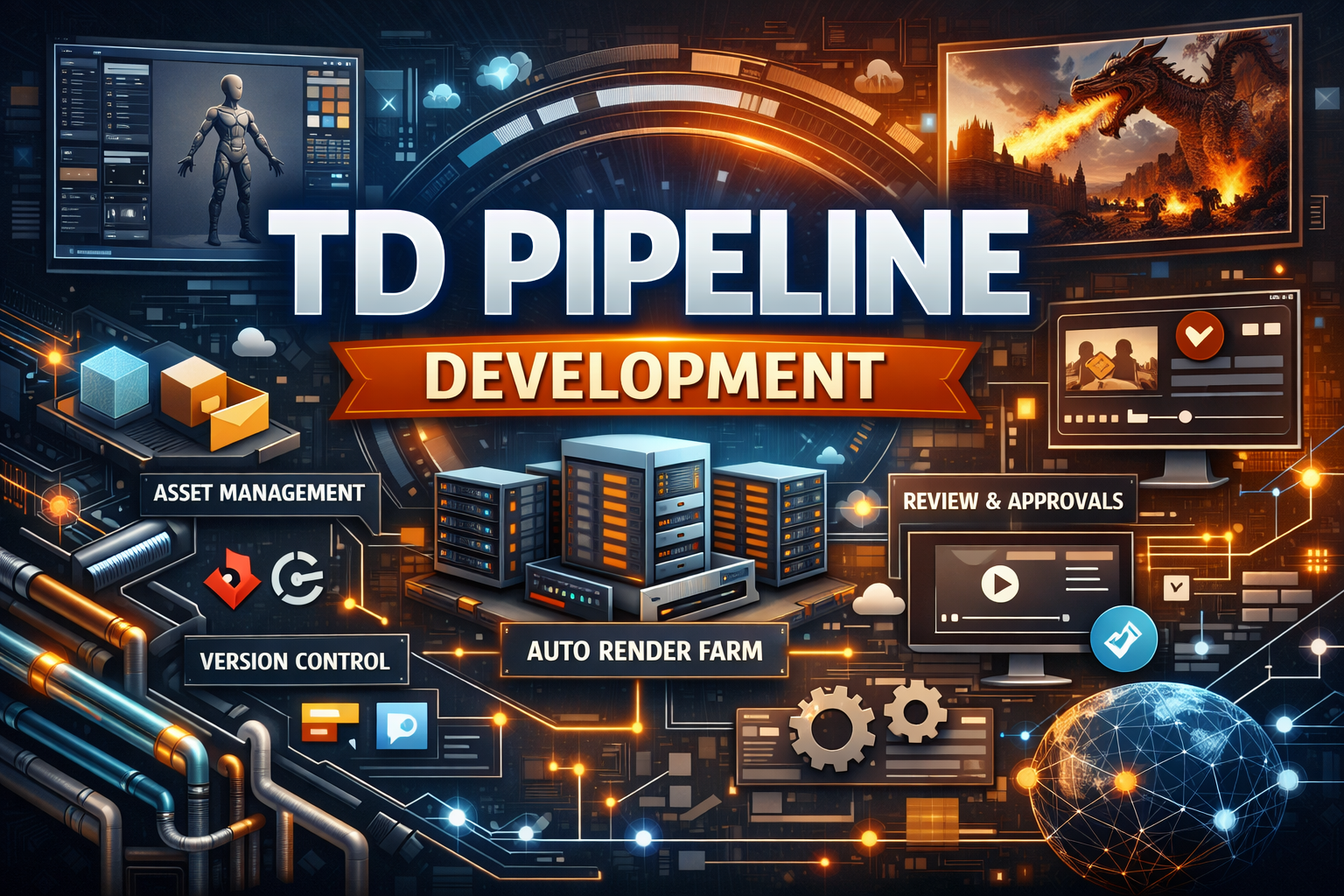
Tag: TD pipeline development

  • TD Pipeline Development:

    TD Pipeline Development:

    If you’ve ever watched a movie, played a AAA game, or even seen a polished ad on Instagram, you’ve already experienced the results of a strong pipeline.

    But behind the scenes?

    There’s a hidden system quietly doing the heavy lifting—making sure artists, animators, editors, and developers can work smoothly without chaos.

    That system is called a TD Pipeline.

    And in this blog, we’re going to break down TD Pipeline Development in a simple, human-friendly, informational way—like RankMath-style content that actually reads like a real person wrote it.


    Table of Contents :

    • What is TD Pipeline Development?
    • What Does a Pipeline TD Do?
    • Why Pipeline Development Matters
    • Core Components of a TD Pipeline
    • Common Tools and Technologies Used
    • Step-by-Step Pipeline Development Process
    • Pipeline Best Practices
    • Real-World Examples
    • Challenges in Pipeline Development
    • Future of TD Pipelines
    • FAQs

    TD Pipeline Development – A Practical Guide to Building Production Pipelines :

    TD Pipeline Development is the process of designing, building, and maintaining workflows, automation tools, and systems that help creative teams deliver projects faster, cleaner, and with fewer mistakes.

    In short:

     Artists focus on creativity
    The pipeline handles technical consistency
    Production becomes smoother and scalable

    TD pipeline development is heavily used in industries like:

    • VFX (Visual Effects)
    • Animation Studios
    • Game Development
    • Virtual Production
    • Motion Graphics
    • AR/VR Production
    • Advertising and Post-production

    What is TD Pipeline Development? :

    TD Pipeline Development means building a structured workflow that connects every step of production.

    For example, in a VFX studio, a pipeline might manage:

    • Asset creation (characters, props, environments)
    • Rigging and animation
    • Simulation and FX
    • Lighting and rendering
    • Compositing
    • Review and approvals
    • Publishing final output

    Without a pipeline, every department might work differently, save files differently, and name assets differently—which creates a lot of confusion and wasted time.

    A good pipeline ensures:

    • Everyone uses the same rules
    • Files stay organized
    • Work is trackable
    • Automation reduces repetitive tasks
    • Teams collaborate efficiently

    What Does a Pipeline TD Do? :

    A Pipeline Technical Director (Pipeline TD) is the person (or team) responsible for building and managing the pipeline.

    They act like the bridge between:

    🎨 Artists
    and
    🧠 Engineering / Technology


    Key Responsibilities of a Pipeline TD

    A Pipeline TD typically handles:

    • Developing tools for artists (GUI-based scripts, plugins)
    • Managing asset publishing systems
    • Automating render submissions
    • Creating file structure and naming conventions
    • Integrating software like Maya, Houdini, Nuke, Blender, Unreal
    • Connecting production tracking tools (ShotGrid, ftrack, Jira)
    • Handling version control systems (Perforce, Git)
    • Building review workflows and dailies tools
    • Supporting production when things break

    Pipeline TDs don’t just write code.

    They solve workflow problems.


    Why TD Pipeline Development is Important :

    Pipeline development is not “extra.”

    It’s the difference between a studio that survives and a studio that collapses under deadlines.


    Benefits of a Strong Pipeline

    A well-built pipeline gives you:

    ✅ Faster Production

    Automation reduces manual work and speeds up tasks like:

    • publishing files
    • creating folder structures
    • rendering submissions
    • exporting playblasts

    ✅ Fewer Errors

    Standard naming, file validation, and version control reduce mistakes like:

    • wrong file versions
    • missing textures
    • broken references

    ✅ Better Collaboration

    When everyone works inside the same system, departments stop fighting file chaos.

    ✅ Scalability

    If your studio grows from 5 artists to 50, the pipeline ensures things still work smoothly.

    ✅ Consistent Output Quality

    A pipeline enforces consistent rendering settings, color management, and formats.


    Core Components of TD Pipeline Development :

    A pipeline is not just one tool. It’s a system.

    Here are the most important components.


    1) Project Structure and Naming Conventions

    This is the foundation.

    A pipeline usually defines:

    • Folder structure (assets, shots, renders, caches)
    • Naming rules for files
    • Naming rules for versions
    • Shot numbering format
    • Asset IDs and categories

    Example naming format:

    shot_010_comp_v003.nk
    char_hero_rig_v012.ma


    2) Asset Management

    Asset management ensures:

    • assets are stored properly
    • versions are tracked
    • dependencies are maintained

    It includes:

    • characters
    • props
    • environments
    • textures
    • rigs
    • shaders

    3) Shot Management

    Shot-based production needs:

    • shot folders auto-generated
    • file templates
    • shot version tracking
    • shot status tracking

    4) Publishing System

    Publishing is a controlled process that moves work from “work-in-progress” to “approved production-ready.”

    A good publishing system:

    • validates files before publishing
    • stores published versions in a clean location
    • updates dependencies automatically

    5) Render Farm and Automation

    Rendering is expensive and time-sensitive.

    Pipeline development often includes:

    • render submission tools
    • farm monitoring dashboards
    • auto error reporting
    • render queue management

    Popular render farm tools include:

    • Deadline
    • Qube!
    • OpenCue

    6) Review and Dailies Workflow

    This is where shots get reviewed.

    Pipeline dailies tools often include:

    • auto playblast generation
    • auto conversion to MP4
    • uploading to review systems
    • syncing with ShotGrid/ftrack

    7) Production Tracking Integration

    Most studios use tracking tools like:

    • Autodesk ShotGrid
    • ftrack
    • Jira
    • Monday.com

    Pipeline development connects the production tracking system with:

    • file structure
    • publishing system
    • render system
    • reviews

    Common Tools and Technologies Used in TD Pipeline Development :

    Pipeline development is a mix of coding, scripting, and software integration.


    Programming Languages

    Most common:

    • Python (industry standard)
    • MEL (for Maya legacy scripting)
    • JavaScript (some web dashboards)
    • C++ (plugins, performance tools)
    • Bash / PowerShell (system automation)

    DCC Software Integration

    Pipeline TDs commonly integrate:

    • Autodesk Maya
    • SideFX Houdini
    • Blender
    • Nuke
    • Unreal Engine
    • Unity
    • Substance Painter
    • Mari
    • Cinema 4D

    Databases and APIs

    A pipeline often stores data in:

    • SQLite
    • PostgreSQL
    • MongoDB

    APIs used:

    • ShotGrid API
    • ftrack API
    • Deadline API
    • AWS APIs

    Version Control Systems

    • Git
    • Perforce (very common in studios)
    • SVN (older setups)

    Step-by-Step TD Pipeline Development Process :

    Let’s talk about how pipelines are actually built in real studios.


    Step 1 – Understand the Production Requirements

    Before writing any code, a Pipeline TD must understand:

    • the studio workflow
    • team size
    • software used
    • project type (VFX, animation, games)
    • deadlines and delivery formats

    Step 2 – Map the Workflow

    This includes:

    • how assets move through departments
    • what file formats are needed
    • what approvals are required
    • where things usually break

    Step 3 – Build a Pipeline Framework

    Most studios build or use a framework such as:

    • OpenPype
    • USD-based pipelines
    • Custom Python frameworks
    • Rez-based package systems

    Step 4 – Create Core Tools

    Tools are created for:

    • publishing
    • loading assets
    • shot setup creation
    • render submission
    • playblast generation

    Step 5 – Integrate Tracking and Review

    The pipeline connects:

    • shot status
    • artist task assignment
    • review approvals
    • production reports

    Step 6 – Test, Deploy, and Support

    A pipeline is never “done.”

    Pipeline TDs must:

    • test with real artists
    • collect feedback
    • fix bugs
    • improve UI and speed

    Pipeline Best Practices :

    Pipeline development is not only about coding. It’s about building something people actually use.


    1) Build for Artists, Not for Engineers

    If a tool is too complex, artists won’t use it.

    The best pipelines feel like:

    “Click, publish, done.”


    2) Keep Everything Consistent

    Consistency is the secret to scalable pipelines:

    • same folder structure
    • same naming rules
    • same publishing rules

    3) Automate Repetitive Work

    If artists do something 50 times per day, automate it.

    Examples:

    • folder creation
    • versioning
    • caching
    • conversions

    4) Use Logging and Error Reporting

    A good pipeline includes:

    • logs for debugging
    • clear error messages
    • automatic crash reporting

    5) Document Everything

    Pipeline documentation should include:

    • how to install tools
    • how to publish
    • naming rules
    • troubleshooting guide

    Real-World Examples of TD Pipeline Development:

    Here are practical examples of pipeline tools studios use.


    Example 1 – Asset Publish Tool

    A tool that allows an artist to:

    • select the asset
    • check dependencies
    • publish a clean version
    • automatically update tracking status


    Example 2 – One-Click Shot Setup

    A tool that automatically:

    • creates shot folders
    • sets frame range
    • loads cameras
    • imports assets
    • sets render settings

    Example 3 – Render Submission Tool

    A tool that:

    • detects the correct render engine
    • assigns farm settings
    • submits to Deadline/Qube
    • tracks render progress

    Challenges in TD Pipeline Development :

    Even great pipelines face challenges.


    1) Multiple Software Compatibility

    Every DCC behaves differently. Supporting Maya + Houdini + Nuke together is not easy.


    2) Artists Resist Change

    If artists are used to a workflow, they may avoid pipeline tools.

    The solution?

    Make tools simple, fast, and reliable.


    3) Pipeline Bugs Under Deadline Pressure

    Pipeline issues often happen when deadlines are close.

    That’s why testing and monitoring are essential.


    4) Scaling Across Teams

    What works for 5 artists may break with 100 artists.

    Scalability requires:

    • good architecture
    • caching
    • database optimization
    • clear permissions

    The Future of TD Pipeline Development :

    Pipeline development is evolving fast.

    Here are trends shaping the future.


    1) USD-Based Pipelines

    USD (Universal Scene Description) is becoming a standard for:

    • sharing assets across tools
    • non-destructive workflows
    • large scene handling

    2) Cloud Rendering and Remote Pipelines

    Studios are moving to:

    • AWS
    • Google Cloud
    • Azure

    This enables remote production at scale.


    3) AI-Assisted Pipeline Tools

    AI is starting to help with:

    • auto tagging assets
    • detecting errors in scenes
    • optimizing render settings
    • predicting pipeline failures

    4) Real-Time Pipelines

    With Unreal Engine and real-time rendering, pipelines now include:

    • live review
    • virtual production workflows
    • LED stage integration

    Internal Links :

    Here are internal link ideas you can use on your website:

    • Artificial Intelligence (AI): A Human-Friendly Guide
    • Virtual Reality (VR): The Tech That Doesn’t Feel Like Tech
    • Cryptocurrency Development: Beginner’s Guide
    • Mixed Reality: The Future of Interactive Tech

    (You can link these to your existing blog posts or create them for better topical authority.)


    External Links :

    Use these for credibility and rich SEO:

    • Autodesk ShotGrid Official Site
    • SideFX Houdini Documentation
    • Pixar USD (Universal Scene Description)
    • Thinkbox Deadline Render Manager
    • OpenPype Pipeline Framework

    Rich Media Link :

    Add a rich media resource like:

    🎥 YouTube Video Suggestion:
    “What is a VFX Pipeline?” (Search on YouTube – multiple studio-level explainers available)

    📌 OR
    A documentation link:
    Pixar USD Overview (official docs)


    (FrequentlyAskedQuestion)FAQs :

    1) What does TD stand for in pipeline development?

    TD usually stands for Technical Director. In pipeline development, it refers to a specialist who builds workflows and tools that connect production departments.


    2) Is pipeline development only for big studios?

    No. Even small studios benefit from pipelines. A lightweight pipeline can save hours every week by reducing errors and improving organization.


    3) What skills are required for a Pipeline TD?

    Common skills include:

    • Python scripting
    • Knowledge of Maya/Houdini/Nuke
    • Understanding of production workflows
    • Databases and APIs
    • Problem-solving and communication

    4) Which is better: Open-source pipeline or custom pipeline?

    It depends. Open-source frameworks like OpenPype are great for fast setup. Custom pipelines are better for studios with unique workflows and bigger teams.


    5) What is the difference between a pipeline and a workflow?

    A workflow is the process.
    A pipeline is the system + tools that support and automate the workflow.


    Conclusion :

    TD Pipeline Development is one of the most valuable systems in any production studio.

    It keeps everything organized, automated, and scalable—so teams can focus on creative work instead of fighting file chaos.

    If your studio wants faster delivery, fewer errors, and better collaboration, building a proper pipeline is not optional anymore.

    It’s essential.

    ☎️: 919967940928

    🌐: https://aibuzz.net/

  • TD Pipeline Strategy: 7 Essential Steps for Smarter Development in 2025

    TD Pipeline Strategy: 7 Essential Steps for Smarter Development in 2025

    In today’s fast-paced digital world, businesses are generating more data than ever before. From AI applications to enterprise software systems, the demand for seamless, scalable, and efficient pipelines is growing rapidly. This is where a well-defined TD Pipeline Strategy comes into play.

    At its core, TD Pipeline Development is all about streamlining the flow of data, code, and processes across different stages of business and technology. By implementing the right strategy, organizations can reduce inefficiencies, accelerate time-to-market, and unlock new levels of productivity.

    But what exactly makes a TD Pipeline so essential for digital transformation? Let’s dive deeper.


    What is TD Pipeline Development?

    TD Pipeline Development refers to the structured design, deployment, and optimization of pipelines that handle large volumes of data and workflows efficiently. Think of it as the backbone that ensures every process—from data collection and storage to analytics and decision-making—runs smoothly.

    A robust TD Pipeline Strategy involves:

    • Collecting and integrating data from multiple sources.
    • Automating workflows to minimize manual errors.
    • Ensuring scalability to handle growing workloads.
    • Delivering accurate insights for faster decision-making.

    In short, it empowers organizations to process data more intelligently and achieve operational excellence.


    7 Essential Steps in a TD Pipeline Strategy

    1. Define Clear Business Goals

    Every pipeline begins with purpose. Before designing a system, businesses must clearly outline objectives such as improving efficiency, reducing costs, or enabling real-time analytics. Clear goals ensure that the pipeline aligns with long-term strategy.

    2. Choose the Right Tools and Frameworks

    Successful TD Pipeline Development relies on selecting the right technologies, whether it’s cloud platforms, automation tools, or analytics software. Choosing scalable solutions helps future-proof the pipeline against growing data demands.

    3. Focus on Data Quality and Governance

    A pipeline is only as strong as the data flowing through it. Implementing governance policies and validation steps ensures data integrity, which directly impacts the accuracy of insights and decisions.

    4. Automate Repetitive Processes

    Automation is the heart of TD Pipeline Strategy. From ETL (extract, transform, load) processes to monitoring, automation reduces human error, speeds up workflows, and allows teams to focus on innovation.

    5. Ensure Security and Compliance

    Data security is critical in today’s landscape. A pipeline must have robust encryption, access controls, and compliance with industry regulations to safeguard sensitive information.

    6. Monitor and Optimize Continuously

    A pipeline isn’t “set and forget.” Real-time monitoring, alerts, and analytics ensure issues are identified early, keeping performance at its best. Continuous optimization also improves scalability.

    7. Integrate AI and Advanced Analytics

    The future of TD Pipeline Development lies in AI-driven automation. By integrating artificial intelligence and machine learning models, businesses can process data faster, predict trends, and make smarter decisions.


    How TD Pipeline Development is Transforming Industries

    • Finance – Real-time fraud detection and faster transactions.
    • Healthcare – Secure handling of patient records and predictive diagnostics.
    • Retail & E-commerce – Personalization through customer behavior analytics.
    • Manufacturing – Optimized supply chains and IoT-driven workflows.
    • Entertainment – Managing streaming data and user engagement analytics.

    Each industry benefits by reducing complexity and leveraging data more effectively.


    How Do We Deliver Effective and Scalable TD Pipeline Solutions?

    Performance-Driven Strategy

    At AIBuzz, we specialize in creating high-impact pipeline solutions that maximize efficiency and ROI. Whether it’s real-time data processing, cloud integration, or workflow automation, we ensure your TD Pipeline works seamlessly across all digital channels.

    Our approach blends data-driven targeting with technical excellence, ensuring your pipelines are optimized for performance and scalability. From design and development to deployment and monitoring, AIBuzz manages every aspect of the pipeline journey with precision—helping your business thrive in today’s competitive landscape.


    The AIBuzz Advantage in Digital Transformation

    AIBuzz Technoventures Pvt Ltd is a leading technology solutions provider committed to delivering high-impact digital transformation services. Their diverse portfolio includes:

    With such a broad spectrum of services, AIBuzz doesn’t just build pipelines—they help organizations embrace digital innovation.


    Conclusion: Build Smarter with TD Pipeline Development

    In 2025, businesses that want to scale efficiently cannot afford to ignore TD Pipeline Development. With its ability to streamline workflows, improve data accuracy, and drive innovation, a strong pipeline strategy is no longer optional—it’s essential.

    At AIBuzz Technoventures Pvt Ltd, we design and deliver scalable TD Pipeline Development solutions that empower organizations to succeed in a competitive market. Combined with our full suite of digital transformation services, we are your partner in building smarter, future-ready businesses.

    📞 Contact AIBuzz: +91 9967940928
    🌐 Visitwww.aibuzz.net
    📧 Mail: info@aibuzz.net

  • TD Pipeline Development: 7 Essential Secrets to Streamline Your Business Growth

    TD Pipeline Development: 7 Essential Secrets to Streamline Your Business Growth


    Introduction

    The business world is running faster than ever before, and the role of data has become the most powerful driver of success. Every company—whether small or global—relies on data for insights, strategies, and real-time decision-making. But here’s the challenge: raw data is often messy, unstructured, and overwhelming. Without the right systems in place, data can slow a business down instead of powering it forward.

    This is where TD Pipeline Development steps in. Think of it as the backbone of modern business intelligence—a streamlined system that automates the flow of data from one point to another, cleans it, organizes it, and ensures it’s ready for analytics and decision-making.

    In this blog, we’ll explore 7 essential secrets of TD Pipeline Development and how it can transform your business. By the end, you’ll know why companies worldwide are adopting pipelines to make smarter, faster, and more profitable decisions.


    1. Understand the Core of TD Pipeline Development

    At its simplest, TD Pipeline Development is the process of creating automated workflows that transport and process data. These workflows connect multiple systems—databases, applications, cloud platforms, and analytics dashboards—so information moves seamlessly without human intervention.

    For example, imagine an e-commerce company pulling data from customer orders, website traffic, and social media campaigns. Without a pipeline, analysts would manually gather files, clean them, and upload them for reporting. With TD Pipeline Development, all of this happens in real time—saving hours of work and ensuring accuracy.

    The key takeaway: TD pipelines turn chaotic data into actionable intelligence.


    2. Build Scalable Architectures

    Scalability is no longer optional—it’s a necessity. As your business grows, so does the volume of your data. A well-designed TD Pipeline Development architecture is built to handle increasing data loads without breaking down.

    Take streaming services like Netflix, for example. Every click, search, and viewing habit generates data. Their pipeline infrastructure is scalable enough to handle millions of data points per second. For smaller businesses, scalable pipelines mean they can start small and expand without overhauling the entire system.

    Pro Tip: Use cloud-based platforms like AWS, Azure, or Google Cloud for pipelines. They provide elasticity—meaning resources can grow or shrink depending on demand.


    3. Ensure Data Quality and Accuracy

    The saying “garbage in, garbage out” applies perfectly to pipelines. If your data is inaccurate, incomplete, or inconsistent, your insights will be flawed. Data quality management is a cornerstone of TD Pipeline Development.

    Effective pipelines incorporate:

    • Validation checks to ensure data matches required formats.
    • Deduplication tools to avoid repeated records.
    • Error handling so bad data doesn’t break the entire system.

    Think of a financial institution analyzing loan applications. If the pipeline allows incorrect salary or credit score data to pass through, it could lead to faulty lending decisions. High-quality pipelines prevent such costly mistakes.


    4. Optimize Performance for Speed

    In today’s fast-moving industries, time is money. Businesses no longer want weekly or monthly reports—they want real-time insights. That’s why performance optimization is a secret weapon in TD Pipeline Development.

    Efficient pipelines minimize data latency (delays) and maximize throughput (the amount of data processed per second). This ensures stakeholders have the latest information available when making decisions.

    For instance, ride-hailing companies like Uber rely on pipelines that analyze driver availability, rider demand, and traffic conditions instantly. Without real-time data, surge pricing and ETA predictions wouldn’t work.


    5. Automate for Efficiency

    Repetitive manual tasks drain both time and energy. That’s why automation lies at the heart of TD Pipeline Development.

    Automation allows:

    • Scheduled tasks, such as hourly or daily data refreshes.
    • Real-time triggers, where new data automatically flows into dashboards.
    • Self-healing workflows, where errors get detected and corrected without human intervention.

    A retail chain, for example, can automate inventory updates. As soon as a sale happens, stock levels update automatically across systems. No delays, no mismatches.

    Automation not only reduces human error but also frees employees to focus on strategy and innovation.


    6. Secure Your Pipelines

    With great data comes great responsibility. Security is non-negotiable in TD Pipeline Development. A breach not only damages reputation but also exposes sensitive customer or business data.

    Robust pipelines integrate:

    • Encryption for data in transit and at rest.
    • Access control policies to ensure only authorized users can interact with data.
    • Compliance frameworks like GDPR, HIPAA, or ISO standards.

    For industries like healthcare and banking, secure pipelines are a must. Patient records or financial transactions can’t be left vulnerable. AIBuzz Technoventures, for example, builds TD pipelines with enterprise-grade security, ensuring peace of mind for clients.


    7. Continuous Monitoring and Improvement

    The final secret is that pipelines are never static. They need regular monitoring, fine-tuning, and upgrades. Businesses evolve, new data sources emerge, and technologies advance—pipelines must adapt.

    Monitoring tools track pipeline performance, detect bottlenecks, and alert teams before issues escalate. Proactive updates keep pipelines efficient, reliable, and aligned with business goals.

    For example, an e-learning platform adding a new payment gateway must integrate it into their existing pipeline. Without flexibility, they’d face delays and disruptions.


    Real-World Benefits of TD Pipeline Development

    Beyond these secrets, the benefits are clear:

    • Efficiency: Save time by automating manual tasks.
    • Accuracy: High-quality data leads to better insights.
    • Agility: Adapt quickly to new business needs.
    • Profitability: Smarter decisions mean higher ROI.
    • Scalability: Grow your data operations without constant rebuilding.

    Industries like retail, healthcare, banking, and manufacturing are already using TD Pipeline Development to revolutionize operations.


    A Spotlight on AIBuzz Technoventures Pvt Ltd: Leaders in TD Pipeline Development

    AIBuzz Technoventures Pvt Ltd is a leading technology solutions provider dedicated to delivering high-impact digital transformation services. Their diverse portfolio spans:

    Their expertise in TD Pipeline Development helps businesses build scalable, automated, and secure data workflows that fuel smarter strategies and innovation.


    Conclusion

    In today’s competitive world, efficient TD Pipeline Development can be the game-changer that sets your business apart. By focusing on scalability, automation, data quality, security, and continuous monitoring, you unlock the true potential of your data.

    For organizations ready to embrace transformation, AIBuzz Technoventures Pvt Ltd stands as a trusted partner—offering cutting-edge TD Pipeline Development alongside a full suite of digital services to power growth.

    Contact: 919967940928
    Visit: www.aibuzz.net
    Mail: info@aibuzz.net

  • 7 Essential Steps to Master a TD Pipeline Strategy in 2025

    7 Essential Steps to Master a TD Pipeline Strategy in 2025

    In today’s tech-driven landscape, delivering scalable, immersive experiences—especially in gaming, simulation, and mixed reality—requires a rock-solid TD pipeline strategy. Whether you’re a developer, a technical director, or a CTO planning your studio’s future, understanding the key elements of a TD pipeline strategy is essential to streamline workflows, reduce costs, and maintain creative flexibility.

    In this guide, we’ll walk through 7 essential steps to mastering a TD pipeline strategy in 2025. From concept to deployment, this blueprint helps you build a dynamic and adaptable production environment tailored for high-quality content creation.


    What Is TD Pipeline Development?

    Visual diagram showing a TD pipeline strategy workflow for digital content creation

    TD Pipeline Development refers to the technical processes and infrastructure that connect every stage of a digital content creation workflow—from modeling and animation to rendering and compositing. The “TD” stands for Technical Director, whose role is to ensure that all tools and systems in the pipeline are optimized, compatible, and efficiently integrated.

    TD pipeline development often overlaps with software development, especially when custom tools or automation scripts are required. Software development provides the programming backbone that supports a pipeline, while TDs ensure that these tools meet the creative team’s production needs. In short, TD pipeline development is where creative vision meets engineering execution.


    Why You Need a TD Pipeline Strategy in 2025

    Digital content teams today work in highly complex environments that demand automation, remote collaboration, and fast iteration cycles. Without a clear TD pipeline strategy, production bottlenecks, tool mismatches, and data mismanagement can stall projects.

    Here’s why a TD pipeline strategy is essential:

    • Efficiency: Automates repetitive tasks and reduces human error.
    • Scalability: Supports growing asset libraries and large team collaboration.
    • Interoperability: Integrates various software packages and custom tools.
    • Consistency: Maintains quality standards across all departments.

    Now let’s dive into the 7 essential steps to building a TD pipeline strategy that works.


    1. Map Your Production Workflow

    Before designing your pipeline, define every step in your content creation process. Whether you’re producing a 3D animation or a mixed reality game, outline each department’s workflow—modeling, rigging, animation, lighting, VFX, rendering, and compositing.

    A successful TD pipeline strategy always begins with clarity. Tools like flowcharts or software like Notion and Miro can help visualize each stage. Understanding handoffs between departments allows TDs to build smoother transitions and automated checkpoints.


    2. Standardize Your Asset Management System

    Asset chaos is one of the biggest bottlenecks in production. A robust TD pipeline strategy must include a centralized, standardized asset management system. This enables version control, reduces file conflicts, and ensures artists work with the correct assets.

    Use naming conventions, metadata tagging, and versioning tools like ShotGrid, Perforce, or Git. With standardized asset management, your team avoids duplication, overwriting, or rework—saving hundreds of hours in the long run.


    3. Automate Repetitive Processes

    One of the core functions of a TD pipeline strategy is to reduce manual labor through automation. For example:

    • Auto-rigging characters
    • Batch rendering
    • Scene validation
    • File conversions between formats

    Python scripting is a powerful tool in this space. Technical Directors often write custom Python tools for Maya, Blender, or Unreal Engine to automate workflows. Automating these tasks increases productivity and reduces errors—an essential part of any modern pipeline.


    4. Choose Scalable Infrastructure

    As projects grow, so does your need for scalable infrastructure. Whether you’re hosting render farms or remote servers, your TD pipeline strategy should anticipate future resource needs.

    Consider the following:

    • Cloud rendering solutions like AWS Thinkbox or Google Cloud Render
    • Hybrid infrastructures that combine on-premise and cloud computing
    • Virtual machines for remote team access

    The more scalable your system, the easier it is to onboard new artists, iterate faster, and deliver on deadlines.


    5. Integrate Collaborative Tools

    Remote work and global teams are the new normal. Your TD pipeline strategy should integrate tools that support asynchronous collaboration.

    Key collaboration tools include:

    • Perforce or Git for source control
    • Slack or Microsoft Teams for communication
    • ShotGridTrello, or Jira for task management

    Integrating these tools directly into your pipeline ensures a seamless experience for developers, artists, and managers alike.


    6. Develop Custom Tools When Necessary

    Off-the-shelf software often meets 70% of your needs. For the other 30%, a strong TD pipeline strategy includes custom tool development. These tools bridge gaps, automate specific tasks, or integrate unique software stacks.

    For example:

    • A custom exporter from Maya to Unreal
    • A render queue manager tailored to your network
    • A script that auto-generates project folders

    Investing in software development within your pipeline ensures flexibility and gives you a competitive edge.


    7. Continuous Testing and Optimization

    The best TD pipeline strategies are never static. They evolve with your team’s needs, new tools, and project complexities. Implement version testing, gather feedback from departments, and track pipeline performance.

    A few metrics to monitor include:

    • Render times
    • Asset load success rates
    • Script execution time
    • Downtime due to errors

    Regularly auditing these stats lets you refine your strategy, increase speed, and maintain a high-quality production pipeline.


    Bonus Tip: Security and Backup Are Non-Negotiable

    An often-overlooked aspect of the TD pipeline strategy is data security and backup. Cloud-based pipelines are vulnerable without encrypted communication and access control.

    Make sure your strategy includes:

    • Auto-backups of critical project data
    • Permission-based access
    • Data recovery testing

    In 2025, with projects becoming increasingly valuable, this is more essential than ever.


    Common Pitfalls in TD Pipeline Strategy

    Even experienced teams fall into these traps:

    • Overengineering the pipeline with too many tools
    • Lack of documentation for tools and workflows
    • Ignoring artist feedback when implementing automation
    • Skipping training for new tools or scripts

    Avoid these mistakes by keeping your TD pipeline strategy transparent, well-documented, and artist-centric.


    Future Trends Shaping TD Pipeline Strategy

    Looking ahead, several trends are shaping how pipelines evolve:

    • AI-assisted asset generation (e.g., textures, characters)
    • Real-time collaboration in mixed reality
    • Node-based pipeline editors
    • GPU-powered cloud rendering

    Staying ahead means adapting your TD pipeline strategy to leverage these technologies while keeping workflows streamlined.


    Final Thoughts: Build Smart, Iterate Often

    A successful TD pipeline strategy isn’t built overnight. It’s an ongoing process that involves planning, testing, optimizing, and collaborating. As you scale your projects, revisit and refine your strategy frequently to adapt to changing technologies and team structures.

    With these 7 essential steps, your team will be well-equipped to deliver cutting-edge digital experiences—faster, smarter, and with fewer hiccups.


    Conclusion: Where Creativity Meets Tech—With aibuzz

    At aibuzz, we specialize in crafting intelligent solutions for businesses exploring TD pipeline strategymixed reality, and beyond. Our technical expertise in pipeline development ensures your creative workflows are powered by the best tools and infrastructure—custom-built for your vision.

    Whether you’re building VR experiences, immersive simulations, or interactive content, our team is ready to help you deliver excellence. Let’s design the future—together.


  • 7 Essential Steps for Seamless AI Pipeline Development in 2025

    7 Essential Steps for Seamless AI Pipeline Development in 2025

    In today’s fast-evolving tech landscape, AI pipeline development has become a core component of building intelligent, automated, and scalable systems. Whether it’s powering predictive analytics, enhancing user experiences, or enabling real-time data processing, a well-structured AI pipeline ensures that machine learning models function effectively and efficiently. This blog explores the 7 essential steps for AI pipeline development, and highlights how it integrates with TD pipeline development and software development processes to drive innovation.


    What is AI Pipeline Development?

    7 Essential Steps for Seamless AI Pipeline Development in 2025

    AI pipeline development refers to the end-to-end process of managing and automating the flow of data from its raw state to actionable insights or decisions using artificial intelligence. It involves various stages like data collection, preprocessing, feature engineering, model training, evaluation, and deployment. A robust AI pipeline is essential for scaling machine learning efforts, reducing manual intervention, and ensuring consistent, reproducible results.


    Why AI Pipeline Development Matters in 2025

    As industries rapidly adopt AI technologies, the demand for structured AI workflows is rising. Enterprises no longer build one-off machine learning models — they need scalable, repeatable, and secure systems that align with business objectives. That’s where AI pipeline development becomes crucial.

    In 2025, the emphasis is not just on AI capabilities but on operationalizing AI — and this can only be achieved with well-planned pipelines that support automation, monitoring, and continuous learning.


    1. Data Collection and Ingestion

    Every AI pipeline starts with data — the lifeblood of any artificial intelligence model. Whether it’s structured data from databases or unstructured data from IoT devices, emails, or images, data ingestion is the first essential step. Effective AI pipeline development ensures this data is gathered in real-time or batches, cleaned, and stored securely.

    Keywords: real-time data ingestion, data lakes, AI data pipeline


    2. Data Preprocessing and Cleaning

    Raw data is rarely usable out of the box. This stage involves handling missing values, outliers, noise, and normalizing data formats. In AI pipeline development, this step is essential to ensure model performance and reliability.

    Techniques such as tokenization for text, normalization for numerical data, and image augmentation are often used here. Automated preprocessing tools and scripts make it easy to replicate results across models.


    3. Feature Engineering

    Once your data is clean, the next step is feature engineering — extracting meaningful inputs that can improve model accuracy. This is often one of the most time-consuming stages in AI pipeline development but yields high rewards.

    Features can be created using domain knowledge, statistical methods, or even through deep learning models that auto-generate embeddings. Feature stores are increasingly used to maintain consistency across projects.


    4. Model Selection and Training

    Here’s where the magic begins. Machine learning models are trained using the cleaned and feature-rich dataset. This stage in the AI pipeline development process involves selecting the best algorithm, tuning hyperparameters, and ensuring model generalization.

    From regression to neural networks, every use case demands a specific approach. Tools like TensorFlow, PyTorch, and Scikit-learn are commonly integrated into this stage of the pipeline.


    5. Model Evaluation and Validation

    Before deploying, it’s critical to evaluate model performance using test data. Metrics like accuracy, precision, recall, and F1-score help decide whether the model is production-ready.

    In modern AI pipeline development, this stage also includes cross-validation and A/B testing to ensure that the model works effectively across different environments.


    6. Model Deployment and Integration

    Once validated, the model is pushed into production. AI pipeline development ensures that this is a seamless, automated process. Deployment can be done using REST APIs, microservices, or directly integrated into apps and dashboards.

    CI/CD (Continuous Integration and Continuous Deployment) is now a standard practice in deploying AI models, thanks to its efficiency and error minimization capabilities.


    7. Monitoring and Feedback Loop

    Deployment isn’t the end — it’s just the beginning of the feedback loop. Monitoring ensures your model performs well in real-world scenarios. Drift detection, performance tracking, and alert systems are essential components of this stage.

    In AI pipeline development, this continuous feedback loop is what differentiates a static model from a learning, evolving system.


    How AI Pipeline Development Supports TD Pipeline Development

    TD pipeline development (short for Technology Development pipeline) is the broader framework under which various technologies, including AI, are developed, tested, and deployed. AI pipeline development is often a subset within this, focusing specifically on machine learning and data flow components.

    While TD pipeline development encompasses hardware testing, software updates, security compliance, and integration with cloud infrastructure, the AI pipeline zeroes in on data, models, and intelligence. Together, they form a unified tech development ecosystem essential for scalable innovation.


    The Role of Software Development in AI Pipeline Development

    Software development lays the groundwork for building the tools, APIs, and infrastructure that make AI pipeline development possible. From writing data transformation scripts to building the back-end logic for model integration, software engineers are crucial to AI success.

    In fact, today’s AI engineers often work hand-in-hand with developers to build flexible, modular pipelines that can be reused and improved over time. Agile methodologies and DevOps practices are also increasingly applied to AI projects, merging the best of both worlds.


    Benefits of AI Pipeline Development

    Let’s break down why AI pipeline development is essential for modern businesses:

    • Scalability: Reusable components make it easier to apply AI across departments.
    • Efficiency: Automation reduces manual effort and speeds up model deployment.
    • Consistency: Standardized steps ensure repeatable and predictable results.
    • Monitoring: Real-time insights into model performance help maintain high accuracy.
    • Collaboration: Engineers, data scientists, and stakeholders can all interact through shared platforms.

    Tools & Technologies for AI Pipeline Development

    Here are some leading tools and platforms commonly used:

    • Apache Airflow – Workflow automation
    • Kubeflow – Machine learning orchestration on Kubernetes
    • MLflow – Experiment tracking and model registry
    • DataRobot – Automated machine learning platform
    • Amazon SageMaker – End-to-end ML service by AWS

    Each tool serves a unique purpose within AI pipeline development, and choosing the right stack depends on your business needs and technical expertise.


    Use Cases of AI Pipeline Development

    1. Retail: Personalized recommendations using real-time user behavior.
    2. Healthcare: Early diagnosis from patient data using predictive models.
    3. Finance: Fraud detection using anomaly recognition pipelines.
    4. Manufacturing: Quality control using computer vision AI pipelines.
    5. Logistics: Route optimization using predictive and real-time data.

    These are all powered by structured AI pipeline development, ensuring not just accuracy but operational efficiency.


    Future Trends in AI Pipeline Development

    7 Essential Steps for Seamless AI Pipeline Development in 2025

    Looking ahead to 2026 and beyond, we expect even more focus on:

    • AI Ops: Operationalizing AI at scale
    • Edge AI pipelines: Processing data closer to where it’s generated
    • Explainable AI pipelines: Transparency in model decisions
    • Federated AI pipelines: Collaborative learning without data sharing

    Enterprises that embrace these trends in AI pipeline development will lead the way in creating smarter, more responsive systems.


    Conclusion: Why AI Pipeline Development Is the Backbone of Modern IT

    As businesses continue their digital transformation journey, AI pipeline development emerges as an essential pillar for success. From data ingestion to model monitoring, each step is crucial for delivering real-time insights and automation. By integrating AI pipeline development with TD pipeline development and leveraging robust software development practices, companies can build scalable and sustainable AI solutions.

    At aibuzz, we specialize in building intelligent IT and tech systems that incorporate advanced AI pipeline development to meet your business goals. Whether you’re looking to automate processes, develop predictive systems, or scale your data science capabilities, our team is here to help transform your ideas into real-world impact.