Tag: TD pipeline strategy

  • TD Pipeline Development: The Human Guide to Building Modern Data Systems

    TD Pipeline Development: The Human Guide to Building Modern Data Systems

    Introduction :

    Most people never think about what happens behind the scenes when they open an app, shop online, watch a video recommendation, or track a delivery in real time.

    But in reality, thousands—or even millions—of pieces of data are moving every second.

    Orders are being processed.
    Payments are being verified.
    Notifications are being sent.
    Analytics dashboards are updating live.

    And the thing quietly managing all of this is often a TD pipeline.

    That’s why TD Pipeline Development has become such an important part of modern technology. Businesses today don’t just need data. They need systems that can move data smoothly, process it quickly, and make it useful in real time.

    If that sounds technical, don’t worry.

    This guide is written in a simple, human way—without overwhelming jargon. Whether you’re a beginner, developer, business owner, or just curious about how modern systems work, this article will help you understand TD pipeline development in a practical and realistic way.


    What is TD Pipeline Development? :

    Let’s keep this simple.

    TD Pipeline Development is the process of building systems that move data from one place to another automatically.

    But it’s not just about moving data.

    A good pipeline also:

    • Cleans the data
    • Organizes it
    • Processes it
    • Stores it
    • Delivers it where it’s needed

    Think of it like a city water system.

    Water travels through pipelines to reach homes safely and efficiently.

    Data pipelines work in a very similar way. Instead of water, they transport information.


    Why TD Pipelines Matter More Than Ever :

    We live in a world completely driven by data.

    Every click, purchase, login, message, and online interaction creates information.

    Now imagine trying to manage all of that manually.

    Impossible.

    That’s exactly why pipelines exist.

    They help businesses:

    • Save time
    • Reduce mistakes
    • Automate processes
    • Handle massive amounts of data
    • Make faster decisions

    Without pipelines, modern apps and digital services would struggle to function properly.


    A Simple Real-Life Example :

    Let’s say you order shoes from an online store.

    Seems simple, right?

    But behind that single order, a lot happens instantly.

    The moment you click “Buy Now”:

    1. Your payment gets verified
    2. Inventory updates automatically
    3. Shipping systems receive your order
    4. Analytics dashboards record the sale
    5. Recommendation systems learn your shopping behavior
    6. Confirmation emails are triggered

    All of this is powered by data pipelines running quietly in the background.

    You never see them.
    But without them, the experience would completely fall apart.


    How a TD Pipeline Actually Works :

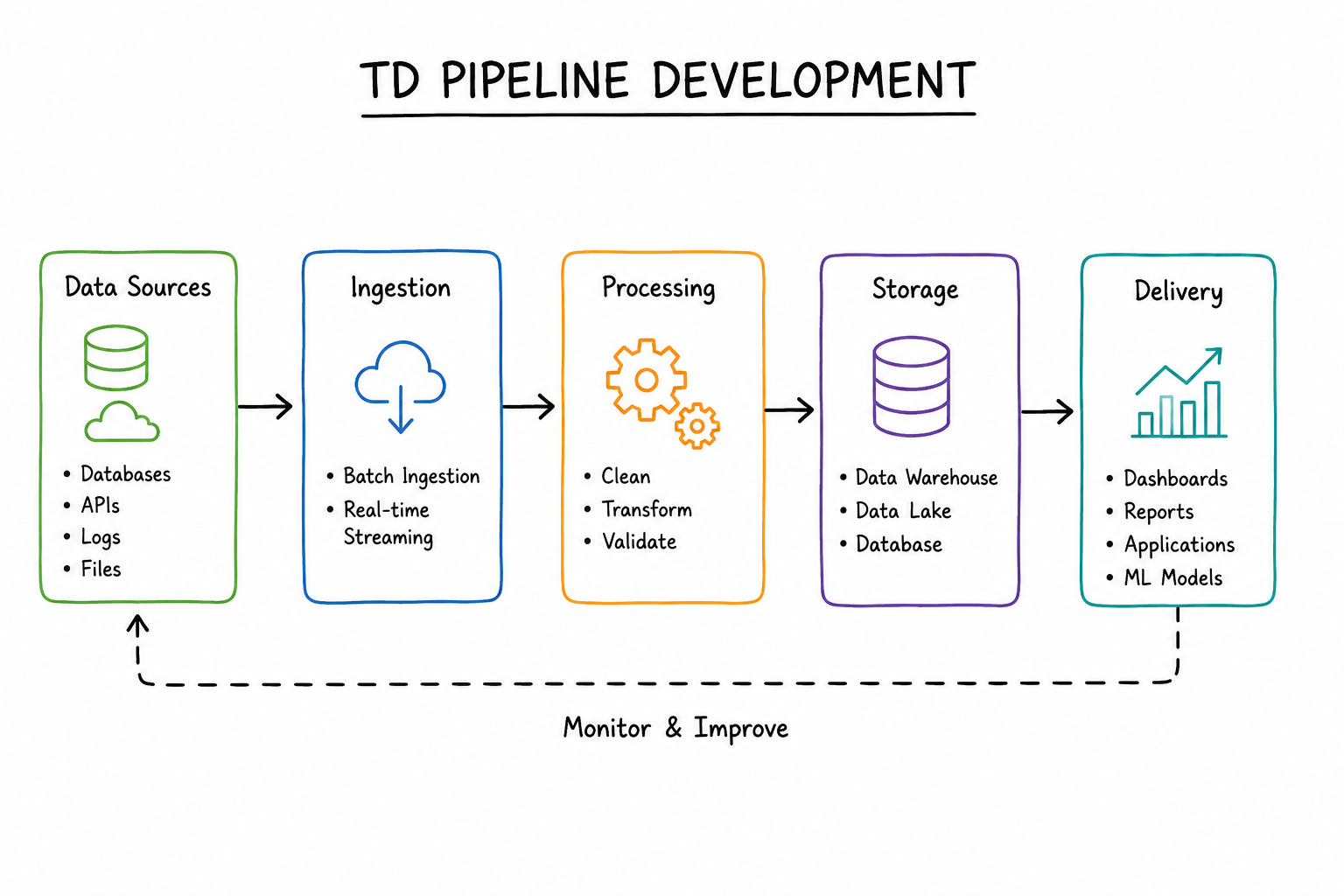
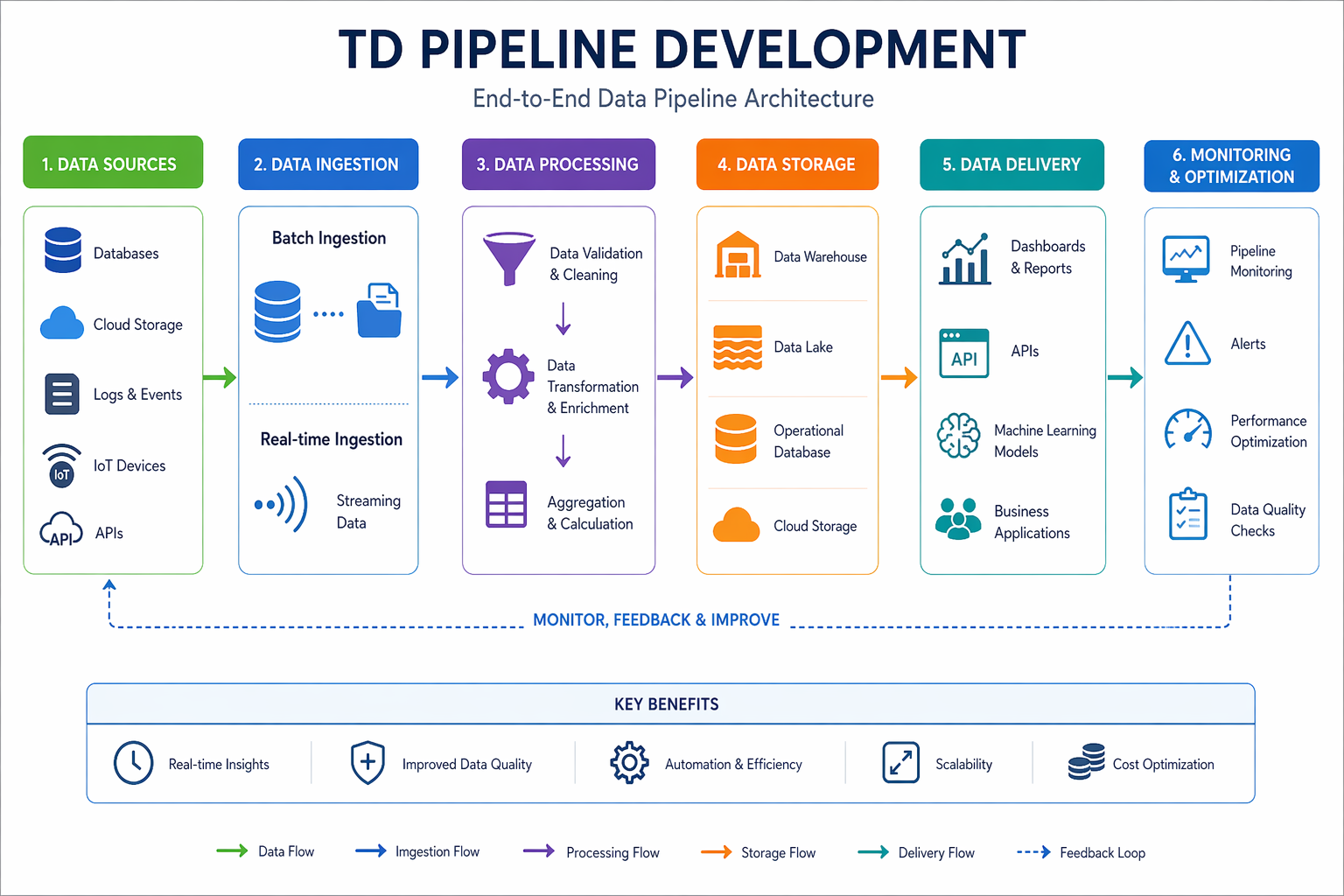
    A pipeline usually moves through several stages.

    Let’s break them down in the easiest way possible.


    1. Data Collection :

    Everything starts with collecting data.

    Data can come from:

    • Websites
    • Apps
    • APIs
    • Databases
    • Cloud platforms
    • IoT devices

    For example:
    A fitness app collects steps, heart rate, and workout activity.

    That information becomes the raw input for the pipeline.


    2. Data Ingestion :

    This is the stage where data enters the system.

    There are usually two approaches.

    Batch Processing :

    Data is collected and processed at intervals.

    Example:
    A company generating daily sales reports every night.


    Real-Time Processing :

    Data moves instantly as it’s created.

    Example:
    Live GPS tracking or stock market updates.

    Real-time pipelines are becoming increasingly popular because businesses want immediate insights.


    3. Data Processing :

    Raw data is usually messy.

    Some records may be incomplete.
    Some may have duplicates.
    Some may contain errors.

    This stage cleans and transforms the data into something useful.

    Typical tasks include:

    • Removing duplicate entries
    • Fixing formatting issues
    • Filtering invalid records
    • Organizing information

    This step is extremely important because poor-quality data leads to poor decisions.


    4. Data Storage :

    Once the data is cleaned, it needs to be stored safely.

    Businesses often use:

    • Data warehouses
    • Cloud storage
    • Data lakes
    • Operational databases

    The choice depends on:

    • Speed requirements
    • Cost
    • Scalability
    • Business goals

    5. Data Delivery :

    Now the data becomes useful.

    It gets delivered to:

    • Dashboards
    • Reports
    • Applications
    • AI systems
    • Analytics platforms

    This is the stage where businesses finally gain insights.


    Types of TD Pipelines :

    Not every business uses the same kind of pipeline.

    Different situations require different approaches.


    Batch Pipelines :

    Batch pipelines process data in chunks.

    For example:

    • Daily reports
    • Weekly analytics
    • Monthly summaries

    Why Businesses Use Batch Pipelines :

    • Easier to manage
    • Lower infrastructure cost
    • Good for large datasets

    The Downside :

    The information is delayed.

    You only get updates after processing is complete.


    Real-Time Pipelines :

    Real-time pipelines process data instantly.

    Examples include:

    • Fraud detection systems
    • Food delivery tracking
    • Live recommendation engines

    Why Real-Time Pipelines Matter :

    People expect speed today.

    Nobody wants to wait hours for updates anymore.

    The Challenge :

    Real-time systems are more complex and expensive to build.


    Hybrid Pipelines :

    Most modern businesses use hybrid pipelines.

    They combine:

    • Batch processing for heavy workloads
    • Real-time processing for instant insights

    This creates a balanced system.


    Tools Commonly Used in TD Pipeline Development :

    You don’t need to learn every tool immediately.

    But understanding the ecosystem helps.


    Programming Languages :

    Python :

    Probably the most beginner-friendly option for data engineering.

    It’s simple, flexible, and widely used.


    Java :

    Popular in enterprise systems because of its performance and stability.


    Scala :

    Common in large-scale big data environments.


    Popular Data Engineering Tools :


    Apache Spark :

    One of the most powerful frameworks for large-scale data processing.

    Useful for:

    • Big data analytics
    • Real-time processing
    • Distributed computing

    Official website:
    Apache Spark


    Apache Airflow :

    Helps automate workflows and schedule pipelines efficiently.

    Official website:
    Apache Airflow


    Amazon Web Services :

    Provides scalable cloud infrastructure for pipelines.

    Official website:
    AWS Big Data Services


    Google Cloud Platform :

    Popular for analytics and AI-based data systems.

    Official website:
    Google Cloud Data Pipelines


    Step-by-Step Process of Building a TD Pipeline :

    Now let’s make this practical.


    Step 1: Understand the Problem :

    Before writing code, ask:

    • What data do we need?
    • Why are we collecting it?
    • What business problem are we solving?

    This step is often overlooked, but it matters the most.


    Step 2: Choose the Right Architecture :

    Decide whether your system needs:

    • Batch processing
    • Real-time processing
    • Hybrid architecture

    Not every project needs a complex real-time setup.


    Step 3: Connect Data Sources :

    Your pipeline needs reliable access to data sources like:

    • APIs
    • Databases
    • Applications
    • Third-party systems

    Step 4: Transform the Data :

    This is where raw information becomes meaningful.

    You clean it.
    Organize it.
    Validate it.

    Good transformation leads to trustworthy insights.


    Step 5: Store Data Properly :

    Storage decisions affect:

    • Performance
    • Cost
    • Scalability

    Planning ahead saves future headaches.


    Step 6: Automate Everything :

    Manual workflows eventually become painful.

    Automation tools like Apache Airflow help pipelines run consistently without constant human intervention.


    Step 7: Monitor the Pipeline :

    Even good pipelines fail sometimes.

    Servers crash.
    Connections drop.
    Data formats change.

    Monitoring helps catch problems early before they become disasters.


    Common Challenges in TD Pipeline Development :

    Nobody talks enough about the difficult parts.

    Building pipelines sounds exciting until real-world problems appear.


    Dirty Data :

    Bad input data is one of the biggest problems in data engineering.

    Even powerful systems fail when data quality is poor.


    Scaling Issues :

    A pipeline that works for 1,000 users may struggle with 1 million users.

    Scalability always becomes important eventually.


    Integration Complexity :

    Different systems often speak different “languages.”

    Connecting them smoothly can be difficult.


    Cost Management :

    Cloud infrastructure can become expensive very quickly if pipelines are poorly optimized.


    Why TD Pipelines Are Important for AI :

    Artificial Intelligence depends heavily on data.

    But AI models are only as good as the information they receive.

    That’s where pipelines become essential.

    They help:

    • Gather training data
    • Clean datasets
    • Deliver features to models
    • Process predictions in real time

    Without pipelines, modern AI systems would not function efficiently.


    Future of TD Pipeline Development :

    The future is moving toward faster, smarter, and more automated systems.

    Here’s what’s coming next.


    Real-Time Systems Everywhere :

    Businesses increasingly expect instant insights.

    Real-time pipelines will continue growing rapidly.


    AI-Powered Automation :

    AI tools are beginning to automate pipeline optimization and monitoring.


    Serverless Data Engineering :

    Less infrastructure management.
    More focus on development.


    Data Mesh Architecture :

    Teams manage their own pipelines independently instead of relying on one centralized system.


    Internal Linking Ideas :

    To improve SEO and user engagement, internally link this article to related topics like:

    Internal links help users explore more content while improving website structure.


    External Resources :

    Useful resources for deeper learning:


    Rich Media Suggestions :

    Adding visuals makes technical blogs far easier to understand.

    Recommended Images :

    • TD pipeline architecture infographic
    • Real-time data flow diagrams
    • Cloud pipeline workflow illustrations

    Recommended Videos :

    • Beginner’s guide to data engineering
    • How real-time pipelines work
    • Introduction to Apache Spark

    Frequently Asked Questions (FAQ) :

    What is TD pipeline development? :

    It’s the process of building systems that automatically collect, process, store, and deliver data efficiently.


    Is TD pipeline development hard for beginners? :

    It can feel overwhelming initially, but starting with small projects makes the learning process much easier.


    Which programming language is best for beginners? :

    Python is usually the best starting point because it’s simple and widely used.


    What is the difference between batch and real-time pipelines? :

    Batch pipelines process data at scheduled intervals, while real-time pipelines process information instantly.


    Are pipelines important for AI systems? :

    Yes. AI systems depend on pipelines to receive clean and organized data.


    Final Thoughts :

    TD Pipeline Development may sound highly technical at first, but at its core, it’s really about solving one important problem:

    Making data useful.

    Modern businesses survive on information.
    Pipelines help move that information efficiently, reliably, and intelligently.

    The best way to learn is not by memorizing definitions.

    It’s by building.
    Experimenting.
    Breaking things.
    Fixing them.
    And slowly understanding how data flows through systems.

    That’s how real growth happens in tech.

    ☎️ 919967940928

    🌐 https://aibuzz.net/

  • TD Pipeline Development: A Practical Guide to Building Smart Data Pipelines

    TD Pipeline Development: A Practical Guide to Building Smart Data Pipelines

    Introduction :

    Think about how much data is created every second—orders, clicks, messages, sensor data, transactions. Now imagine trying to manage all of that manually. It would be chaos.

    That’s exactly why TD (Technical Data) Pipeline Development exists.

    A data pipeline is like a well-organized delivery system. It picks up raw data from different places, cleans it, organizes it, and delivers it exactly where it needs to go—whether that’s a dashboard, an app, or a machine learning model.

    In this guide, we’ll break everything down in a simple, practical way—so even if you’re new, you’ll understand how pipelines actually work in the real world.


    What is TD Pipeline Development :

    At its core, TD pipeline development is about moving data from point A to point B—but in a smart, automated way.

    Instead of manually handling data, pipelines:

    • Collect it
    • Clean it
    • Transform it
    • Store it
    • Deliver it

    All of this happens automatically.

    Think of it like a food delivery app:

    • Restaurant = Data source
    • Delivery system = Pipeline
    • Customer = End user

    Why TD Pipelines Are So Important Today :

    Let’s be real—data is useless if you can’t use it properly.

    Here’s why pipelines matter:

    1. Saves Time

    No more manual data handling.

    2. Improves Accuracy

    Less human error, cleaner data.

    3. Enables Real-Time Insights

    Businesses can react instantly.

    4. Scales Easily

    As your data grows, pipelines grow with it.


    A Simple Real-World Example :

    Let’s say you run an e-commerce business.

    When someone places an order:

    1. Data gets recorded
    2. Inventory updates automatically
    3. Payment gets verified
    4. Analytics dashboard updates
    5. Recommendation system learns from it

    All of this is handled by a pipeline behind the scenes.

    Without it? You’d need a team doing everything manually.


    How a TD Pipeline Actually Works :

    Let’s break it into simple stages.


    1. Data Collection (Where It All Starts) :

    Data comes from different places like:

    • Apps
    • Websites
    • Databases
    • APIs
    • Devices

    2. Data Ingestion (Bringing Data In) :

    This is how data enters your system.

    Two common ways:

    • Batch → Data comes in chunks (e.g., every hour)
    • Real-time → Data flows continuously

    3. Data Processing (Making It Useful) :

    Raw data is messy. This step cleans it.

    Examples:

    • Removing duplicates
    • Fixing errors
    • Formatting data

    4. Data Storage (Saving It Safely) :

    Once cleaned, data is stored in:

    • Warehouses
    • Data lakes
    • Cloud systems

    5. Data Delivery (Final Output) :

    Now the data is ready to be used:

    • Dashboards
    • Reports
    • Apps
    • AI models

    Types of TD Pipelines :


    Batch Pipelines :

    • Work on schedules
    • Best for reports

    Real-Time Pipelines :

    • Instant processing
    • Used in live tracking, fraud detection

    Hybrid Pipelines :

    • Mix of both
    • Most modern systems use this

    Popular Tools Used in TD Pipelines :

    Here are some tools professionals actually use:

    • Python – Easy and powerful
    • Apache Spark – Handles big data
    • Apache Airflow – Automates workflows
    • Amazon Web Services – Cloud infrastructure
    • Google Cloud Platform – Data and AI tools

    You don’t need to learn everything at once—start small and build gradually.


    Step-by-Step: How to Build a TD Pipeline :

    Let’s keep this practical.


    Step 1: Understand Your Goal :

    Ask yourself:

    • What problem am I solving?
    • What data do I need?

    Step 2: Choose Pipeline Type :

    Batch? Real-time? Hybrid?


    Step 3: Connect Data Sources :

    Use APIs, databases, or streams.


    Step 4: Clean and Transform Data :

    Make data usable.


    Step 5: Store Data Properly :

    Choose the right storage system.


    Step 6: Automate Everything :

    Use tools like Apache Airflow.


    Step 7: Monitor and Improve :

    Check:

    • Errors
    • Speed
    • Data quality

    Best Practices :


    Keep It Simple :

    Don’t overcomplicate your pipeline early.


    Focus on Data Quality :

    Bad data = bad results.


    Make It Scalable :

    Your system should handle growth.


    Automate Smartly :

    Reduce manual work as much as possible.


    Always Monitor :

    Pipelines can fail silently—monitor them.


    Common Challenges You Might Face :

    Let’s be honest—things don’t always go smoothly.


    Dirty Data :

    Messy input causes problems.


    System Failures :

    Pipelines can break if not monitored.


    Integration Issues :

    Different systems don’t always “talk” well.


    Cost Problems :

    Cloud services can get expensive.


    TD Pipelines in AI and Machine Learning :

    Pipelines are the backbone of AI systems.

    They help:

    • Prepare training data
    • Build features
    • Feed models

    Without pipelines, AI simply doesn’t work effectively.


    Future of TD Pipeline Development :

    Here’s where things are going:


    Real-Time Everything :

    Businesses want instant insights.


    AI-Driven Pipelines :

    Automation will get smarter.


    Serverless Systems :

    Less infrastructure management.


    Data Mesh :

    Teams manage their own data independently.


    Internal Linking Ideas :

    You can link this blog to:


    External Learning Resources :

    Apache Spark
    https://spark.apache.org/


    Apache Hadoop
    https://hadoop.apache.org/


    Rich Media Suggestions :

    Image Idea :

    • Data pipeline flow diagram

    Video Idea :

    • “How Data Pipelines Work (Beginner Friendly)”

    (Frequently Asked Questions) FAQ :


    What is a TD pipeline? :

    It’s a system that moves and processes data automatically.


    Is TD pipeline development hard? :

    Not really—if you start step by step.


    Which language should I learn first? :

    Start with Python.


    Do I need cloud knowledge? :

    Yes, platforms like Amazon Web Services are very useful.


    Can beginners build pipelines? :

    Absolutely. Start with small projects and grow.


    Final Thoughts :

    If you’re getting into tech, learning TD pipelines is one of the smartest moves you can make.

    It’s not just about data—it’s about making data useful.

    Start small. Build simple pipelines. Break things. Fix them. Improve them.

    That’s how real learning happens.

    ☎️ 919967940928

    🌐 https://aibuzz.net/

  • 9 Winning Ways to Elevate Your TD Pipeline Strategy in 2025

    9 Winning Ways to Elevate Your TD Pipeline Strategy in 2025

    Introduction

    In the fast-paced world of data engineering, having an effective TD pipeline strategy is more than just a technical requirement—it’s a business imperative. Whether you’re running complex data integrations, developing AI applications, or powering machine learning workflows, your ability to design, optimize, and maintain your data pipelines determines how quickly and accurately insights reach your decision-makers.

    As we dive into 2025, organizations are realizing that a reliable, scalable, and intelligent TD pipeline strategy isn’t just “nice to have”—it’s a game changer. This blog explores nine powerful ways you can elevate your TD pipeline strategy with a focus on automation, cloud-native solutions, and real-time streaming, all optimized for WordPress enthusiasts and tech leaders alike.


    What is a TD Pipeline Strategy?

    Unlock the full potential of your data flow with these 9 powerful insights to master TD pipeline strategy in 2025. Transform your business with scalable, automated pipeline systems tailored for success.

    Before we delve into the tactics, let’s define it clearly. A TD pipeline strategy refers to the blueprint for managing data flows through a technology-driven architecture—TD here often implies Technology/Data. These strategies encompass how data is collected, processed, transformed, stored, and delivered across platforms and applications.

    It includes tools, frameworks, and policies used to ensure that every step in the data journey—right from ingestion to visualization—is efficient, secure, and scalable. Whether you’re dealing with structured data from databases or unstructured feeds from IoT devices, the right TD pipeline strategy helps streamline your operations.


    The Power of an Optimized TD Pipeline

    With businesses producing more data than ever before, inefficient pipelines lead to lost revenue, slow decision-making, and data quality issues. An optimized TD pipeline strategy brings:

    • Speed: Real-time analytics and faster batch processing.
    • Accuracy: Cleaner data with fewer inconsistencies.
    • Reliability: Fewer failures in data delivery.
    • Scalability: Ready-to-grow systems with your data needs.
    • Cost Efficiency: Fewer bottlenecks and redundancies.

    1. Align Pipeline Objectives with Business Goals

    The first step toward a winning TD pipeline strategy is alignment. Identify what your organization aims to achieve—be it faster reporting, better customer insights, or predictive analytics. Then structure your pipelines to meet these objectives.

    For example, if your business goal is real-time personalization, then your TD pipeline must support streaming ingestion, real-time data processing, and low-latency outputs.


    2. Choose the Right Tools and Technologies

    In 2025, the data tool landscape is vast—Kafka, Apache Airflow, dbt, Snowflake, AWS Glue, Google Cloud Dataflow, and more. The best TD pipeline strategy isn’t about using the most tools, but about using the right tools.

    Key considerations:

    • Compatibility with your data architecture.
    • Cost of ownership.
    • Integration with cloud environments.
    • Automation and monitoring capabilities.

    Adopt a modular approach. Use orchestration tools like Airflow to schedule jobs, and leverage cloud-native solutions for scaling up.


    3. Embrace Real-Time Data Streaming

    One of the biggest trends in 2025 is real-time everything. Gone are the days when daily batch updates sufficed. If your pipeline isn’t supporting real-time or near-real-time capabilities, you’re missing out.

    Integrating streaming technologies like Apache Kafka, Flink, or AWS Kinesis allows your TD pipeline strategy to respond instantly to new data, enabling use cases such as fraud detection, dynamic pricing, and live dashboards.


    4. Implement Automated Testing and Monitoring

    Without visibility and quality assurance, even the best-designed pipelines can collapse. Embed automated testing for your data transformations, schema validations, and pipeline logic.

    Monitoring tools such as Prometheus, Grafana, and OpenTelemetry should be part of every TD pipeline strategy. These tools help in:

    • Catching issues before they impact business.
    • Tracking throughput, failures, and latency.
    • Setting alerts for anomalies.

    5. Enable Scalability Through Cloud-Native Infrastructure

    Scalability is no longer optional. Cloud platforms like AWS, Azure, and GCP offer elastic compute and storage that enable your pipelines to scale as data volumes grow.

    Using services like AWS Lambda, Google Cloud Functions, or Azure Data Factory, your TD pipeline strategy can scale horizontally, ensuring that performance isn’t compromised even during peak loads.

    Cloud-native pipelines also support infrastructure as code (IaC), making it easier to manage deployments using Terraform or Pulumi.


    6. Prioritize Data Governance and Compliance

    Data privacy laws are tightening across the globe—GDPR, HIPAA, CCPA, and more. A powerful TD pipeline strategymust ensure data compliance.

    That includes:

    • Data lineage tracking: Know where your data came from and where it’s going.
    • Access control: Only authorized users should access sensitive data.
    • Audit trails: Keep records of every transformation and access.

    Tools like Apache Atlas and Great Expectations assist with governance and quality assurance.


    7. Optimize for Performance and Cost

    A bloated pipeline is a costly pipeline. Poorly optimized queries, unnecessary data duplication, and lack of caching increase both latency and costs.

    Pro tips:

    • Minimize transformations in-flight; use pre-processed data where possible.
    • Use columnar storage formats like Parquet or ORC for analytics.
    • Archive old data using cold storage options to reduce expenses.

    A leaner TD pipeline strategy leads to faster processing and lower operational costs.


    8. Foster a Culture of Data Ownership and Collaboration

    A successful TD pipeline strategy isn’t just a technical problem—it’s also organizational. Foster collaboration between data engineers, analysts, developers, and business stakeholders.

    Use centralized documentation tools, version control (like Git), and data catalogs to keep everyone aligned. When teams feel ownership over the pipeline, they maintain it with greater care.


    9. Incorporate AI and Predictive Analytics

    The future of data pipelines is autonomous. By embedding machine learning into your TD pipeline strategy, you can build smarter workflows that:

    • Automatically detect data anomalies.
    • Predict failures before they happen.
    • Trigger business actions in real-time.

    Whether it’s training recommendation models or auto-tuning your pipeline’s performance, AI will be a key enabler in transforming your data operations.


    A Quick Look at Software Development

    Software development is the bedrock of every modern pipeline strategy. It involves the systematic process of creating applications through stages like requirement gathering, coding, testing, and deployment. In the context of TD pipeline strategy, software development provides the logic, interfaces, and automation that turn raw data into business intelligence. APIs, microservices, containerized apps, and CI/CD pipelines all depend on strong software engineering principles.


    Conclusion

    A high-performance TD pipeline strategy is the cornerstone of any modern data-driven enterprise. By aligning pipeline design with business goals, leveraging the right tools, enabling real-time insights, and fostering collaboration, you can unlock powerful outcomes—from faster decision-making to scalable innovation.

    At AIBuzz, we specialize in building robust, cloud-native TD pipeline strategies that empower businesses to thrive in the age of big data and artificial intelligence. Whether you’re a startup seeking efficiency or an enterprise aiming for transformation, we help you design, deploy, and optimize pipelines tailored to your unique needs.

    Our TD pipeline expertise seamlessly connects with our offerings in virtual reality, helping enterprises visualize and interact with their data in immersive environments for unparalleled insight and engagement.


  • 7 Essential Steps to Master a TD Pipeline Strategy in 2025

    7 Essential Steps to Master a TD Pipeline Strategy in 2025

    In today’s tech-driven landscape, delivering scalable, immersive experiences—especially in gaming, simulation, and mixed reality—requires a rock-solid TD pipeline strategy. Whether you’re a developer, a technical director, or a CTO planning your studio’s future, understanding the key elements of a TD pipeline strategy is essential to streamline workflows, reduce costs, and maintain creative flexibility.

    In this guide, we’ll walk through 7 essential steps to mastering a TD pipeline strategy in 2025. From concept to deployment, this blueprint helps you build a dynamic and adaptable production environment tailored for high-quality content creation.


    What Is TD Pipeline Development?

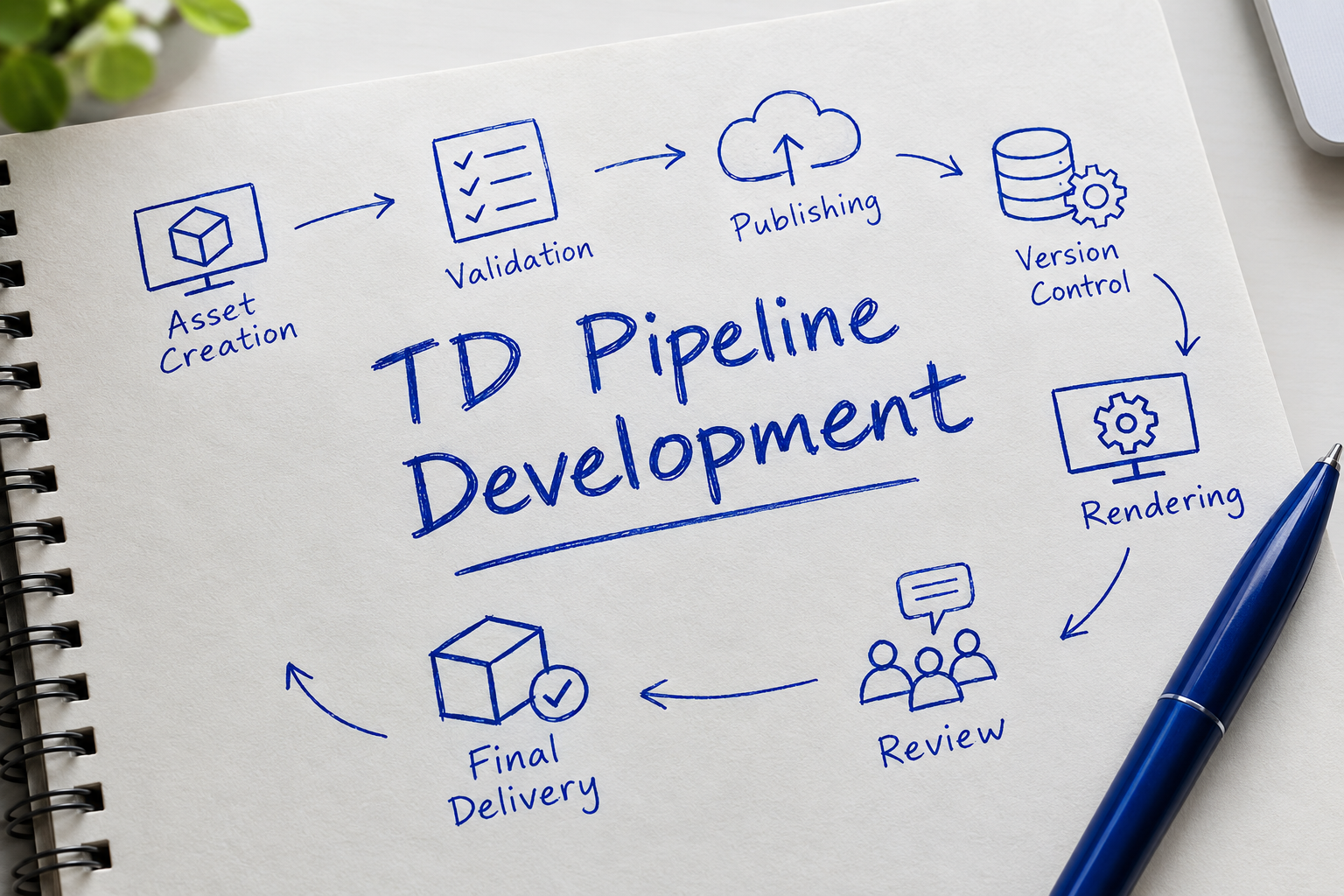
    Visual diagram showing a TD pipeline strategy workflow for digital content creation

    TD Pipeline Development refers to the technical processes and infrastructure that connect every stage of a digital content creation workflow—from modeling and animation to rendering and compositing. The “TD” stands for Technical Director, whose role is to ensure that all tools and systems in the pipeline are optimized, compatible, and efficiently integrated.

    TD pipeline development often overlaps with software development, especially when custom tools or automation scripts are required. Software development provides the programming backbone that supports a pipeline, while TDs ensure that these tools meet the creative team’s production needs. In short, TD pipeline development is where creative vision meets engineering execution.


    Why You Need a TD Pipeline Strategy in 2025

    Digital content teams today work in highly complex environments that demand automation, remote collaboration, and fast iteration cycles. Without a clear TD pipeline strategy, production bottlenecks, tool mismatches, and data mismanagement can stall projects.

    Here’s why a TD pipeline strategy is essential:

    • Efficiency: Automates repetitive tasks and reduces human error.
    • Scalability: Supports growing asset libraries and large team collaboration.
    • Interoperability: Integrates various software packages and custom tools.
    • Consistency: Maintains quality standards across all departments.

    Now let’s dive into the 7 essential steps to building a TD pipeline strategy that works.


    1. Map Your Production Workflow

    Before designing your pipeline, define every step in your content creation process. Whether you’re producing a 3D animation or a mixed reality game, outline each department’s workflow—modeling, rigging, animation, lighting, VFX, rendering, and compositing.

    A successful TD pipeline strategy always begins with clarity. Tools like flowcharts or software like Notion and Miro can help visualize each stage. Understanding handoffs between departments allows TDs to build smoother transitions and automated checkpoints.


    2. Standardize Your Asset Management System

    Asset chaos is one of the biggest bottlenecks in production. A robust TD pipeline strategy must include a centralized, standardized asset management system. This enables version control, reduces file conflicts, and ensures artists work with the correct assets.

    Use naming conventions, metadata tagging, and versioning tools like ShotGrid, Perforce, or Git. With standardized asset management, your team avoids duplication, overwriting, or rework—saving hundreds of hours in the long run.


    3. Automate Repetitive Processes

    One of the core functions of a TD pipeline strategy is to reduce manual labor through automation. For example:

    • Auto-rigging characters
    • Batch rendering
    • Scene validation
    • File conversions between formats

    Python scripting is a powerful tool in this space. Technical Directors often write custom Python tools for Maya, Blender, or Unreal Engine to automate workflows. Automating these tasks increases productivity and reduces errors—an essential part of any modern pipeline.


    4. Choose Scalable Infrastructure

    As projects grow, so does your need for scalable infrastructure. Whether you’re hosting render farms or remote servers, your TD pipeline strategy should anticipate future resource needs.

    Consider the following:

    • Cloud rendering solutions like AWS Thinkbox or Google Cloud Render
    • Hybrid infrastructures that combine on-premise and cloud computing
    • Virtual machines for remote team access

    The more scalable your system, the easier it is to onboard new artists, iterate faster, and deliver on deadlines.


    5. Integrate Collaborative Tools

    Remote work and global teams are the new normal. Your TD pipeline strategy should integrate tools that support asynchronous collaboration.

    Key collaboration tools include:

    • Perforce or Git for source control
    • Slack or Microsoft Teams for communication
    • ShotGridTrello, or Jira for task management

    Integrating these tools directly into your pipeline ensures a seamless experience for developers, artists, and managers alike.


    6. Develop Custom Tools When Necessary

    Off-the-shelf software often meets 70% of your needs. For the other 30%, a strong TD pipeline strategy includes custom tool development. These tools bridge gaps, automate specific tasks, or integrate unique software stacks.

    For example:

    • A custom exporter from Maya to Unreal
    • A render queue manager tailored to your network
    • A script that auto-generates project folders

    Investing in software development within your pipeline ensures flexibility and gives you a competitive edge.


    7. Continuous Testing and Optimization

    The best TD pipeline strategies are never static. They evolve with your team’s needs, new tools, and project complexities. Implement version testing, gather feedback from departments, and track pipeline performance.

    A few metrics to monitor include:

    • Render times
    • Asset load success rates
    • Script execution time
    • Downtime due to errors

    Regularly auditing these stats lets you refine your strategy, increase speed, and maintain a high-quality production pipeline.


    Bonus Tip: Security and Backup Are Non-Negotiable

    An often-overlooked aspect of the TD pipeline strategy is data security and backup. Cloud-based pipelines are vulnerable without encrypted communication and access control.

    Make sure your strategy includes:

    • Auto-backups of critical project data
    • Permission-based access
    • Data recovery testing

    In 2025, with projects becoming increasingly valuable, this is more essential than ever.


    Common Pitfalls in TD Pipeline Strategy

    Even experienced teams fall into these traps:

    • Overengineering the pipeline with too many tools
    • Lack of documentation for tools and workflows
    • Ignoring artist feedback when implementing automation
    • Skipping training for new tools or scripts

    Avoid these mistakes by keeping your TD pipeline strategy transparent, well-documented, and artist-centric.


    Future Trends Shaping TD Pipeline Strategy

    Looking ahead, several trends are shaping how pipelines evolve:

    • AI-assisted asset generation (e.g., textures, characters)
    • Real-time collaboration in mixed reality
    • Node-based pipeline editors
    • GPU-powered cloud rendering

    Staying ahead means adapting your TD pipeline strategy to leverage these technologies while keeping workflows streamlined.


    Final Thoughts: Build Smart, Iterate Often

    A successful TD pipeline strategy isn’t built overnight. It’s an ongoing process that involves planning, testing, optimizing, and collaborating. As you scale your projects, revisit and refine your strategy frequently to adapt to changing technologies and team structures.

    With these 7 essential steps, your team will be well-equipped to deliver cutting-edge digital experiences—faster, smarter, and with fewer hiccups.


    Conclusion: Where Creativity Meets Tech—With aibuzz

    At aibuzz, we specialize in crafting intelligent solutions for businesses exploring TD pipeline strategymixed reality, and beyond. Our technical expertise in pipeline development ensures your creative workflows are powered by the best tools and infrastructure—custom-built for your vision.

    Whether you’re building VR experiences, immersive simulations, or interactive content, our team is ready to help you deliver excellence. Let’s design the future—together.