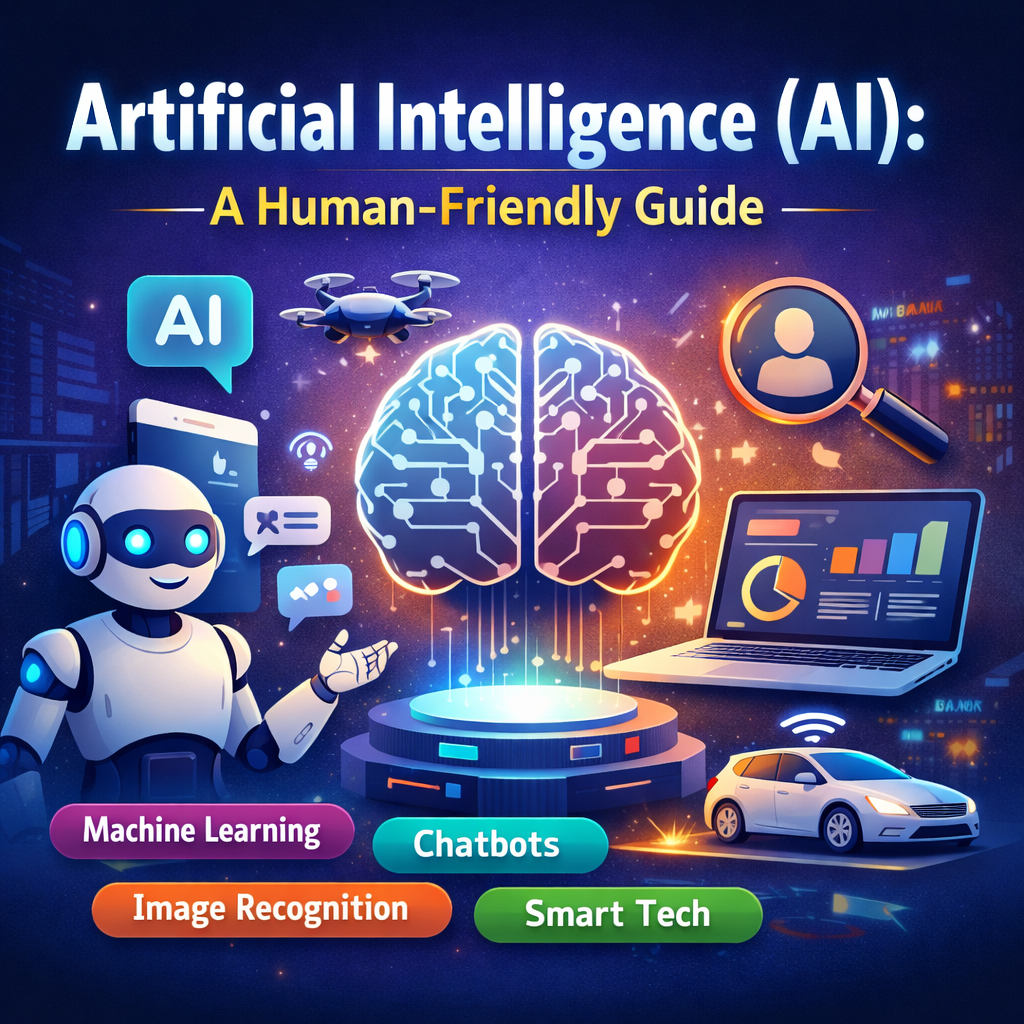
Let’s start with something real.
When most people hear Artificial Intelligence, their brain instantly goes to one of these places:
- Robots taking over the world
- A scary sci-fi movie
- A super genius computer that replaces humans
- Or… something too technical to understand
But AI isn’t that.
In fact, AI is already in your life—quietly working in the background—helping you scroll faster, shop smarter, and even find the best route when you’re late.
So if you’ve ever wondered:
“What is AI actually?”
“How does it work?”
“Is it useful for normal people?”
You’re in the right place.
This blog is written like a friend explaining it to you—simple, informational, and easy to understand.
What is Artificial Intelligence :(AI)?
Artificial Intelligence (AI) is a technology that allows machines to do tasks that normally require human intelligence.
That means AI can:
- Learn from data
- Recognize patterns
- Understand language
- Make predictions
- Solve problems
- Improve over time
The simplest way to define AI is:
AI is when a computer system can “learn” and make smart decisions instead of only following fixed instructions.
For example:
If you type “Good mor…” and your phone suggests “Good morning”, that’s AI.
It learned how people usually type.
Why AI is Suddenly Everywhere:
AI isn’t new.
The idea of AI has been around for decades.
So why is it suddenly exploding now?
Because today we have:
1) More Data Than Ever
Everything is data now.
- Your searches
- Your purchases
- Your location
- Your watch history
- Your likes and comments
AI uses this data to learn patterns.
2) More Powerful Computers
AI needs strong computing power.
Cloud systems and GPUs made AI training faster and cheaper.
3) Better AI Models
AI systems today are smarter than older ones.
That’s why AI now feels more “real” than it did 10 years ago.
How Does Artificial Intelligence Work?:
Here’s the easiest way to understand AI:
AI works like a student.
A student learns by:
- Reading examples
- Practicing
- Making mistakes
- Improving
AI does the same thing.
It learns from:
Data (Examples)
AI needs examples to learn patterns.
Example:
If you want AI to detect spam emails, you show it thousands of spam emails.
Algorithms (Learning Rules)
Algorithms tell AI how to learn.
They are like the study method.
Training (Practice)
AI trains again and again until it becomes accurate.
Results (Predictions / Decisions)
Once trained, AI can:
- Predict outcomes
- Suggest actions
- Recognize objects
- Answer questions
So yes, AI feels intelligent.
But it’s basically:
a very powerful pattern-recognition machine.
Types of Artificial Intelligence :
AI is usually divided into three types.
1) Narrow AI (Weak AI)
This is the AI we use today.
Narrow AI is designed for one job.
Examples:
- Google Translate
- Face recognition
- Chatbots
- YouTube recommendations
- Spam detection
This AI is smart in its own area.
But it cannot do everything.
Your phone camera AI cannot write poetry.
And ChatGPT cannot drive a car.
2) General AI (Strong AI)
This is the “human-level AI.”
General AI would be able to learn and perform any task a human can do.
It would have:
- Reasoning
- Logic
- Learning ability
- Flexibility
But the reality is:
General AI does not exist yet.
3) Super AI
This is the AI that becomes smarter than humans.
It’s mostly theoretical and used in sci-fi discussions.
The Core Parts of AI (Without the Confusion):
AI is not one single tool. It’s a mix of technologies.
Machine Learning (ML)
Machine Learning is when AI learns from data instead of being manually programmed.
Example:
Netflix learns what you like based on your watch history.
Deep Learning
Deep Learning is like Machine Learning on steroids.
It uses neural networks inspired by the human brain.
Example:
- Voice assistants
- Image recognition
- AI that detects cancer in scans
Natural Language Processing (NLP)
This is how AI understands language.
Examples:
- ChatGPT
- Google Assistant
- AI customer support bots
- Grammar tools
Computer Vision
Computer vision is how AI understands images and videos.
Examples:
- Face unlock
- Self-driving cars
- Security cameras
- Medical imaging
Real-Life Examples of AI (That You Use Daily):
A lot of people say:
“I don’t use AI.”
But they do.
Every day.
AI in Your Smartphone
- Face unlock
- Camera auto-enhancement
- Smart typing suggestions
AI in Social Media
- Instagram reels recommendations
- TikTok feed personalization
- Auto captions
- Fake account detection
AI in Shopping
- Amazon recommendations
- Personalized offers
- Chatbots for support
AI in Banking
- Fraud detection
- Smart transaction alerts
- Credit scoring
So AI is not “future technology.”
It’s already part of daily life.
How Businesses Use AI (And Why It’s a Big Deal):
AI is becoming a huge advantage for businesses.
Because it helps them:
Save Time
AI automates repetitive tasks like:
- Customer support replies
- Scheduling
- Data sorting
- Reporting
Reduce Mistakes
AI can reduce errors in large data work.
Make Smarter Decisions
AI can analyze data faster than humans.
This helps with:
- Predicting sales
- Understanding customer behavior
- Improving marketing campaigns
Improve Customer Experience
AI can personalize experiences.
Example:
If you run an e-commerce store, AI can suggest products based on a customer’s browsing.
If you want to explore business services connected to this, check:
Internal Link: IT and Tech Services: Complete Guide
Benefits of Artificial Intelligence (The Real Ones):
AI isn’t popular for no reason.
It has real advantages.
1) AI Saves Time
It automates repetitive tasks.
2) AI Improves Productivity
It helps teams focus on important work.
3) AI Can Work 24/7
AI doesn’t need breaks.
4) AI Improves Personalization
AI makes user experiences feel more relevant.
5) AI Supports Better Decision-Making
AI helps businesses predict outcomes more accurately.
The Limitations of AI (Important to Know):
AI is powerful, but it has issues too.
1) AI Can Be Wrong
AI sometimes “hallucinates” or gives incorrect answers.
It sounds confident, but that doesn’t mean it’s correct.
2) AI Needs Quality Data
Bad data = bad results.
3) AI Can Be Biased
AI learns from human data, and human data can contain bias.
4) AI Doesn’t Have Real Emotions
AI can mimic empathy, but it doesn’t actually feel.
5) Privacy Risks
AI tools often collect user data, which creates privacy concerns.
AI vs Human Intelligence (The Truth):
AI is better than humans at:
- Speed
- Processing huge data
- Repetitive tasks
- Pattern recognition
Humans are better than AI at:
- Creativity
- Emotions
- Ethics
- Common sense
- Real-world context
So instead of thinking:
“AI vs Humans”
Think:
“AI + Humans.”
That’s the future.
The Future of Artificial Intelligence:
AI is not slowing down.
In fact, it’s just getting started.
Here are the biggest future trends:
AI in Healthcare
AI will help doctors detect diseases earlier.
AI in Education
AI will personalize learning for every student.
AI in Cybersecurity
AI will detect attacks in real time.
AI in Marketing
AI will help brands create smarter campaigns.
AI + Mixed Reality
AI will power immersive Mixed Reality experiences.
If you want to explore that future shift, read:
Internal Link: Why Mixed Reality Is the Next Big Shift After Mobile Apps
Rich Media (Recommended Video):
If you prefer video learning, this is a great starting point:
Rich Media Link (YouTube):
Artificial Intelligence Explained – What is AI?
How to Start Learning AI (Beginner Friendly):
If you want to learn AI, you don’t need to start with coding.
Here’s a simple path:
Step 1: Learn the Basics
Understand:
- What AI is
- How it works
- Real-world examples
Step 2: Explore AI Tools
Try tools like:
- ChatGPT
- Canva AI
- Grammarly
- Notion AI
Step 3: Learn Python (If You Want)
Python is the most common language in AI.
Step 4: Learn About AI Ethics
AI ethics is important for responsible use.
External Resources :
Here are reliable resources:
External Link 1: IBM AI Guide
https://www.ibm.com/topics/artificial-intelligence
External Link 2: Google AI
https://ai.google
External Link 3: Microsoft AI
https://www.microsoft.com/en-us/ai
Frequently Asked Questions (FAQ):
1. What is Artificial Intelligence in simple words?
Artificial Intelligence is a technology that helps machines learn from data and perform tasks that usually require human intelligence.
2. Is AI dangerous?
AI itself is not dangerous, but it can be misused. The main risks include privacy, bias, and unethical use.
3. What is the difference between AI and machine learning?
AI is the full concept of making machines intelligent. Machine learning is a part of AI where machines learn from data.
4. Can AI replace humans?
AI can replace repetitive tasks, but it cannot replace human creativity, emotional understanding, and real-world judgment.
5. How can beginners start learning AI?
Start with basics, explore AI tools, and if you want to go deeper, learn Python and machine learning.
Conclusion: AI is Not Magic, It’s a Tool:
Artificial Intelligence is not a trend.
It’s a major shift.
It’s changing how we work, how we learn, how businesses operate, and how technology evolves.
And the best part?
You don’t need to be a tech expert to understand it.
Because once you understand AI, you stop seeing it as something scary or complicated…
…and start seeing it as a tool you can actually use.
☎️:919967940928
🌐: https://aibuzz.net/
Leave a Reply