Introduction
A lot of people still hear the words Artificial Intelligence and imagine something futuristic.
Robots.
Science fiction movies.
Machines taking over the world.
But real-life AI doesn’t usually look dramatic.
In fact, most of the time, it looks completely normal.
It looks like:
- Your phone unlocking with your face
- Netflix suggesting a movie you actually enjoy
- Google Maps helping you avoid traffic
- Instagram somehow knowing what you’ll probably scroll for hours
That’s AI.
Quietly working in the background.
And honestly, that’s what makes Artificial Intelligence so interesting. It didn’t suddenly arrive one day and announce itself to the world. It slowly blended into everyday life until using it became completely natural.
Most people don’t even realize how often they interact with AI anymore.
We’ve reached a point where technology is no longer just responding to us—it’s learning from us.
And whether we notice it or not, that changes everything.
What is Artificial Intelligence? :
Let’s keep this simple and real.
Artificial Intelligence is technology designed to learn from information and improve over time.
Traditional software follows instructions exactly as they are programmed.
AI is different.
Instead of only following commands, AI studies:
- Patterns
- Behavior
- Choices
- Data
Then it uses that information to make smarter decisions in the future.
A simple example?
When Spotify recommends songs that perfectly match your taste, it’s not guessing randomly. The system has learned what you enjoy listening to.
The more you use it, the more accurate it becomes.
That’s essentially how AI works.
Learning through experience.
Why AI Feels So Personal Today :
Sometimes AI feels strangely accurate.
You search for running shoes once… and suddenly every app seems to know you’re interested in fitness.
You watch one cooking video… and now your feed is full of recipes.
It can feel a little creepy sometimes, honestly.
But AI isn’t “watching” you in the human sense.
It’s studying patterns.
It notices:
- What you click
- What you ignore
- What you spend time watching
- What you search repeatedly
Over time, those patterns help AI predict what you’ll probably like next.
And because modern systems process huge amounts of data so quickly, the recommendations often feel surprisingly good.
That’s why technology today feels much more personalized than it did a few years ago.
How Artificial Intelligence Actually Works :
A lot of people assume AI is too technical to understand.
But the core idea is actually pretty human.
AI Learns from Examples :
Think about how humans learn.
We observe things.
We practice.
We improve after making mistakes.
AI works in a very similar way.
For example:
- Show AI thousands of photos of cats → it learns how cats look
- Show AI spam emails → it learns how to identify spam
- Show AI shopping behavior → it learns customer habits
The more information it receives, the smarter it becomes.
Not because it’s “alive,” but because it becomes better at recognizing patterns.
Machine Learning :
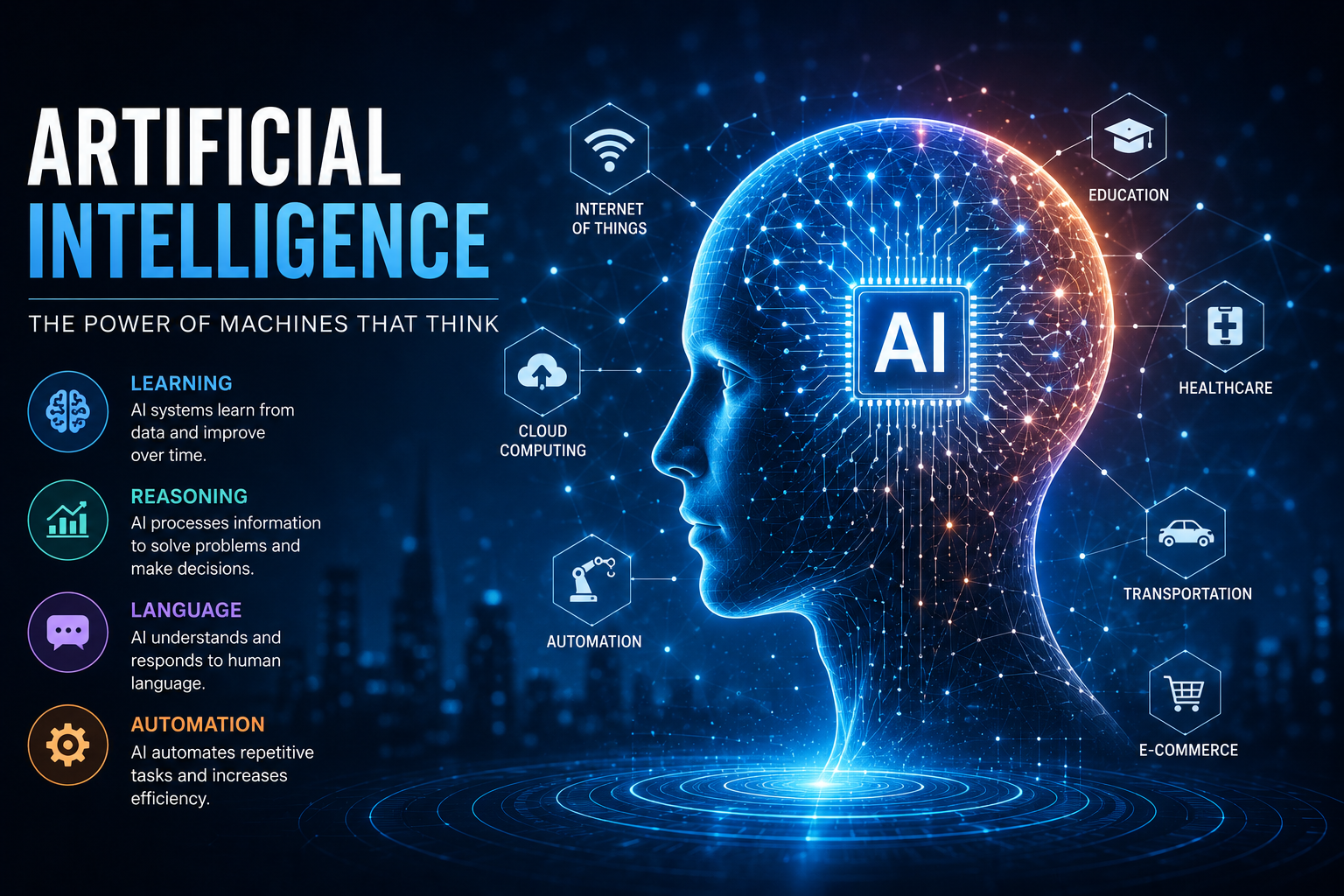
Machine Learning is one of the most important parts of AI.
Instead of manually teaching every single rule, developers allow machines to learn from data.
This is what powers:
- Recommendation systems
- Search engines
- Smart assistants
- Social media algorithms
And honestly, this is one of the biggest reasons technology feels smarter today than it did ten years ago.
Deep Learning :
Deep Learning is a more advanced type of AI inspired by the human brain.
It helps systems:
- Recognize faces
- Understand speech
- Translate languages
- Analyze images
This is why AI tools today can understand voices, photos, and conversations much more naturally.
Natural Language Processing (NLP) :
Natural Language Processing helps machines understand human language.
Without it:
- Chatbots would sound robotic
- Voice assistants wouldn’t understand questions properly
- AI writing tools wouldn’t exist
NLP is what makes communication between humans and machines feel smoother and more natural.
The Different Types of AI :
Not all AI works the same way.
Narrow AI :
This is the type of AI we currently use every day.
It focuses on one specific task and performs that task extremely well.
Examples include:
- Siri
- Google Assistant
- Netflix recommendations
- Face recognition systems
This AI is smart—but only within its assigned role.
General AI :
General AI refers to systems that could think and learn across multiple tasks like humans.
This level of AI doesn’t fully exist yet, although researchers continue exploring it.
Super AI :
Super AI is the idea of machines becoming more intelligent than humans.
Right now, it remains theoretical, but it’s one of the biggest discussions surrounding the future of technology.
Where We Use AI in Everyday Life :
One of the most fascinating things about AI is how normal it has become.
Most people use it constantly without even noticing.
AI in Smartphones :
Your smartphone likely uses AI all the time.
For example:
- Face unlock
- Camera improvements
- Predictive typing
- Voice assistants
Even photo enhancement tools often rely on AI.
AI in Social Media :
Social media platforms use AI to decide:
- What appears on your feed
- Which videos get recommended
- Which ads match your interests
That’s why everyone’s feed feels different.
AI personalizes content for each person.
AI in Online Shopping :
Online stores use AI to:
- Recommend products
- Predict customer interests
- Improve user experiences
That’s why shopping online often feels unusually personalized.
AI in Healthcare :
AI is helping doctors:
- Detect diseases earlier
- Analyze medical reports faster
- Improve patient care
In many cases, AI helps save time during critical situations.
AI in Education :
AI is also changing how students learn.
It supports:
- Personalized lessons
- Smart tutoring systems
- Faster learning feedback
Education is becoming more flexible and interactive because of AI.
The Biggest Benefits of Artificial Intelligence :
There’s a reason businesses everywhere are investing heavily in AI.
It Saves Time :
AI can automate repetitive tasks much faster than humans.
It Improves Accuracy :
Machines can process large amounts of information with fewer mistakes.
It Creates Personalized Experiences :
From playlists to shopping recommendations, AI adapts to individual users.
It Works Continuously :
Unlike humans, AI systems don’t need breaks or sleep.
The Concerns Around AI :
Even though AI is exciting, it also raises important questions.
Privacy Concerns :
AI depends heavily on user data.
Naturally, people worry about:
- Data collection
- Privacy protection
- How information is being used
Job Automation :
Some repetitive jobs may become automated in the future.
At the same time, AI is also creating entirely new industries and career opportunities.
Bias in AI :
AI learns from human-created data.
So if the data contains bias, the AI can unintentionally reflect those same problems.
That’s why ethical AI development matters so much.
The Future of Artificial Intelligence :
The future of AI feels exciting because we’re still only seeing the beginning.
Over time, we’ll likely experience:
- Smarter assistants
- Better automation
- More personalized technology
- Faster innovation across industries
Eventually, AI may become so normal that people stop thinking about it as “AI.”
It will simply become part of everyday life—just like the internet did.
Why Understanding AI Matters :
You don’t need to become a software engineer to understand AI.
But understanding the basics genuinely matters now.
Because AI is already shaping:
- Businesses
- Careers
- Communication
- Technology
- Everyday experiences
And the people who understand these changes will adapt much faster in the future.
Internal Links :
External Links :
Rich Media Suggestions :
Images :
Videos :
Frequently Asked Questions (FAQ) :
Q1: What is Artificial Intelligence in simple words? :
Artificial Intelligence is technology that allows machines to learn from information and make smart decisions.
Q2: Is AI already part of everyday life? :
Yes. AI is used in smartphones, apps, social media, online shopping, healthcare, and many other technologies we use daily.
Q3: Can AI replace humans completely? :
No. AI can automate certain tasks, but human creativity, emotions, and judgment are still extremely important.
Q4: Is learning AI difficult? :
Not necessarily. Anyone can begin by understanding basic concepts and gradually exploring more advanced topics.
Q5: Why is AI important for the future? :
AI is improving efficiency, automation, healthcare, education, and many industries shaping modern life.
Conclusion :
Artificial Intelligence no longer feels distant or futuristic.
It has quietly become part of how we live, work, shop, communicate, and consume information every day.
And while AI will continue evolving, one thing is becoming very clear:
The future won’t just belong to people who use technology.
It will belong to people who understand how technology is changing the world around them.
☎️ 919967940928
🌐 https://aibuzz.net/