Take a moment and think about your day.
You wake up, check your phone, scroll through social media, maybe watch a video, order something online, or use maps to go somewhere. It all feels normal… routine, even.
But behind many of those small, everyday actions, there’s something quietly working—Artificial Intelligence.
Not robots walking around. Not sci-fi machines. Just smart systems helping things run a little smoother.
This blog isn’t here to impress you with technical terms. It’s here to help you actually understand AI in a way that feels natural—like you’re learning from a friend, not a textbook.
So, What Is Artificial Intelligence—Really? :
Let’s keep it simple.
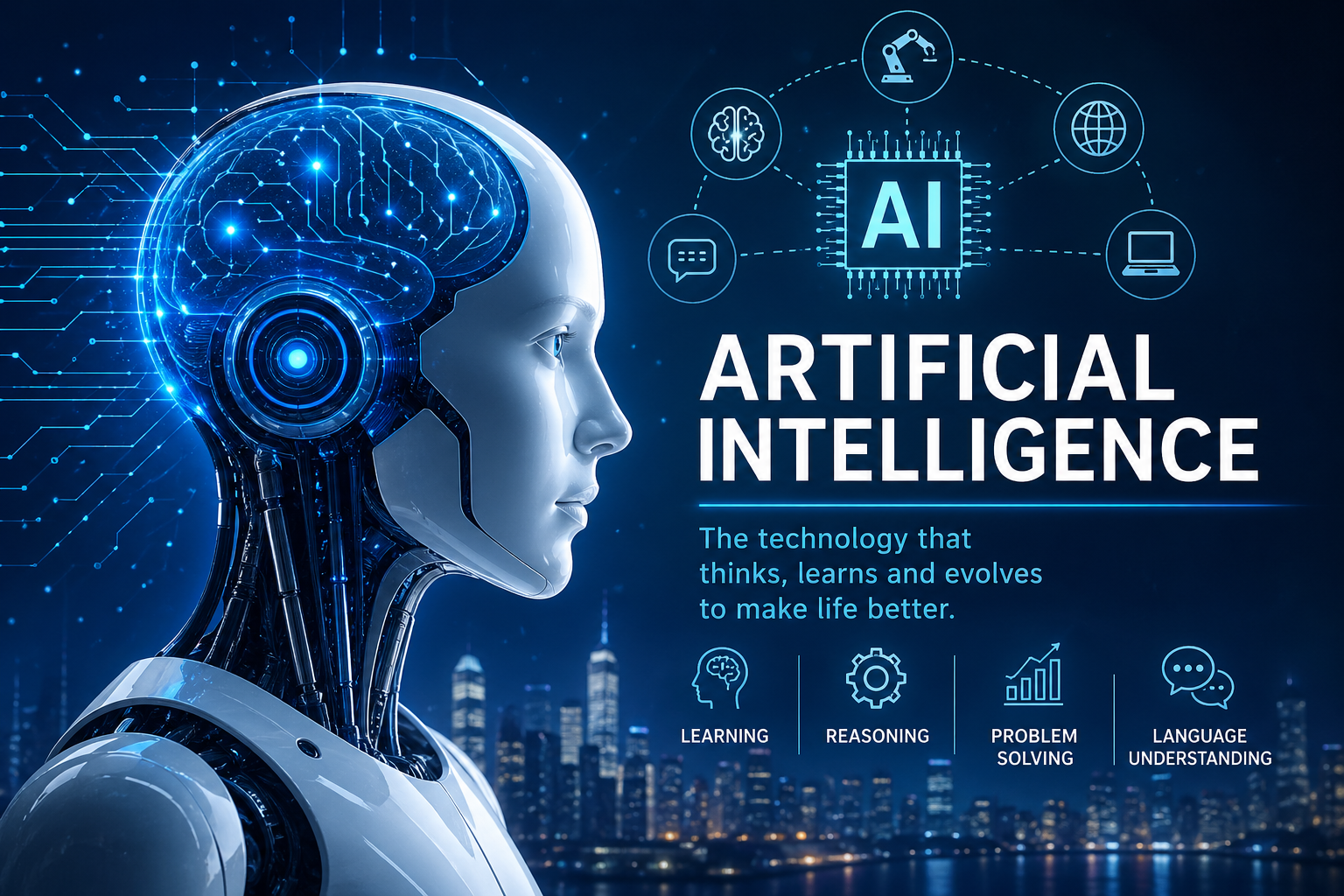
Artificial Intelligence is when machines are designed to learn from experience and make decisions, instead of just following fixed instructions.
That’s it.
No complicated definition needed.
When your phone suggests the next word while typing…
When your playlist somehow matches your mood…
When your feed shows exactly what catches your attention…
That’s AI doing its thing.
Companies like Google, Microsoft, and OpenAI build these systems—but you experience them in the simplest ways.
How AI Works :
Here’s where most people get confused—but it doesn’t have to be.
AI is less about “programming every step” and more about teaching a system how to learn.
Imagine teaching someone how to recognize mangoes:
You show them different mangoes—ripe, raw, small, big. Over time, they just know.
AI learns in a similar way:
- It sees data
- It finds patterns
- It improves with more exposure
It’s not magic. It’s practice—just much faster than humans.
The Simple Pieces That Make AI Work :
Let’s not overcomplicate this. These are just different ways AI learns.
Machine Learning :
This is the core idea—machines learning from data instead of instructions.
Deep Learning :
A more advanced version, where learning happens in layers (kind of like how we think step by step).
Natural Language Processing :
This helps machines understand human language—like when you type or speak.
Computer Vision :
This allows machines to understand images and videos.
The Different “Levels” of AI :
Not all AI is equally powerful—and that’s important to understand.
Narrow AI (What You Use Daily) :
This AI is focused on one task—and it does it well.
Like:
- Recommending videos
- Filtering spam
- Answering questions
General AI (Still a Work in Progress) :
This would be AI that can think like a human across different situations.
We’re not there yet.
Super AI (Mostly Theoretical) :
This is the idea of machines being smarter than humans in every way.
Sounds exciting—but also raises a lot of questions.
Where You See AI Without Even Thinking About It :
This is where it clicks. :
AI isn’t something separate from your life—it’s already part of it.
Watching Shows :
Netflix somehow keeps recommending things you actually enjoy.
Online Shopping :
Amazon shows products that feel surprisingly relevant.
Navigation :
Maps don’t just show directions—they predict traffic.
Your Phone :
Face unlock, voice assistants, smart replies—it’s all AI.
Cars :
Companies like Tesla are building smarter, semi-autonomous vehicles.
Why AI Feels So Important Right Now :
Because it’s quietly improving everything.
Not in a loud, dramatic way—but in small, meaningful ways:
- Things become faster
- Decisions become smarter
- Experiences feel more personal
It’s like upgrading life in the background.
The Good Side of AI :
AI isn’t popular just because it’s “cool.” It’s useful.
- It doesn’t get tired
- It handles repetitive work
- It processes huge data quickly
- It helps humans make better decisions
From doctors diagnosing diseases to businesses understanding customers—AI is helping people do better work.
The Honest Concerns :
Let’s not pretend AI is flawless.
There are real concerns—and they matter.
- Privacy: Your data is valuable and needs protection
- Jobs: Some roles will change
- Bias: AI can reflect human mistakes
- Cost: It’s expensive to build
That’s why groups like the World Economic Forum are working on responsible AI practices.
The Future of AI :
A lot of people imagine a future where AI replaces humans.
But the reality is different.
The future is about partnership.
- Humans bring creativity, emotion, and judgment
- AI brings speed, data, and efficiency
It’s not about competition—it’s about collaboration.
Internal Links :
External Resources :
Rich Media Suggestion :
Image Idea:
A simple, warm illustration of a human and a digital system working side by side—not dramatic, just natural.
- Image Title: Everyday Life with AI
- Alt Text: Human using AI technology in daily life
- Caption: AI quietly becoming part of our daily routine
- Description: A relatable visual showing how AI fits naturally into everyday human activities
AI in Business :
Businesses care about AI for one simple reason—it helps them understand people better.
Not in a complicated way. Just practically:
- What customers like
- What they need
- How to improve services
The companies that understand this early usually stay ahead.
(Frequently Asked Questions)FAQ :
Is AI only for tech people? :
No. Most AI tools are built for everyday users.
Will AI replace humans? :
Not really. It will change how we work, not remove us completely.
Can AI think like us? :
It can mimic certain patterns—but it doesn’t have feelings or awareness.
Is AI safe? :
It can be, if used responsibly.
How should I start learning AI? :
Stay curious. Start simple. Explore tools. You don’t need to rush.
Final Thoughts :
You don’t need to fear AI.
You don’t need to fully master it either.
Just start by understanding it.
Because the truth is—AI isn’t coming in the future.
It’s already here, quietly becoming part of your daily life.
And the more naturally you understand it, the more useful it becomes.
☎️ 919967940928
🌐 https://aibuzz.net/
Leave a Reply