Imagine visiting another country without booking a flight, exploring the human body without entering a laboratory, or practising a difficult task without facing real-world risks. These experiences may sound futuristic, but Virtual Reality (VR) is making them possible today.
Technology has changed the way people communicate, learn, work, and entertain themselves. Among these developments, Virtual Reality is becoming an important innovation because it allows people to experience computer-generated environments rather than simply viewing information on a screen.
From education and healthcare to gaming, architecture, and business, VR is creating new opportunities for individuals and organisations. It makes digital experiences more interactive, engaging, and realistic.
In this blog, we will explore what Virtual Reality is, how it works, its major applications, benefits, challenges, and what businesses can expect from this evolving technology.
What Is Virtual Reality? :
Virtual Reality (VR) is a technology that creates a computer-generated three-dimensional environment where users can interact with digital objects and explore simulated surroundings. It usually requires a VR headset that covers the user’s eyes and displays a virtual world.
Unlike traditional computers or mobile devices, which show digital information on a flat screen, Virtual Reality creates an immersive experience. Users can look around, move through virtual spaces, and interact with objects using controllers, hand tracking, or other input devices.
For example, a student studying ancient history can explore a digitally recreated historical monument instead of only reading about it in a textbook.
The main purpose of Virtual Reality is to make digital experiences feel more natural and interactive.
How Does Virtual Reality Work? :
Virtual Reality combines hardware and software to create an immersive digital experience. Different technologies work together to make the virtual environment respond to the user’s movements.
1. VR Headsets
A VR headset is the primary device used to experience virtual environments. It contains displays and lenses that present separate images to each eye, creating a sense of depth.
2. Motion Tracking
Sensors and tracking cameras monitor the user’s head and body movements. When users turn their heads or move around, the virtual environment responds accordingly.
3. Controllers and Hand Tracking
Controllers allow users to pick up virtual objects, operate equipment, and interact with digital environments. Some systems also recognise hand movements without requiring physical controllers.
4. 3D Graphics and Software
Specialised software creates the virtual environment, including buildings, objects, characters, and landscapes. Real-time rendering helps the environment respond to user actions.
5. Spatial Audio
Spatial audio makes sounds appear to come from specific directions within the virtual environment. This adds another layer of realism to the experience.
When these technologies work together, they create an environment that users can explore and interact with.
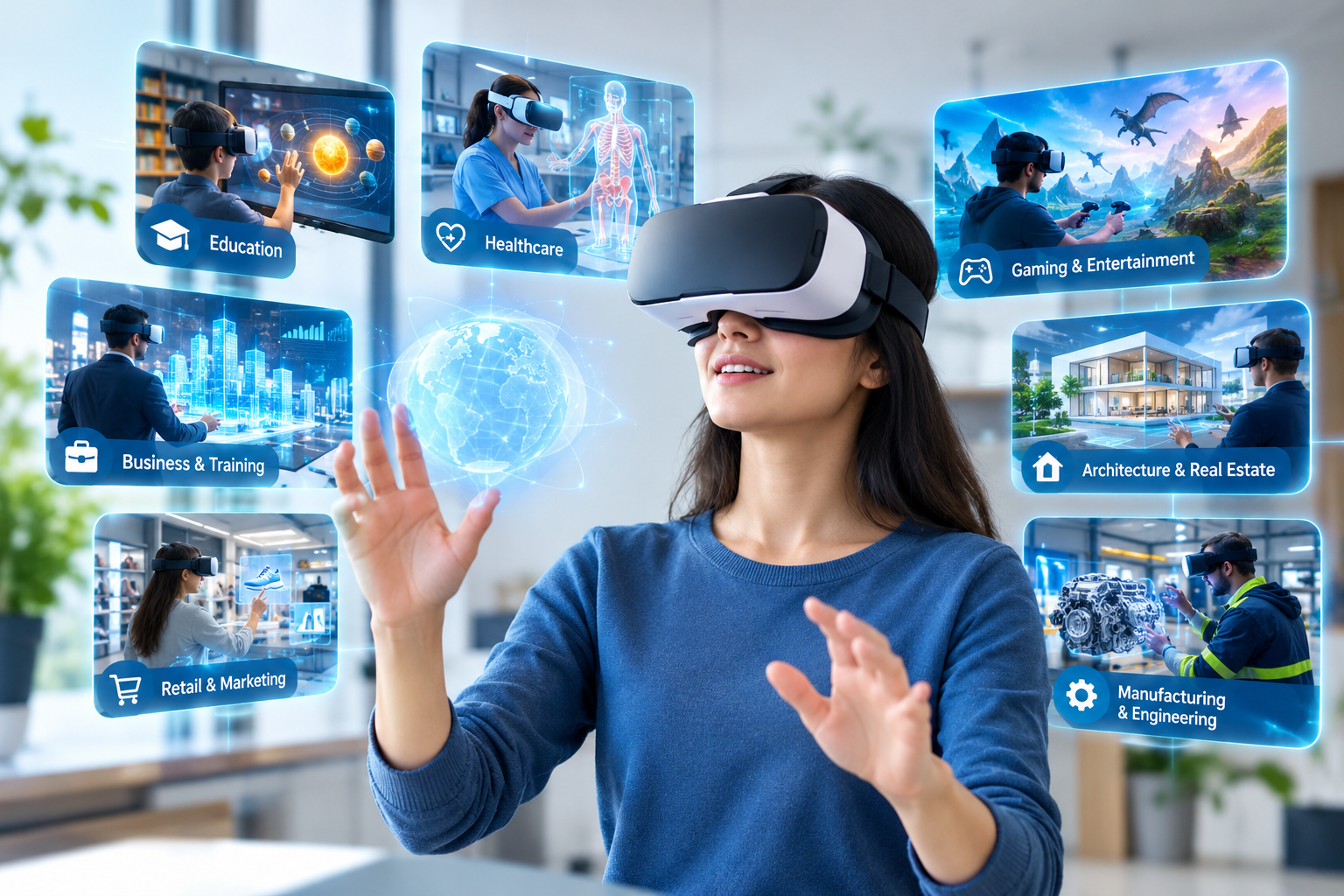
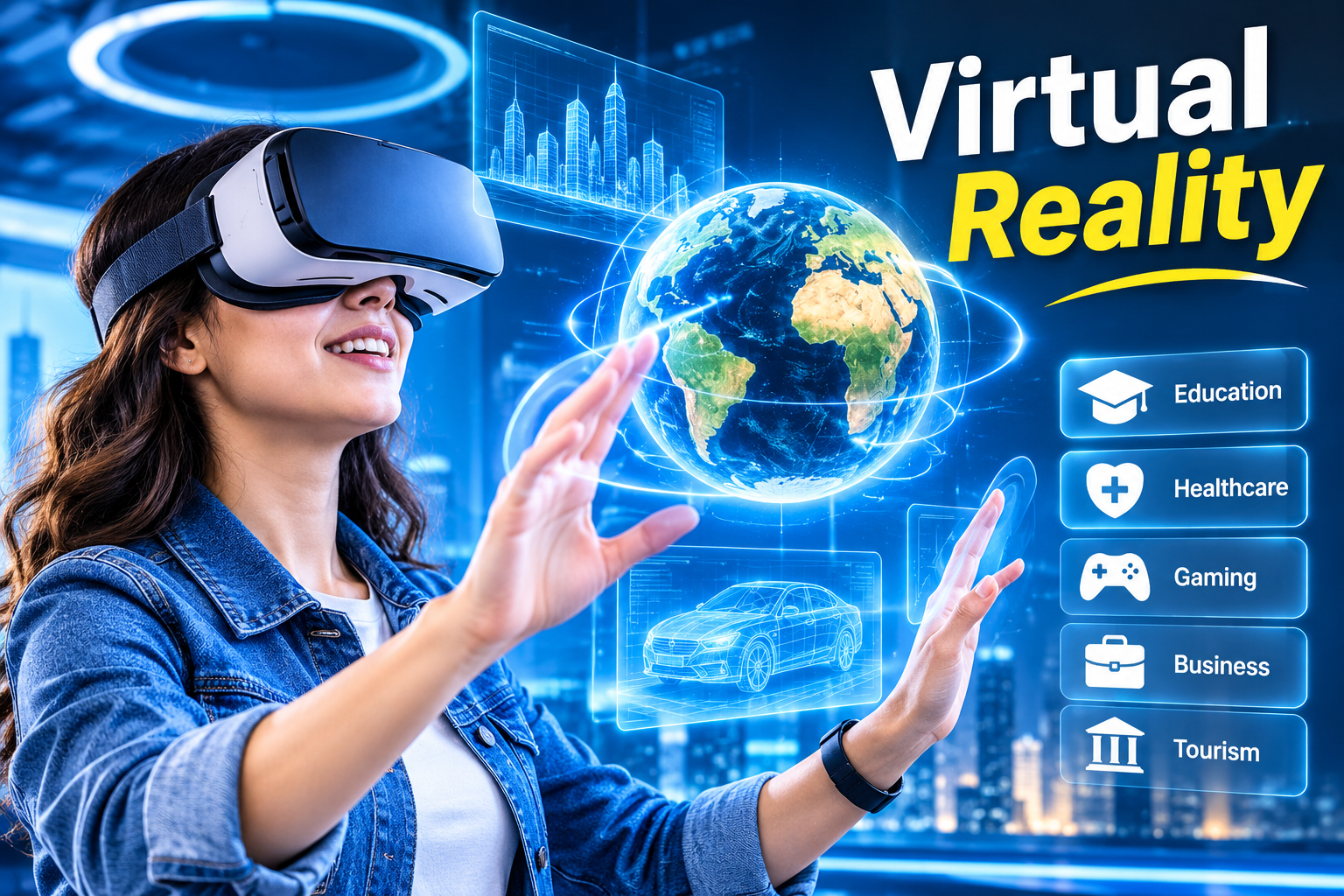
7 Powerful Applications of Virtual Reality :
Virtual Reality is no longer limited to entertainment. Organisations across different industries are exploring how immersive technology can improve their daily operations and services.
1. Virtual Reality in Education
Education is one of the areas where VR can make learning more engaging. Traditional teaching methods often depend on textbooks, presentations, and classroom explanations. Although these methods remain valuable, some subjects are easier to understand through practical experiences.
With Virtual Reality, students can explore historical locations, examine the solar system, visit virtual laboratories, and understand complex scientific concepts through simulations.
For example, medical students can study human anatomy through interactive 3D models. Science students can explore environments that may be difficult to access in real life.
VR can make lessons more interactive and help students understand concepts through visual experiences.
2. Virtual Reality in Healthcare
Healthcare professionals need practical knowledge and continuous training. Virtual Reality can support medical education by providing simulated environments where students and professionals can practise specific procedures.
Some healthcare applications include:
- Medical training and surgical simulations.
- Anatomy education using interactive 3D models.
- Rehabilitation exercises in controlled environments.
- Certain supervised mental health interventions.
- Patient education through visual demonstrations.
VR can allow medical professionals to practise procedures in a simulated setting before performing them in real clinical environments. However, it supports rather than replaces professional medical training and clinical judgement.
3. Virtual Reality in Gaming and Entertainment
Gaming is one of the most familiar applications of Virtual Reality. Traditional video games allow players to control characters through screens, while VR can place players inside interactive digital worlds.
Players can explore virtual locations, interact with objects, and experience games from a first-person perspective.
Beyond gaming, VR is also used for virtual concerts, interactive storytelling, digital exhibitions, and immersive entertainment experiences.
This creates new ways for audiences to engage with digital content.
4. Virtual Reality in Business and Employee Training
Businesses often need to train employees for tasks involving specialised equipment, customer interactions, or workplace safety.
Virtual Reality can create simulated training environments where employees practise different situations without immediately facing real-world consequences.
For example, manufacturing companies can use VR simulations to familiarise workers with equipment and operational procedures. Retail businesses can train employees to handle customer interactions, while organisations can use virtual meeting environments for collaboration.
VR-based training can also help businesses repeat scenarios consistently and assess employee performance.
5. Virtual Reality in Architecture and Real Estate
Architecture and real estate are changing through immersive visualisation.
Earlier, customers generally depended on floor plans, photographs, and physical models to understand a building design. With Virtual Reality, they can explore a digital representation of a property before construction is complete.
Architects can present building layouts, interior designs, lighting arrangements, and room dimensions through virtual walkthroughs.
Real estate businesses can also offer virtual property tours to customers who cannot visit a location physically.
This makes it easier to communicate design ideas and collect feedback during the planning process.
6. Virtual Reality in Tourism
Travel is an exciting experience, but not everyone can visit every destination because of time, distance, accessibility, or financial limitations.
Virtual Reality offers an alternative way to explore destinations digitally. Users can experience virtual tours of museums, historical monuments, natural landscapes, and cultural attractions.
Tourism businesses can use immersive previews to introduce destinations to potential travellers.
Although a virtual tour cannot fully replace physical travel, it can help people discover places and make more informed travel decisions.
7. Virtual Reality in Manufacturing and Engineering
Manufacturing and engineering involve complex designs, equipment, and processes. Virtual Reality can help teams visualise products and industrial environments before making physical changes.
Engineers can review digital prototypes, examine equipment layouts, and simulate certain operating conditions.
For example, a manufacturing company may create a virtual factory layout to evaluate equipment placement and workflow before investing in physical installation.
These applications can support planning, design reviews, and employee training.
Major Benefits of Virtual Reality :
Virtual Reality offers several advantages when it is used for the right purpose.
Improved Learning Experiences
VR turns certain theoretical concepts into interactive experiences. Learners can explore virtual environments and understand topics through practical visual demonstrations.
Safer Training Simulations
Employees and students can practise selected tasks in simulated environments, particularly when real-world training involves risks, expensive equipment, or difficult conditions.
Better Visualisation
Businesses can present products, buildings, and designs in three dimensions. This helps customers and stakeholders understand ideas more clearly.
Increased Engagement
Interactive virtual environments can capture attention and encourage active participation compared with some traditional digital formats.
Remote Experiences
VR can help people explore virtual spaces and participate in certain collaborative experiences without travelling to the same physical location.
Challenges and Limitations of Virtual Reality :
Despite its potential, Virtual Reality also has limitations that organisations should consider before adopting it.
High Initial Costs: VR headsets, compatible computers, software development, and maintenance can require significant investment.
Physical Discomfort: Some users may experience motion sickness, eye strain, dizziness, or discomfort during extended sessions.
Technical Requirements: High-quality VR experiences often need capable hardware, reliable software, and suitable physical space.
Content Development: Creating realistic and useful virtual environments requires skilled designers, developers, and technical resources.
Privacy and Safety: VR systems may collect movement, interaction, and other user-related data. Organisations should protect this information and provide appropriate safety guidelines.
A successful VR implementation should consider the target audience, business objectives, accessibility, and available resources.
What Is the Future of Virtual Reality? :
The future of Virtual Reality will be influenced by improvements in artificial intelligence, graphics processing, motion tracking, and immersive hardware.
AI can help create more responsive virtual characters and personalised learning experiences. Better graphics and tracking can make virtual environments feel more natural, while improved hardware may make devices more comfortable and accessible.
Businesses may increasingly explore VR for employee training, product demonstrations, design reviews, and remote collaboration.
The technology will not replace every traditional method. Instead, its value will depend on how effectively it solves real problems and improves existing experiences.
How Aibuzz Can Help Businesses Explore Virtual Reality :
At Aibuzz, we recognise the importance of technology in creating new opportunities for businesses. Virtual Reality is an innovative approach that can help organisations present ideas, improve digital experiences, and explore new ways of connecting with their audiences.
From immersive digital concepts to technology-driven solutions, businesses can explore how VR fits their goals and customer requirements.
Whether an organisation wants to introduce interactive experiences, improve product visualisation, or explore immersive training, choosing the right technology and development approach is essential.
Visit Aibuzz to explore technology and IT services that can support your digital journey.
Internal, External and Rich Media Link :
1. Internal link :
2. External links :
3. Rich media link :

How Do VR Headsets Work? – The Technology of Virtual Reality
Frequently Asked Questions (FAQ’S) :
1. What is Virtual Reality in simple words?
Virtual Reality is a technology that creates a computer-generated 3D environment. Users can explore and interact with this environment through a VR headset and compatible devices.
2. Where is Virtual Reality commonly used?
VR is used in gaming, education, healthcare, employee training, architecture, real estate, tourism, manufacturing, and engineering.
3. What equipment is required for Virtual Reality?
A typical VR setup includes a VR headset, compatible software, tracking sensors, and controllers or hand-tracking technology. Requirements depend on the experience and device.
4. Is Virtual Reality useful for businesses?
Yes. Businesses can use VR for employee training, product demonstrations, virtual property tours, design visualisation, and selected collaborative activities.
5. What is the difference between Virtual Reality and Augmented Reality?
Virtual Reality creates a computer-generated environment that surrounds the user. Augmented Reality adds digital elements to the user’s view of the real world.
Conclusion :
Virtual Reality is changing the way people experience digital technology. It allows users to move beyond traditional screens and interact with computer-generated environments in meaningful ways.
From helping students understand complex subjects to supporting employee training and improving product visualisation, VR offers opportunities across many industries.
However, successful adoption requires careful planning, suitable technology, useful content, and attention to user safety and privacy.
📞 Contact: 919967940928
🌐 Visit: http://aibuzz.net