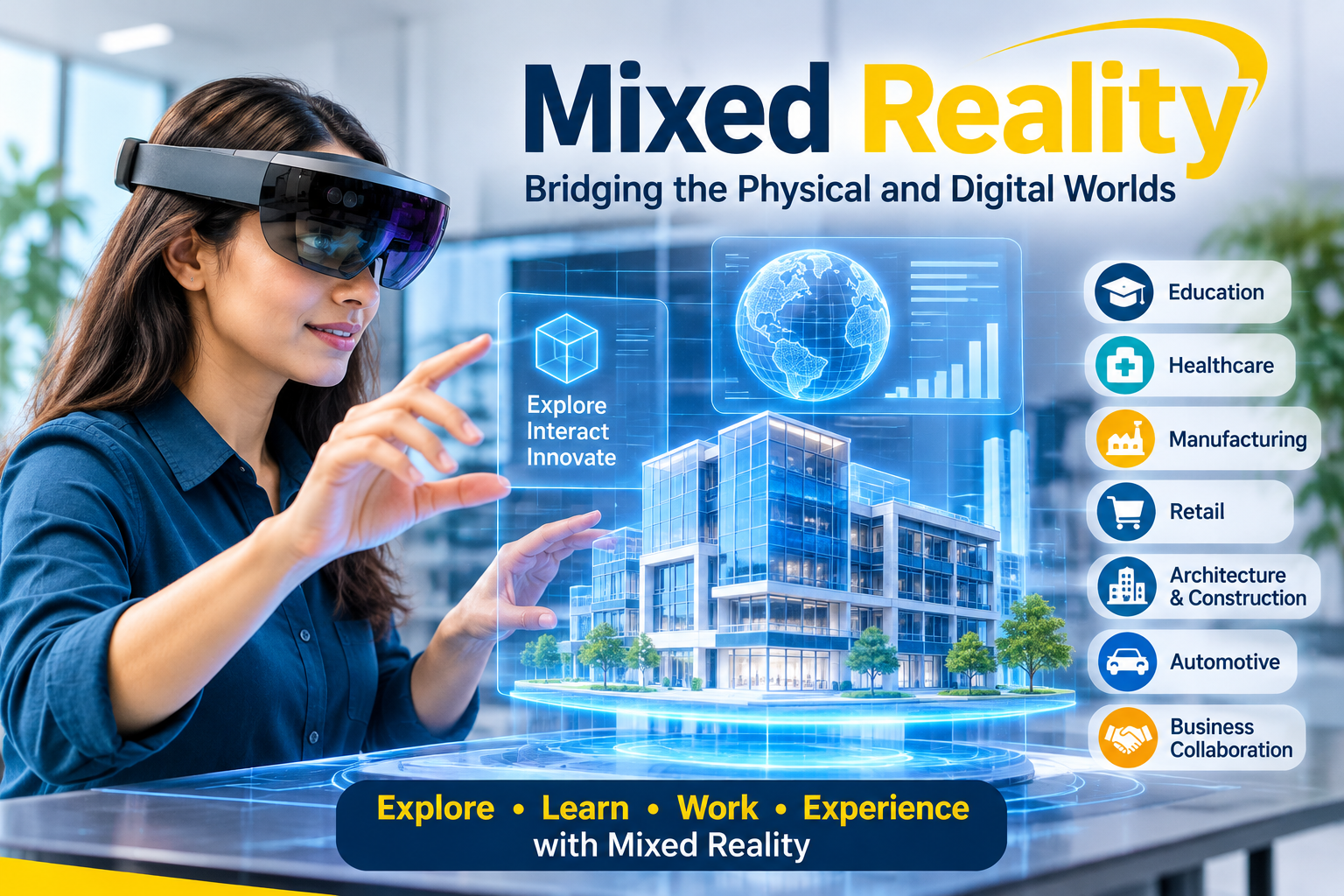
Technology is changing the way people work, learn, communicate, and experience the world. One of the most exciting developments in this transformation is Mixed Reality (MR). It brings digital content into the real world, allowing people to interact with virtual objects while remaining connected to their physical surroundings.
Imagine an engineer examining a virtual machine model directly on a factory floor, a medical student practising a complex procedure using a digital human body, or a customer viewing how furniture would look inside their home before purchasing it. These experiences are becoming possible through Mixed Reality.
Unlike traditional digital experiences, Mixed Reality creates a connection between physical environments and computer-generated objects. It offers businesses and individuals new ways to understand information, solve problems, and collaborate.
As immersive technologies continue to develop, Mixed Reality is becoming an important part of digital transformation across multiple industries.
What Is Mixed Reality? :
Mixed Reality is an immersive technology that combines elements of the physical and digital worlds. It allows digital objects, images, and information to appear within a real environment and respond to the user’s actions.
For example, someone wearing a compatible Mixed Reality headset can see a virtual product placed on a real table. They can walk around it, examine its details, and interact with it as though it were physically present.
Mixed Reality uses technologies such as cameras, sensors, spatial mapping, motion tracking, and advanced computing to understand the surrounding environment.
How Does Mixed Reality Work?
Mixed Reality works by combining several technologies to create an interactive experience.
- Environmental sensing: Cameras and sensors identify the user’s surroundings.
- Spatial mapping: The system understands surfaces, walls, objects, and distances.
- Motion tracking: It follows head, hand, and sometimes eye movements.
- Digital object placement: Virtual elements are positioned within the physical environment.
- Real-time interaction: Users can move, select, resize, and interact with digital objects.
These technologies help digital content respond naturally to the real world, making the experience more realistic and useful.
Mixed Reality vs. Augmented Reality vs. Virtual Reality :
Mixed Reality, Augmented Reality, and Virtual Reality are closely related technologies, but they offer different experiences.
| Technology | How It Works |
|---|---|
| Augmented Reality (AR) | Adds digital information or objects to a real-world view. |
| Virtual Reality (VR) | Creates a fully computer-generated environment. |
| Mixed Reality (MR) | Connects digital objects with the physical environment and enables interaction between them. |
For example, AR might display directions over a camera view, VR might place a user inside a virtual training environment, and MR might allow an interactive digital machine to sit on a real factory floor.
Understanding these differences helps businesses choose the right technology for their requirements.
7 Important Applications of Mixed Reality Across Industries :
Mixed Reality is not limited to entertainment or gaming. It has practical applications in industries where visual information, training, accuracy, and collaboration are important.
1. Mixed Reality in Education
Education is becoming more interactive with the introduction of immersive technologies. Mixed Reality allows students to explore subjects through 3D models instead of depending entirely on textbooks and traditional classroom explanations.
For example, students can examine the human body, explore the solar system, or understand historical structures through interactive digital models.
Key benefits:
- Makes complex subjects easier to understand.
- Encourages practical and interactive learning.
- Improves student engagement.
- Supports virtual demonstrations and simulations.
Teachers can also use Mixed Reality to create learning experiences that encourage curiosity and active participation.
2. Mixed Reality in Healthcare
Healthcare is another industry where Mixed Reality can support medical professionals and students. It can help visualize anatomical structures, understand medical information, and practise procedures in simulated environments.
For example, medical students can study interactive 3D representations of organs before working with real patients.
Key benefits:
- Supports medical education and training.
- Helps visualize complex anatomical structures.
- Improves communication through 3D medical models.
- Supports procedural planning and simulation.
However, Mixed Reality applications in healthcare must be properly validated and should not replace professional medical judgement.
3. Mixed Reality in Manufacturing
Manufacturing companies can use Mixed Reality to improve production processes, equipment maintenance, and employee training.
Workers can view digital instructions over physical machinery, follow step-by-step repair guidance, and understand complex equipment without relying only on printed manuals.
For example, a technician could see highlighted machine components and digital maintenance instructions while inspecting an actual industrial machine.
Key benefits:
- Simplifies equipment maintenance.
- Supports employee training.
- Helps reduce operational errors.
- Improves access to technical information.
4. Mixed Reality in Retail and E-Commerce
Customer expectations are changing, and businesses are looking for better ways to present their products online and offline.
Mixed Reality can allow customers to visualize products in their surroundings before making a purchase. For example, someone shopping for furniture could view a digital sofa inside their living room and examine its size, shape, and appearance.
Key benefits:
- Creates interactive shopping experiences.
- Helps customers understand product dimensions.
- Supports better product visualization.
- Makes online shopping more engaging.
This technology can help customers make more informed purchasing decisions.
5. Mixed Reality in Architecture and Construction
Architects and construction professionals can use Mixed Reality to visualize building designs within actual environments.
Instead of understanding a project only through 2D drawings, clients and construction teams can explore 3D building models and examine different design elements.
For example, an architect can display a virtual building structure at its actual construction location, helping stakeholders understand how the finished project may look.
Key benefits:
- Improves design visualization.
- Supports project presentations.
- Helps identify potential design issues.
- Encourages better collaboration between teams.
6. Mixed Reality in Business and Remote Collaboration
Modern businesses often work with employees, customers, and partners across different locations. Mixed Reality can support collaboration by bringing digital models, presentations, and shared visual information into interactive environments.
Teams can discuss product designs, examine virtual prototypes, and share technical information without always being physically present in the same location.
Key benefits:
- Supports interactive remote meetings.
- Improves product demonstrations.
- Helps teams understand complex ideas.
- Encourages more effective communication.
7. Mixed Reality in Automotive
The automotive industry can use Mixed Reality during vehicle design, manufacturing, employee training, and customer experiences.
Engineers can examine digital vehicle components, visualize design changes, and review virtual prototypes. Training teams can also use simulated environments to explain vehicle systems and maintenance procedures.
For customers, interactive vehicle visualization can make it easier to explore interior layouts, features, and design options.
Key Technologies Behind Mixed Reality :
Mixed Reality depends on several technologies working together to create realistic and responsive experiences.
Spatial Computing
Spatial computing allows digital systems to understand and interact with physical spaces. It helps virtual objects remain positioned within an environment as users move around.
Artificial Intelligence
Artificial Intelligence can improve Mixed Reality applications through object recognition, intelligent assistance, voice interaction, and automated information processing.
For example, an AI-powered application could identify a machine component and display relevant maintenance information.
3D Modelling and Real-Time Rendering
3D modelling creates digital representations of real-world objects, while real-time rendering displays those models with appropriate lighting, movement, and visual detail.
These technologies are particularly useful in product design, architecture, manufacturing, and simulation.
Sensors and Motion Tracking
Sensors and tracking systems help Mixed Reality devices understand the user’s position, movement, and surroundings. They make it possible to interact with digital objects through gestures, gaze, and other supported input methods.
Microsoft’s Mixed Reality documentation provides further information about the technologies and development approaches used to build immersive experiences. Microsoft Learn+1
Benefits of Mixed Reality for Businesses :
Mixed Reality offers businesses opportunities to improve how they develop products, train employees, and communicate with customers.
Some important advantages include:
- Better visualization: Businesses can present complex ideas through interactive 3D models.
- Improved training: Employees can learn through practical simulations and guided instructions.
- Enhanced customer experience: Customers can explore products in more engaging ways.
- Effective collaboration: Teams can discuss digital models and information across different locations.
- Faster product development: Virtual prototypes can support design reviews before physical production.
- Practical learning: Users can understand complex processes through visual demonstrations.
The actual benefits depend on the application, device capabilities, implementation quality, and business requirements.
Challenges and Limitations of Mixed Reality :
Although Mixed Reality offers exciting opportunities, businesses should understand its limitations before adopting the technology.
High Development Costs
Creating a professional Mixed Reality application may require specialized developers, 3D designers, compatible devices, and ongoing maintenance.
Hardware Requirements
Not every organization or customer has access to compatible headsets and devices. Hardware costs and availability can affect adoption.
User Experience and Comfort
Poorly designed experiences can cause discomfort, visual fatigue, or difficulty interacting with digital objects. Applications should prioritize accessibility, usability, and safe usage.
Data Privacy and Security
Mixed Reality devices may collect spatial information, images, audio, and other environmental data. Businesses must implement suitable privacy policies, data protection measures, and access controls.
Technical Complexity
Developing reliable applications requires knowledge of 3D environments, spatial computing, software development, and device integration.
Businesses should begin with clearly defined use cases and test their applications before introducing them across an entire organization.
The Future of Mixed Reality :
The future of Mixed Reality will be influenced by improvements in Artificial Intelligence, spatial computing, wearable devices, cloud technology, and real-time 3D development.
As hardware becomes more capable and software becomes easier to develop, Mixed Reality may become increasingly useful in professional and everyday environments.
AI-powered assistance could make virtual interactions more intelligent, while digital twins could help businesses visualize and monitor real-world systems through digital representations.
Education may become more interactive, healthcare training more immersive, and industrial maintenance more visually guided.
However, widespread adoption will depend on affordability, practical value, privacy, device comfort, and the availability of useful applications.
Businesses that explore Mixed Reality with clear objectives can identify opportunities to improve existing processes and create more engaging digital experiences.
How Aibuzz Can Support Your Digital Transformation Journey :
Adopting emerging technologies requires more than selecting new hardware. Businesses need the right software, development strategy, and technical expertise to turn an idea into a practical solution.
At Aibuzz, we focus on IT and technology services, including Software Development, Artificial Intelligence, Virtual Reality, and Mixed Reality.
From interactive digital experiences to customized software solutions, the right development approach can help businesses explore new opportunities and improve the way they operate.
Explore our Aibuzz website to learn more about our technology services and digital solutions.
Ready to explore Mixed Reality for your business? Connect with Aibuzz to discuss your technology requirements and development ideas.
1. Internal links
Add these links within your blog to connect readers with relevant Aibuzz services:
| Suggested anchor text | Internal destination |
|---|---|
| Software Development Services | Aibuzz Website |
| Artificial Intelligence Services | Aibuzz Website |
| Virtual Reality Solutions | Aibuzz Website |
| IT & Technology Services | Aibuzz Website |
For better internal SEO, link these anchors to their respective dedicated service pages once published.
2. External links
Use these authoritative resources:
- Microsoft – Mixed Reality Documentation
- Microsoft – Spatial Mapping
- Microsoft – Introduction to Mixed Reality Development
3. Rich media link
Microsoft Products & Services | Microsoft Hardware | Insight Australia
Mixed Reality Spatial Mapping Demonstration
Official Microsoft technical demonstration and explanation.
Frequently Asked Questions (FAQs) :
1. What is Mixed Reality in simple terms?
Mixed Reality is a technology that combines the physical and digital worlds. It allows users to see and interact with virtual objects within their real surroundings.
2. What is the difference between Mixed Reality and Virtual Reality?
Virtual Reality creates a completely digital environment, while Mixed Reality combines digital objects with the physical world and allows interaction between them.
3. Which industries use Mixed Reality?
Mixed Reality is useful in healthcare, education, manufacturing, automotive, retail, architecture, construction, and business collaboration.
4. What devices are required for Mixed Reality?
Mixed Reality experiences can use compatible headsets, cameras, sensors, spatial tracking systems, and supported computing devices. The exact requirements depend on the application.
5. How does Mixed Reality help businesses?
It helps businesses improve employee training, product visualization, customer experiences, technical demonstrations, and collaboration.
Conclusion :
Mixed Reality is changing the way people interact with technology by connecting digital information with physical environments. From healthcare and education to manufacturing and retail, it offers new opportunities to improve learning, communication, visualization, and business operations.
Although challenges such as hardware costs, development complexity, and data privacy remain, continuous technological improvements are creating new possibilities for immersive experiences.
For businesses looking to explore digital transformation, Mixed Reality can become a valuable technology when implemented with the right strategy and purpose.
📞 Contact: 919967940928
🌐 Visit: http://aibuzz.net
Leave a Reply