Let’s start with a simple truth:
Most people don’t care about technology.
They care about what technology does for them.
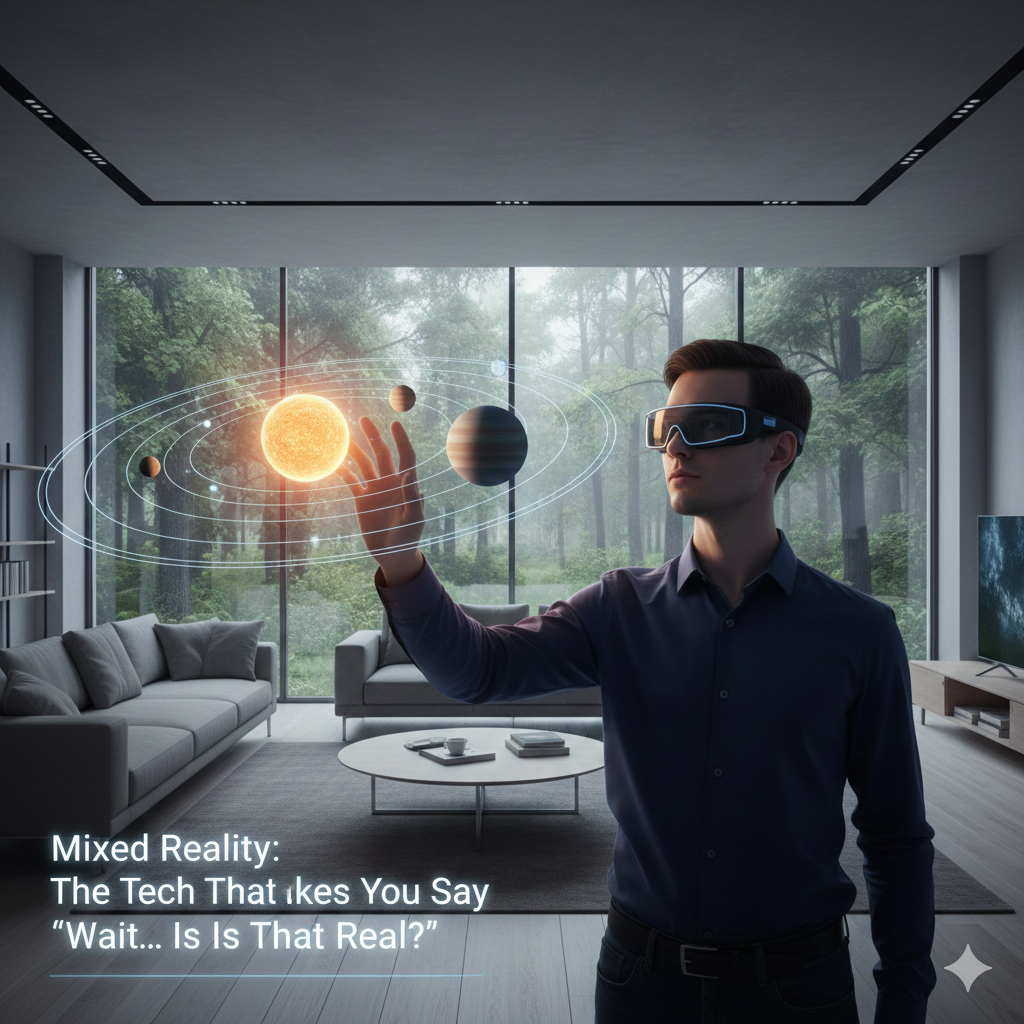
That’s why Mixed Reality is so interesting. Because the moment you experience it, you don’t feel like you’re using a gadget… you feel like you’ve stepped into a new kind of reality—one where the digital world finally stops living inside screens and starts living with you.
Mixed Reality (MR) is one of those rare technologies that doesn’t just improve something.
It changes the way you interact with the world.
And once you understand it properly, you’ll realize something important:
Mixed Reality isn’t a “trend.”
It’s the next natural step after mobile apps.
What Is Mixed Reality? :
Mixed Reality is a technology where the real world and the digital world blend together in a way that feels natural.
Not like a filter.
Not like a sticker.
Not like a random 3D object floating on your phone.
In Mixed Reality, digital objects feel like they actually belong in your space.
So instead of just seeing a digital object…
You can:
- walk around it
- look at it from different angles
- move it with your hands
- interact with it like it’s real
Think of it like this:
AR shows you something.
VR takes you somewhere.
MR brings something into your world.
And that’s why MR feels so powerful.
Mixed Reality vs AR vs VR :(The Easiest Explanation You’ll Ever Read):
If you’ve ever felt confused between AR, VR, and MR—don’t worry. Everyone does.
Here’s the easiest way to understand them:
AR (Augmented Reality):
AR is like putting digital makeup on the real world.
Example:
- Snapchat filters
- Instagram effects
- Pokémon GO
AR is fun, but the digital objects don’t truly interact with your environment. They mostly just “sit there.”
VR (Virtual Reality):
VR is like leaving Earth for a while.
You wear a headset and you’re inside a fully digital world.
Example:
- VR games
- VR training
- VR tours
It’s immersive, but you’re completely disconnected from your real surroundings.
MR (Mixed Reality):
Mixed Reality is like your real world becomes a stage.
Digital objects enter your space and behave realistically.
Example:
A digital robot walks across your real floor, hides behind your real sofa, and reacts when you move closer.
That’s Mixed Reality.
And once you see it, it feels like magic.
Why Mixed Reality Feels Like the Next Big Shift:
Let’s talk about why people are taking MR seriously.
Because the truth is… mobile apps are getting boring.
Not because they’re bad.
But because we’ve reached the stage where apps are everywhere. They load fast, look good, and do their job. Nothing feels surprising anymore.
Mixed Reality brings back that feeling of “Whoa…”
Because it makes technology feel less like something you stare at… and more like something you experience.
And that’s why many people call MR:
The next big shift after mobile apps.
Internal Link: If you want to explore that idea deeper, read:
Why Mixed Reality Is the Next Big Shift After Mobile Apps
How Mixed Reality Works (No Technical Headache):
Okay, I won’t bore you with heavy technical terms.
But here’s the simple version of what happens behind the scenes.
Mixed Reality devices use sensors, cameras, and smart software to understand your surroundings.
1) It Scans Your Space
The device understands where your floor is, where your walls are, and where your furniture is.
2) It Understands Depth
So if a digital object is behind your real chair, it actually appears behind it.
3) It Places Digital Objects Correctly
Not floating. Not shaky. Not random.
It places them in your space like they belong there.
4) It Lets You Interact
With hand tracking, controllers, voice commands, and sometimes even eye tracking.
And this is the part that makes MR feel so real.
Where Mixed Reality Is Actually Used (Not Just in Sci-Fi):
A lot of people think MR is just for gaming.
Gaming is definitely one part of it.
But the real power of Mixed Reality is how useful it is in industries where mistakes are expensive.
Let’s go through the real-world uses.
Mixed Reality in Education (Learning That Doesn’t Feel Like Studying):
Let’s be honest:
Most education still looks like this:
- textbooks
- lectures
- memorization
- exams
But humans don’t learn best that way.
We learn best by seeing, touching, and experiencing.
Mixed Reality makes education feel like discovery.
Real examples:
- Students exploring a 3D solar system in their classroom
- Medical students studying the human body in full 3D
- Engineering students examining machines without needing the physical equipment
Instead of imagining concepts, students can literally see them.
And that makes learning faster and more memorable.
Mixed Reality in Healthcare (Where Accuracy Matters):
Healthcare is one of the biggest MR game-changers.
Because in healthcare, the cost of mistakes is extremely high.
Surgery assistance
Doctors can view 3D scans and overlays while performing surgery.
Medical training
Students can practice procedures safely before working with real patients.
Patient education
Patients can understand their condition visually, instead of trying to decode medical language.
External Link: Microsoft’s official Mixed Reality solutions:
https://www.microsoft.com/hololens
Mixed Reality in Architecture & Real Estate (No More Guessing):
If you’ve ever looked at a building plan and thought:
“Okay… but I still can’t picture it.”
You’re not alone.
Mixed Reality makes architecture feel real before it’s built.
What MR helps with
- walking through a building before construction
- seeing interior designs in real scale
- testing furniture placement
- checking lighting and space
This reduces redesign costs and makes clients more confident.
Mixed Reality in Shopping & Retail (Buy Smarter, Return Less):
Online shopping is convenient.
But it also creates a problem:
You can’t always trust what you’re buying.
Mixed Reality solves that by letting you preview products in your real space.
Real examples
- placing a sofa in your room
- checking if a TV fits on your wall
- trying on glasses digitally
- previewing a watch on your wrist
It makes shopping feel less like guessing.
External Link: Meta Quest Mixed Reality official page:
https://www.meta.com/quest/
Mixed Reality in Manufacturing & Industry (The Practical Superpower):
This is where MR becomes less “cool” and more “seriously useful.”
Factories and industrial teams use MR for:
Step-by-step work guidance
Instructions appear in front of workers while they assemble parts.
Repair and maintenance support
Technicians can see exactly what to do without stopping work.
Remote expert help
An expert sitting in another city can guide a worker in real time.
This saves time, reduces errors, and improves safety.
Mixed Reality in Gaming (Where It Gets Wild):
Now yes… MR gaming is the part that makes people excited instantly.
Because it’s not like sitting on a sofa playing a game.
Your room becomes the game.
Imagine this
- your wall becomes a portal
- enemies hide behind your furniture
- your table becomes a battlefield
- you physically move to dodge and explore
It feels personal, active, and immersive.
And honestly?
It brings back that childhood feeling of wonder.
Why Businesses Are Taking Mixed Reality Seriously:
Businesses don’t invest in tech because it’s “cool.”
They invest because it saves money, time, and effort.
Mixed Reality helps businesses by improving:
Training
People learn faster by doing instead of reading.
Product visualization
Customers understand what they’re buying.
Collaboration
Teams can work together in shared 3D spaces even from different countries.
Efficiency
Less physical prototyping and fewer costly mistakes.
The Challenges of Mixed Reality (The Realistic Side):
Now let’s not pretend MR is perfect.
Mixed Reality still has challenges.
1) Headsets can be expensive
High-quality MR devices aren’t cheap yet.
2) Content creation requires skills
You need 3D designers and developers to build MR experiences.
3) Some users need time to adjust
Not everyone is comfortable wearing a headset at first.
But here’s the thing:
This is normal.
Every major technology starts like this.
Smartphones were expensive once.
Internet was slow once.
AI was confusing once.
MR is in that early stage right now.
Mixed Reality Devices You Should Know:
Some popular Mixed Reality devices include:
- Meta Quest (MR-enabled)
- Microsoft HoloLens
- Apple Vision Pro
External Link: Apple Vision Pro official page:
https://www.apple.com/apple-vision-pro/
Is Mixed Reality Really the Future?:
Yes.
But not in a “tomorrow everything changes” way.
Mixed Reality will grow the same way smartphones grew.
First:
- expensive
- niche
- mostly for tech lovers
Then:
- useful
- more affordable
- adopted by businesses
Then:
- normal
- everywhere
- part of daily life
And one day you’ll realize it became normal without you even noticing.
Internal Links :
To improve RankMath SEO, connect this blog to your related content:
- Internal Link: Artificial Intelligence (AI): A Super Human, No-Pressure Guide
- Internal Link: Virtual Reality (VR): What It Is and How It Works
- Internal Link: Why Mixed Reality Is the Next Big Shift After Mobile Apps
(Frequently Asked Questions) FAQ :
1) What is Mixed Reality in simple words?
Mixed Reality is when digital objects appear in your real environment and interact with it realistically.
2) Is Mixed Reality the same as AR?
No. AR adds objects to the real world, but MR makes them behave like they belong there.
3) Is Mixed Reality only for gaming?
No. MR is used in education, healthcare, retail, architecture, and manufacturing.
4) Do you need a headset for Mixed Reality?
For the best experience, yes. Headsets provide deeper immersion and better interaction.
5) What is the biggest benefit of Mixed Reality?
It makes learning, training, shopping, and collaboration more natural by blending digital content into real spaces.
Final Thoughts: Mixed Reality Isn’t a Buzzword, It’s a New Way of Living :
Mixed Reality is exciting because it doesn’t feel like technology is pulling you away from real life.
It feels like technology is stepping into real life.
It’s the kind of shift that doesn’t just improve apps.
It changes how humans interact with information.
Instead of reading about something…
You experience it.
And that’s why Mixed Reality isn’t just “the next big thing.”
It’s the next normal.
☎️ :919967940928
🌐:https://aibuzz.net/
Leave a Reply