Let’s be real.
Most people don’t wake up thinking,
“Hmm… I wonder how Virtual Reality works.”
But the moment you try VR for the first time, you instantly get why it’s such a big deal.
You put on the headset…
you look around…
and suddenly your brain goes:
“Okay, I’m not in my room anymore.”
That’s the magic of Virtual Reality.
VR isn’t just another gadget like a smartwatch or a fancy phone. It’s different because it doesn’t sit in your hand — it takes over your senses. And when a technology can do that, it stops being “technology” and starts feeling like an experience.
In this blog, we’re going to talk about VR like normal people — not like a textbook. You’ll learn what VR is, how it works, where it’s used, and why it’s growing so fast (even outside gaming).
What is Virtual Reality:(VR)?
Virtual Reality (VR) is a technology that creates a digital environment you can step into using a headset.
Instead of watching something on a screen, VR makes you feel like you’re inside the scene.
And yes — that “inside” part is the key.
The simplest way to understand VR
Imagine you’re watching a football match on TV.
Now imagine you’re standing on the field, hearing the crowd, seeing players run past you, and turning your head naturally to follow the ball.
That’s what VR does.
It turns content into an environment.
How Virtual Reality Works:(No boring explanation, I promise)
VR works by doing something your brain already does every day:
It combines sight, movement, and sound to understand reality.
VR just replaces the “real world” input with digital input.
1) The headset gives you a 3D world
A VR headset shows two images — one for each eye.
Your brain merges them and creates depth.
That’s why VR doesn’t feel flat like a video.
It feels like a space.
2) Motion tracking makes it feel real
This part is honestly the secret sauce.
The headset tracks your head movements.
So when you look left, the VR world moves left.
When you look up, the VR world moves up.
This tiny detail is what makes VR feel believable.
3) Controllers (or hand tracking) let you interact
Most VR systems come with controllers.
So you can:
- pick up objects
- open doors
- aim, shoot, throw
- press buttons
- draw or build
Some newer headsets don’t even need controllers. They track your hands directly, which feels even more natural.
4) 3D audio seals the deal
VR uses spatial audio, which means sound has direction.
If something speaks behind you, you’ll hear it behind you.
This is one of those details you don’t think about until you experience it — and then you realize how powerful it is.
Types of Virtual Reality :(Yes, there are different “levels”)
Not all VR experiences feel the same. Some feel like a basic simulation, and some feel like you teleported.
1) Non-Immersive VR
This is like VR-lite.
Example:
- a 3D simulation on a computer screen
- a training program on a monitor
It’s still virtual, but you’re not inside it.
2) Semi-Immersive VR
This is used a lot in professional training.
Example:
- flight simulators
- driving training systems
- military practice environments
You feel immersion, but not full headset-level immersion.
3) Fully Immersive VR
This is the one people get excited about.
You wear a headset, use controllers, and experience a full 360° environment.
This is the VR that makes people laugh, scream, and lose track of time.
VR vs AR vs MR :(Quick and clear)
People mix these up constantly, so let’s clear it up like a normal conversation.
Virtual Reality (VR)
You enter a digital world.
The real world disappears.
Augmented Reality (AR)
Digital objects appear in your real world.
Example: Snapchat filters, Pokémon Go.
Mixed Reality (MR)
Digital objects appear in your real world and interact with it.
Example: a virtual object sitting realistically on your table.
Internal link suggestion:
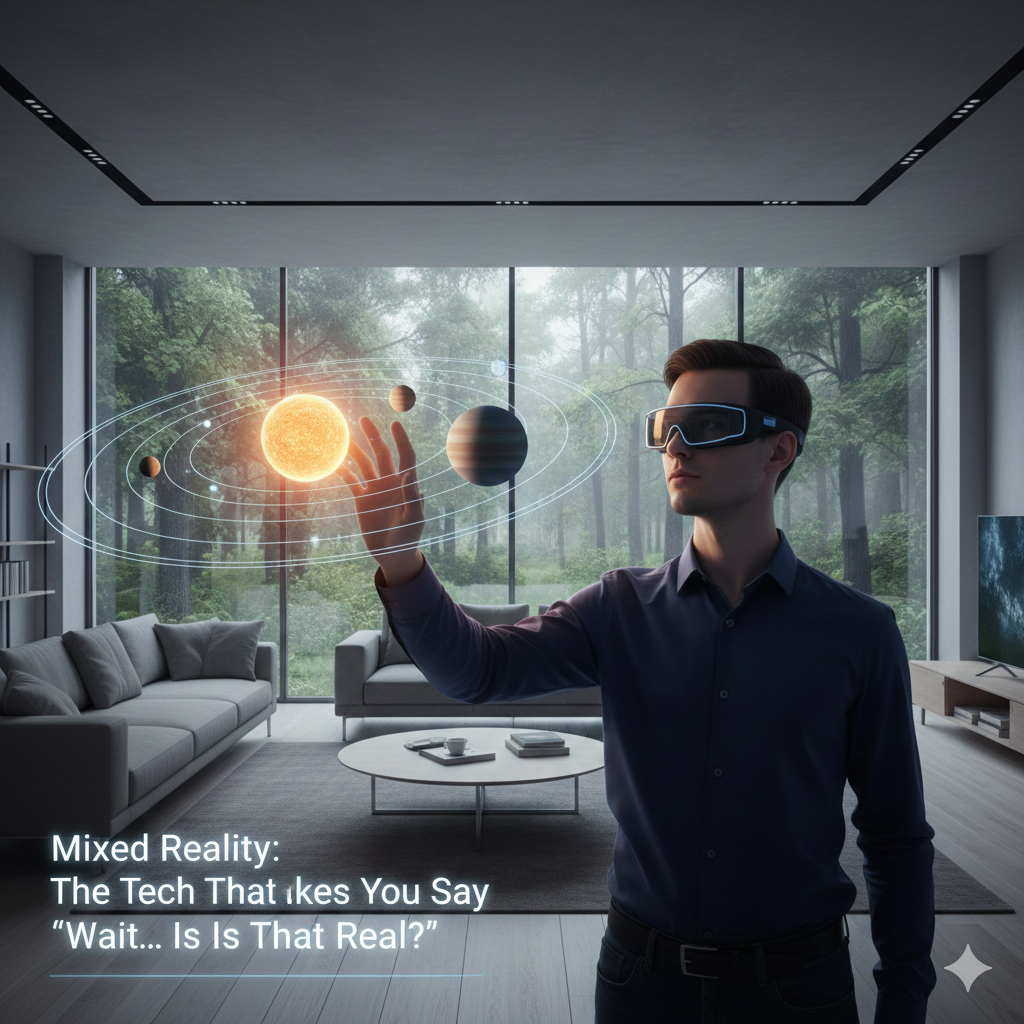
👉 Read also: Mixed Reality: The Tech That Makes You Say “Wait… Is That Real?”
(Perfect internal link for your website)
Where Virtual Reality is Used:(And yes, gaming is only one part)
If you think VR is only for games, you’re not alone.
But the truth is: gaming is just the loudest use case.
The biggest VR growth is happening in industries that don’t go viral on social media — like healthcare, education, and business training.
Let’s go through the real-world uses.
Virtual Reality in Education:(This is where VR shines)
Traditional learning is usually:
- reading
- listening
- memorizing
But VR makes learning feel like living.
Real examples of VR in education
Students can:
- explore the solar system in 3D
- visit historical places like the Taj Mahal or pyramids
- walk inside the human body to learn anatomy
- practice science experiments safely
And here’s the important part:
When students experience something, they remember it better.
That’s why VR in education is growing fast.
Virtual Reality in Healthcare :(The most meaningful use case)
VR in healthcare is not just impressive — it’s genuinely useful.
1) VR for surgical training
Doctors can practice complex procedures in VR.
No risk.
No real patient.
Just training until they get it right.
2) VR for therapy and mental health
VR is used in exposure therapy.
Example:
If someone has a fear of heights, VR can slowly help them face it.
It’s also used for:
- PTSD
- anxiety
- stress management
- fear of flying
- public speaking practice
3) VR for pain relief
This one surprises people.
Some hospitals use VR to distract patients during painful treatments. And it works because your brain can only focus deeply on so many things at once.
So when your brain is busy “being in a beach in VR,” it reduces focus on pain.
Virtual Reality in Gaming :(Still the biggest crowd-puller)
Okay, now let’s talk about the fun part.
VR gaming is popular because it changes the whole idea of gaming.
In traditional games, you control a character.
In VR?
You become the character.
That’s why VR horror games are terrifying.
That’s why VR sports games make you sweat.
That’s why VR shooting games feel way too intense sometimes.
VR gaming makes you feel like you’re inside the action — not just watching it.
Virtual Reality in Business :(The quiet revolution)
This is the part most people don’t realize:
Businesses love VR.
Not because it’s trendy — because it saves time, money, and mistakes.
VR is used for:
- employee onboarding
- safety training
- customer service practice
- factory simulations
- equipment handling training
Instead of training workers with manuals or videos, companies can put them in VR and let them practice safely.
This is huge for industries like:
- manufacturing
- aviation
- oil and gas
- construction
- logistics
Virtual Reality in Real Estate: (Tour homes without traveling)
VR is basically made for real estate.
Because property buying has one big problem:
People can’t visit every location.
With VR, customers can:
- walk through a home virtually
- explore rooms in 360°
- check the layout properly
- view apartments before they’re even built
For real estate companies, VR is a serious competitive advantage.
Virtual Reality in Retail and Shopping: (Still early, but coming)
VR shopping is not mainstream yet.
But it’s growing.
The idea is simple:
Instead of scrolling through product photos, you can walk through a virtual showroom and explore products like you’re physically there.
This is already being tested in:
- car showrooms
- furniture previews
- luxury retail
Benefits of Virtual Reality: (Why VR keeps growing)
VR is not growing just because it’s cool.
It’s growing because it solves real problems.
1) It makes training safer
You can practice risky tasks without risk.
2) It makes learning faster
People learn better through experience than reading.
3) It boosts engagement
VR removes distractions.
When you’re in VR, you’re in.
4) It saves money long-term
Yes, VR setup can be expensive.
But long-term, it reduces:
- travel costs
- repeated training expenses
- physical equipment damage
- training time
5) It creates unforgettable brand experiences
This is why VR is powerful for marketing too.
Limitations of Virtual Reality: (The honest side)
VR is amazing, but it still has issues.
1) Motion sickness
Some people feel dizzy.
This happens when your eyes feel movement but your body doesn’t.
2) Headsets can still be expensive
Prices are dropping, but good VR devices still cost money.
3) Content creation takes effort
VR experiences require:
- 3D design
- development
- testing
- optimization
4) VR needs physical space
Some VR experiences require room to move.
Not everyone has that.
Popular VR Headsets:(Most used today)
Here are the common VR headsets right now:
- Meta Quest
- PlayStation VR
- HTC Vive
- Valve Index
- Pico VR
For beginners, Meta Quest is usually the easiest option.
The Future of Virtual Reality :
We’re still early in VR.
And the next stage will be much bigger.
1) VR headsets will feel like glasses
They’ll become lighter, smaller, and more comfortable.
2) VR will look more realistic
Better displays and graphics will make VR worlds feel close to real life.
3) Full-body tracking will become common
Not just hands — legs and body movement too.
4) AI + VR will explode
AI will make VR worlds smarter.
Imagine:
- virtual teachers
- AI-powered training assistants
- NPCs that talk naturally
- VR characters that respond like humans
5) VR will become a normal tool
Just like smartphones became normal, VR will become normal too — for work, learning, and entertainment.
How Businesses Can Start Using Virtual Reality:
If you’re a business owner, VR can help you stand out — especially in 2026 and beyond.
Choose one goal
Start small.
Pick one:
- training
- marketing
- product demos
- virtual tours
Step 2: Choose a platform
Standalone VR headsets are easiest.
Step 3: Build your VR experience
This could be:
- a VR training simulation
- a virtual showroom
- an interactive demo
Step 4: Test comfort
Comfort matters more than graphics.
Frequently Asked QuestionsFAQ :
What is Virtual Reality in simple words?
Virtual Reality is a technology that lets you enter a digital world using a headset, making you feel like you’re actually inside it.
Is VR only for gaming?
No. VR is used in education, healthcare, business training, real estate, and therapy.
Can VR help in mental health?
Yes. VR is used for anxiety, PTSD, phobias, and stress therapy.
Does VR require internet?
Not always. Many VR apps work offline, but online VR games and updates require internet.
What’s the difference between VR and AR?
VR replaces the real world with a digital one. AR adds digital objects into the real world.
Rich Media Link :
🎥 Virtual Reality Explained (YouTube)
https://www.youtube.com/results?search_query=virtual+reality+explained
External Links :
- Meta Quest Official: https://www.meta.com/quest/
- Unity VR Development: https://unity.com/solutions/vr
- Unreal Engine VR: https://www.unrealengine.com/en-US
Internal Link Suggestions :
- Artificial Intelligence (AI): A Super Human, No-Pressure Guide
- Mixed Reality: The Next Big Shift After Mobile Apps
- Types of Artificial Intelligence: Narrow AI vs General AI vs Super AI
Final Thoughts: Why VR Actually Matters:
Virtual Reality is one of those technologies that doesn’t make sense until you try it.
And once you try it, you realize:
This isn’t just a gadget.
It’s a new way of experiencing the digital world.
VR is already changing how we learn, train, heal, shop, and entertain ourselves.
And as it gets cheaper, lighter, and smarter (especially with AI), it’s going to become part of normal life.
Not tomorrow.
But sooner than most people think.
☎️ : 919967940928
🌐 : https://aibuzz.net/