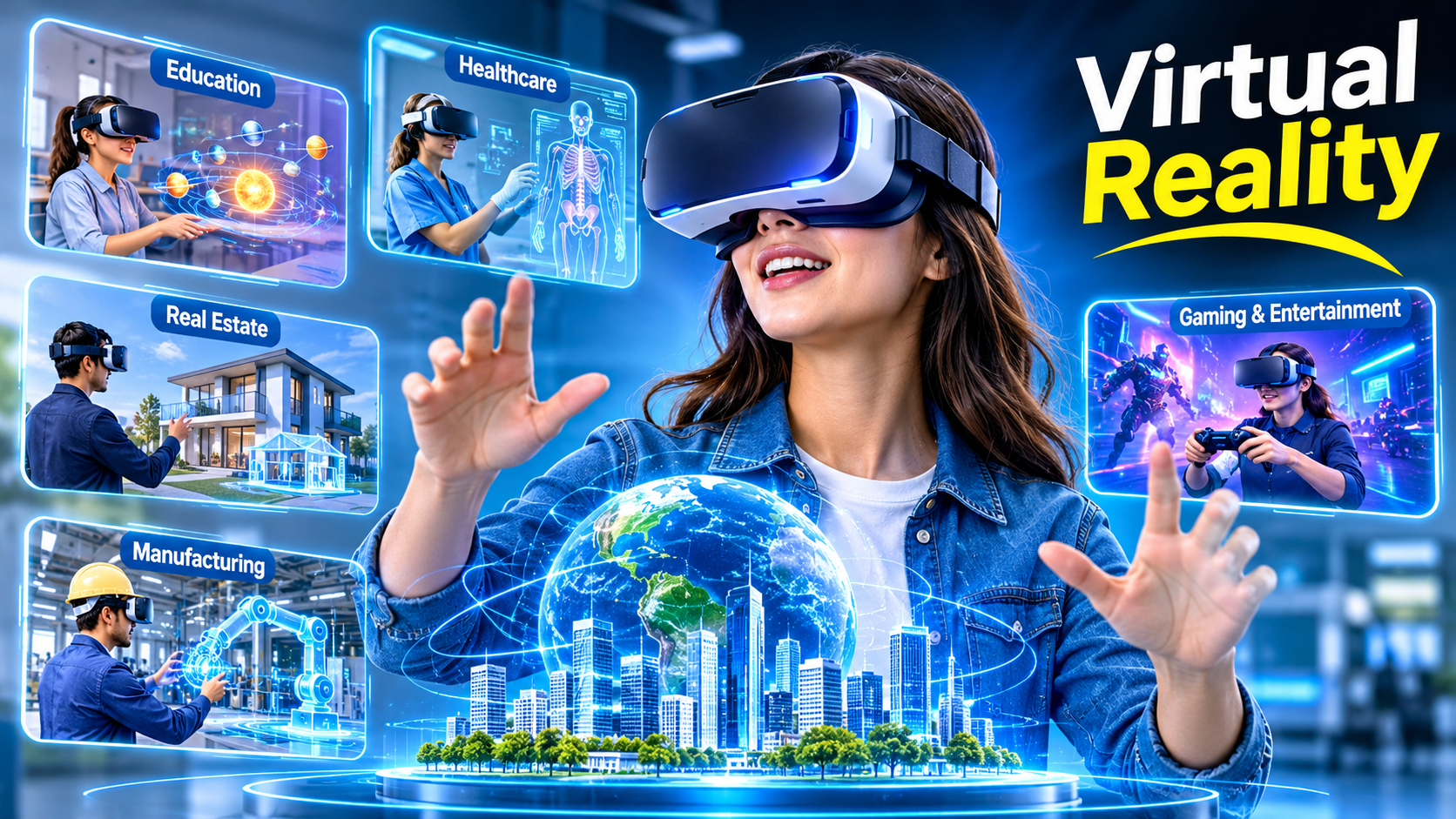
Virtual Reality (VR) is changing the way people interact with technology, learn new skills, experience entertainment, and conduct business. What once seemed like a concept from science-fiction movies has become a practical technology used across industries. From virtual classrooms and healthcare training to product demonstrations and immersive gaming, VR is creating experiences that go beyond traditional screens.
As businesses continue to adopt digital solutions, Virtual Reality is becoming an important tool for improving customer engagement, employee training, collaboration, and decision-making. It allows users to enter computer-generated environments, explore virtual spaces, and interact with digital objects as if they were physically present.
In this blog, we will explore what Virtual Reality is, how it works, its major applications, benefits, challenges, and what the future may look like for this growing technology.
What Is Virtual Reality? :
Virtual Reality is a technology that creates a computer-generated, three-dimensional environment where users can experience and interact with digital surroundings. Instead of simply watching content on a computer or mobile screen, users can enter a virtual environment through specialised equipment such as VR headsets, controllers, and motion-tracking sensors.
The main purpose of Virtual Reality is to create a sense of presence, making users feel as though they are inside a different environment.
For example, a student studying the solar system can use VR to explore planets in a simulated space environment. Similarly, an architect can present a virtual building where clients can walk through rooms before construction begins.
VR is not limited to entertainment. It is increasingly being used in professional training, education, healthcare, manufacturing, real estate, and other business applications.
How Does Virtual Reality Work? :
Virtual Reality combines hardware and software to create immersive digital experiences. These technologies work together to track user movements, display realistic environments, and support interaction.
1. VR Headsets and Displays
A VR headset is the primary device used to experience virtual environments. It contains displays and lenses that create a stereoscopic 3D view, giving users a sense of depth.
Modern headsets can also provide a wide field of view and high-resolution visuals, helping make virtual experiences more realistic.
2. Motion Tracking Sensors
Motion tracking allows the system to detect the user’s head, hand, and sometimes body movements. When users turn their heads, move their hands, or change their position, the virtual environment responds accordingly.
This interaction makes the experience feel more natural.
3. Controllers and Input Devices
VR controllers allow users to interact with digital objects. They can pick up virtual items, operate equipment, select menus, and perform other actions.
Some advanced systems also support hand tracking, allowing users to interact without holding physical controllers.
4. VR Software and 3D Environments
Specialised software creates the virtual world, including its objects, characters, lighting, sounds, and interactive features.
Game engines and 3D development tools help developers build realistic environments for training, education, simulation, and entertainment.
Major Applications of Virtual Reality Across Industries :
Virtual Reality is becoming useful in industries where visualisation, practical learning, and realistic simulations can improve everyday activities.
1. Virtual Reality in Education
Realidad Virtual en educación | Aprendizaje inmersivo y eficaz
Traditional learning methods often depend on textbooks, presentations, and videos. VR introduces an interactive approach that allows students to explore educational topics through immersive experiences.
Students can visit historical locations, examine the human body, explore the solar system, and understand scientific concepts in three dimensions.
Key applications include:
- Virtual science laboratories.
- Interactive history lessons.
- Medical and technical training simulations.
- Virtual field trips.
- Practical learning experiences.
VR can make complex subjects easier to understand by turning abstract information into visual experiences.
2. Virtual Reality in Healthcare
Customize Your Medical Training with the SimX Virtual Manikin Series | HealthySimulation.com
Healthcare is another important area where Virtual Reality is making a difference. Medical professionals can use VR simulations to practise procedures and develop practical skills in controlled environments.
It can also support certain rehabilitation programmes and supervised therapeutic experiences.
Key applications include:
- Medical education and surgical simulations.
- Rehabilitation exercises.
- Clinical skills training.
- Pain management support.
- Patient education.
VR provides opportunities to practise challenging situations without exposing patients to unnecessary training risks. Its effectiveness depends on the application, clinical evidence, and professional supervision.
3. Virtual Reality in Real Estate
VR & 3D Real Estate Walkthroughs in Dubai | Web3Interactive
Virtual Reality is changing how real estate businesses present properties to potential buyers and tenants.
Instead of visiting every property physically, customers can take virtual tours and explore rooms, layouts, and interiors through a VR headset or compatible digital platform.
Key applications include:
- Virtual property tours.
- Interior design visualisation.
- Architectural presentations.
- Property layout demonstrations.
- Remote customer experiences.
This technology helps customers understand a property’s design before making a purchasing or rental decision.
4. Virtual Reality in Manufacturing
Manufacturing companies can use VR to simulate production environments, train employees, and visualise equipment layouts before implementing changes.
Workers can practise operating machinery and responding to different situations in a virtual environment.
Key applications include:
- Employee safety training.
- Equipment operation simulations.
- Factory layout planning.
- Product design visualisation.
- Maintenance training.
By using virtual simulations, businesses can identify certain design and workflow issues earlier in the development process.
5. Virtual Reality in Gaming and Entertainment
Game On Simulations — Indoor Golf, Shooting & VR Simulators | Portage la Prairie
Gaming is one of the most recognised applications of VR. It allows players to become part of interactive digital worlds rather than controlling everything through a traditional screen.
Users can explore virtual locations, interact with characters, participate in simulations, and experience immersive storytelling.
Beyond gaming, VR is also being explored for virtual events, interactive exhibitions, digital tourism, and entertainment experiences.
6. Virtual Reality in Employee Training
Custom VR Training Programs for Enterprise Teams | The Prime VR
Businesses are increasingly exploring VR to train employees in realistic workplace situations. Instead of relying entirely on classroom sessions, organisations can create simulations that allow employees to practise tasks and improve their skills.
For example, aviation companies can use flight simulators, while industrial organisations can train workers to respond to equipment failures and workplace emergencies.
Key applications include:
- Workplace safety training.
- Customer service simulations.
- Leadership and communication training.
- Technical skill development.
- Emergency response practice.
This approach can help organisations provide repeatable training experiences while reducing the need to recreate expensive or potentially dangerous real-world situations.
Benefits of Virtual Reality for Businesses :
Virtual Reality offers several advantages when it is introduced with a clear business objective.
1. Better Customer Engagement
VR allows businesses to create interactive experiences that capture customer attention. Virtual product demonstrations and immersive brand experiences can help customers understand products and services more effectively.
2. Improved Learning and Training
Employees and students can learn through practical simulations rather than depending only on theoretical explanations. They can repeat activities and receive feedback in a controlled environment.
3. Reduced Training Risks
Some activities involve expensive equipment or potentially dangerous situations. Virtual simulations allow users to practise selected tasks without exposing themselves to the same physical risks.
4. Better Product Visualisation
Businesses can present products, buildings, and designs in three dimensions. Customers can explore different features before making decisions.
5. Remote Collaboration
Virtual environments can bring geographically separated teams together. Participants can explore digital spaces, discuss designs, and work with shared 3D objects.
Challenges and Limitations of Virtual Reality :
Although VR has significant potential, businesses should understand its limitations before investing in the technology.
- High initial investment: VR headsets, software development, and implementation can require considerable investment.
- Technical requirements: High-quality experiences may need powerful hardware, reliable connectivity, and specialised development skills.
- User discomfort: Some people experience eye strain, dizziness, or motion sickness during VR sessions.
- Privacy and security: Motion tracking and other collected data can create privacy and cybersecurity concerns.
- Content development: Creating realistic and useful virtual environments requires time, technical expertise, and ongoing maintenance.
Businesses should evaluate these challenges and identify applications where VR offers measurable value. The OECD also discusses these opportunities and risks in its Virtual Reality and Its Opportunities and Risks report.
The Future of Virtual Reality :
The future of Virtual Reality will be influenced by improvements in artificial intelligence, 3D graphics, cloud computing, connectivity, and wearable technology.
Some important developments to watch include:
AI-Powered Virtual Experiences
Artificial Intelligence can help create more responsive virtual environments, intelligent virtual characters, and personalised learning experiences.
More Realistic Environments
Improvements in display quality, motion tracking, and spatial audio will help developers create more natural and immersive experiences.
VR and Digital Twins
Digital twins can represent real-world products, buildings, or industrial systems in digital environments. When combined with VR, they allow teams to visualise and explore these models interactively.
Virtual Business Experiences
Companies may increasingly use VR for product demonstrations, employee onboarding, customer experiences, and collaborative design.
However, the future of VR will depend not only on technological improvements but also on affordability, accessibility, user safety, and practical business value.
Internal Links :
Add relevant internal links within your website:
External Links :
For additional information and credibility, include these authoritative resources:
- OECD – Virtual Reality: Opportunities and Risks
- European Commission – Extended Reality
- U.S. Government Accountability Office – Immersive Technologies
Rich Media Link :
Include this research resource to provide readers with additional information:
– European Commission – Extended Reality: Opportunities, Success Stories and Challenges
You can also embed a relevant VR demonstration video from YouTube to make the article more engaging.
Frequently Asked Questions (FAQs) :
1. What is Virtual Reality in simple words?
Virtual Reality is a technology that creates a computer-generated 3D environment where users can interact with digital objects and experience simulated surroundings using a VR headset or compatible device.
2. What are the main uses of Virtual Reality?
VR is used in education, healthcare, gaming, real estate, manufacturing, employee training, architecture, and entertainment.
3. How does Virtual Reality work?
VR uses headsets, displays, motion sensors, controllers, and specialised software to create interactive digital environments that respond to the user’s movements.
4. What are the benefits of Virtual Reality in business?
VR can improve customer engagement, support employee training, enhance product visualisation, reduce certain training risks, and enable immersive collaboration.
5. Is Virtual Reality useful for education?
Yes. VR can help students explore complex subjects through interactive simulations, virtual laboratories, historical environments, and three-dimensional learning experiences.
Conclusion :
Technology should solve real problems and create meaningful experiences. At Aibuzz, we focus on IT and technology solutions that help businesses explore digital opportunities and improve the way they operate.
From software development and Artificial Intelligence to Virtual Reality and Mixed Reality solutions, businesses can explore innovative ways to connect with customers, improve workflows, and support digital transformation.
Whether you are considering an immersive product demonstration, a virtual training environment, or a customised digital experience, choosing the right technology and development approach is essential.
Explore Aibuzz’s technology services at Aibuzz.
📞 Contact: 919967940928
🌐 Visit: http://aibuzz.net
Leave a Reply