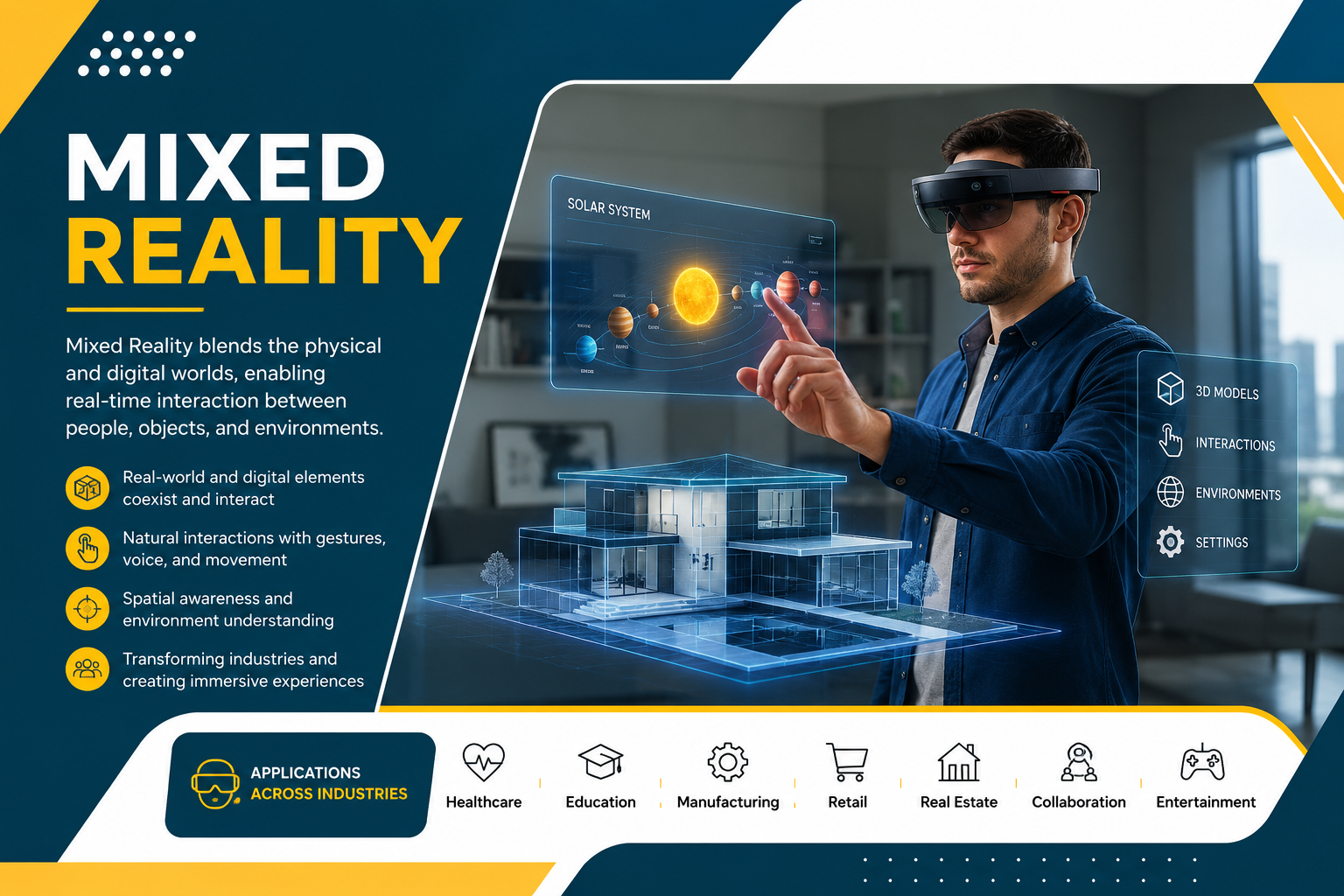
Technology is moving at a breakneck pace. Over the last decade, we have watched Artificial Intelligence, Virtual Reality (VR), and Augmented Reality (AR) leap from the pages of science fiction right into our daily lives.
But among these innovations, Mixed Reality (MR) stands out as the true game-changer. It isn’t just an upgrade to how we view screens—it is completely redefining how we interact with the world around us as part of a wider digital transformation across enterprise workflows.
Imagine slipping on a pair of sleek glasses and watching a digital engine blueprint appear on your physical desk. You don’t just look at it; you can reach out, turn a virtual gear with your fingers, and watch the physical shadows adjust accordingly. Unlike VR, which cuts you off from reality, or AR, which simply places flat data on top of your view, Mixed Reality flawlessly merges both worlds into a single, interactive sandbox.
From operating rooms and classrooms to factory floors and retail spaces, MR is quietly spark-plugging an industry revolution. Let’s dive into how it works, why it matters, and where it’s taking us.
Stripping Down the Tech: What Exactly is Mixed Reality? :
At its core, Mixed Reality (MR) is a technology that weaves physical environments and digital content together so seamlessly that they can interact with one another in real time.
In an MR space, you aren’t just a passive observer. You can:
- Contextualize: See virtual objects sitting naturally on top of your real coffee table.
- Interact Naturally: Use your actual hands, voice commands, or natural eye movements to manipulate data.
- Navigate Freely: Walk around a digital statue and view it from different angles, just as if it were carved out of real marble.
The Reality-Virtuality Continuum
To see where MR fits, it helps to look at the broader spectrum of immersive tech:
| Technology | What It Does | Everyday Example |
| Virtual Reality (VR) | Completely replaces your real-world surroundings with a 100% digital environment. Check out our Virtual Reality Development page to see how this builds fully enclosed digital spaces. | Immersive gaming headsets like the Meta Quest. |
| Augmented Reality (AR) | Overlays static digital text or graphics onto your real-world view without spatial context. Learn more about simple overlays via our Augmented Reality Development guidelines. | Pokémon GO or Instagram face filters. |
| Mixed Reality (MR) | Blends real and digital worlds so they can interact dynamically. | A virtual anatomy model reacting to a surgeon’s hands. |
The Magic Behind the Curtain: How MR Works :
Achieving this level of realism requires a complex symphony of hardware and software working together at lightning speed.
1. Spatial Mapping & Computer Vision
Before an MR device can place a digital object, it has to understand your room. It uses advanced computer vision to scan and recognize walls, floors, couches, and even minor obstacles. This ensures a virtual glass doesn’t clip through your solid wooden table.
2. High-Tech Sensors and Cameras
MR devices are packed to the brim with depth sensors, infrared cameras, and motion trackers. They continuously track your head movements and eye positioning so the digital world shifts instantly as you move—eliminating lag and motion sickness.
3. Artificial Intelligence & Real-Time Rendering
AI acts as the brain of MR, handles object recognition, and interprets your voice or hand gestures. Simultaneously, powerful graphic engines render those 3D visuals on the fly. Developers typically construct these responsive environments using major rendering platforms like Unity or Unreal Engine.
Real-World Applications: Out of the Lab, Into the Wild :
Mixed Reality is no longer just a cool demo at a tech convention. It is actively solving high-stakes problems across global industries today.
🩺 Healthcare & Life Sciences :
- Precision Surgery: Surgeons can overlay 3D holographic scans of a patient’s specific anatomy directly onto their body during a procedure, significantly reducing operating risks.
- Risk-Free Training: Medical students can practice complex, rare surgeries thousands of times on digital twins before ever touching a scalpel.
🏭 Manufacturing & Industry 4.0 :
- Hands-Free Guidance: Field technicians working on complex machinery can view step-by-step digital repair manuals overlaid directly onto the parts they are fixing, keeping their hands free to work.
- Smart Prototyping: Automotive and aerospace engineers can test aerodynamic designs on virtual car models without building expensive physical prototypes.
🛍️ Retail & Real Estate :
- “Try Before You Buy”: Customers can see exactly how a couch looks in their living room, or virtually try on clothing items that adapt to their body shape via high-performance Mobile App Development solutions.
- Virtual Open Houses: Homebuyers can walk through properties across the globe, toggling different paint colors or furniture layouts in real-time.
Watch it in Action :
To truly grasp how these components mesh together on the business floor, check out this video explainer by Microsoft outlining how modern spatial computing works in real-world professional environments:
👉 Watch “What is Mixed Reality?” by Microsoft on YouTube (Note: Replace with your embedded YouTube video player layout if your CMS supports direct iframe embeds)
The Business Case: Why Companies are Investing Heavily :
The ROI of Mixed Reality goes far beyond the “cool factor.” According to structural analysis from organizations like the World Economic Forum, immersive technologies are rapidly shifting from novelty to necessity.
Massive Cost Savings: By replacing physical prototypes and reducing corporate travel through immersive workspaces, businesses cut overhead dramatically.
Accelerated Training: Employees learn hands-on skills up to four times faster than in standard classrooms, with much higher knowledge retention.
Minimized Human Error: Giving assembly line or maintenance workers real-time, visual checkpoints drastically reduces costly mistakes.
Organizations looking to implement these tech stacks often pair them with flexible Cloud Computing Solutions to handle heavy processing workloads remotely, keeping onsite hardware requirements minimal and scalable.
The Roadblocks: What’s Holding MR Back? :
While the potential is massive, it isn’t entirely smooth sailing just yet. Mass adoption still faces a few speed bumps:
- Hardware Form Factors: Many high-end MR devices, such as the Microsoft HoloLens, are still relatively bulky and carry an enterprise price tag.
- Data & Privacy: Because MR devices must constantly scan your surroundings to work, they raise valid questions about data privacy and how environmental maps are stored.
- Development Complexity: Creating high-fidelity, interactive 3D assets requires specialized talent. Navigating these requirements successfully typically demands expert IT Consulting Services and tailored Software Development Services to ensure smooth systems integration.
Frequently Asked Questions (FAQs) :
What is the main difference between AR and MR?
Think of Augmented Reality (AR) as a sticker placed on a window—it sits on top of your vision but doesn’t interact with the outside world. Mixed Reality (MR) is like a hologram that knows the window is there; it can sit on the windowsill, cast a shadow, and be blocked if someone walks in front of it.
Do I need a headset to experience Mixed Reality?
Currently, the most immersive MR experiences require specialized headsets. However, advanced smartphone platforms are increasingly capable of entry-level MR experiences through advanced spatial computing applications.
Where can I read more about the enterprise impact of emerging software models?
For a deeper conceptual look at how data and immersive logic merge across modern tech frameworks, explore research topics such as IBM Emerging Technologies to see how big data informs interactive design.
Final Thoughts :
The line between our physical reality and the digital universe is permanently blurring. Mixed Reality isn’t just a new medium; it’s the next paradigm shift in human-computer interaction. For forward-thinking businesses, the message is clear: the early adopters of today will be the market leaders of tomorrow.
☎️ 919967940928
🌐 https://aibuzz.net/
Leave a Reply