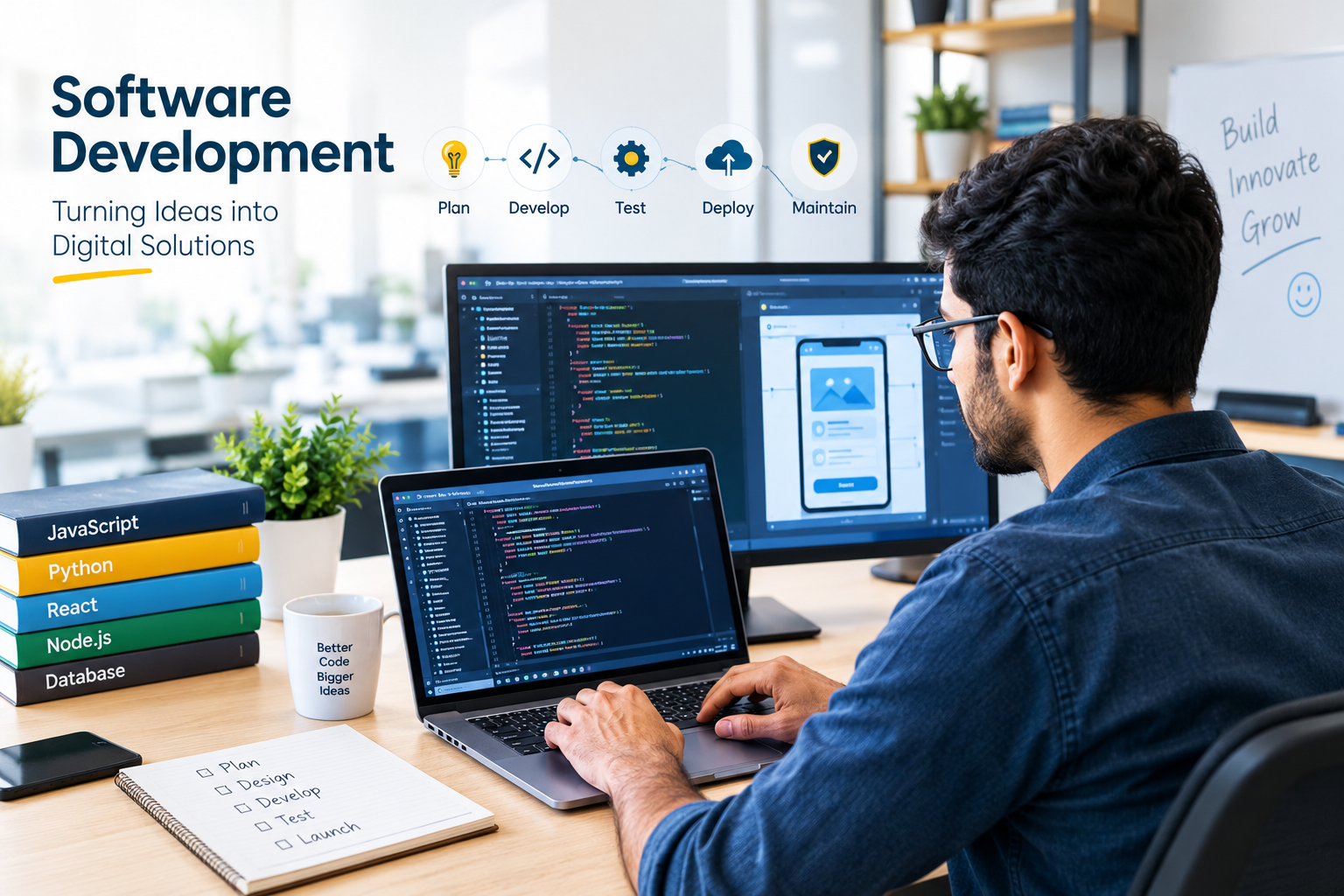
Software development is no longer limited to writing code. It is about understanding people’s needs, solving everyday problems, and creating digital products that make work easier. From business websites and mobile applications to advanced AI-powered platforms, software helps organizations improve their services and reach more people.
In this guide, we will explore what software development means, how the development process works, which technologies are commonly used, and why choosing the right development approach matters for long-term business growth.
What Is Software Development? :
Software development is the process of planning, designing, building, testing, deploying, and maintaining computer programs and applications. These applications help individuals and businesses perform tasks, manage information, communicate, and solve specific problems.
For example, an online shopping application allows customers to browse products, place orders, and make payments. A business management system helps employees organize records, track operations, and prepare reports. Both are examples of software developed to meet particular needs.
Good software development starts with a clear understanding of the problem. Developers then choose suitable technologies and build a solution that is reliable, secure, and easy to use.
Why Is Software Development Important for Businesses? :
Almost every industry now depends on digital tools to manage its daily activities. Software development helps businesses improve their operations, serve customers more effectively, and adapt to changing expectations.
1. Improves Business Efficiency
Many businesses spend valuable time on repetitive tasks such as entering data, preparing reports, and managing records. Custom software can automate these activities, reduce manual effort, and allow employees to focus on more important work.
2. Enhances Customer Experience
Customers expect digital services to be convenient, responsive, and easy to navigate. Well-designed websites, mobile applications, and customer portals help people find information, purchase products, and receive support without unnecessary complications.
3. Supports Business Growth
As a company grows, its operational needs become more complex. Scalable software can support additional users, larger amounts of data, and new features without requiring an entirely new system every time the business expands.
4. Strengthens Data Management
Software helps businesses collect, organize, and analyze information in a structured way. When supported by appropriate access controls and security measures, these systems can improve decision-making while protecting sensitive business information.
5. Creates Opportunities for Innovation
Businesses can use modern software to introduce new services, improve existing products, and explore technologies such as artificial intelligence, cloud computing, and data analytics.
Types of Software Development :
Software development covers several areas, and each serves a different purpose. Understanding these categories helps businesses identify the right solution for their requirements.
Web Development
Web development involves creating websites and web applications that people access through internet browsers. Examples include company websites, e-commerce stores, booking platforms, and online dashboards.
Front-end development focuses on the parts users see and interact with. Back-end development handles server-side logic, databases, authentication, and other functions that keep an application running.
Mobile App Development
Mobile app development focuses on applications designed for smartphones and tablets. Businesses use mobile apps for online shopping, customer engagement, bookings, communication, and service delivery.
Developers may create separate native applications for Android and iOS or use cross-platform technologies to share much of the same code across both platforms.
Custom Software Development
Custom software development involves building applications around the specific requirements of an organization. Instead of forcing a business to adapt to a generic tool, developers design features and workflows that match its operations.
Examples include inventory management systems, employee management platforms, customer relationship management tools, and industry-specific business applications.
Enterprise Software Development
Enterprise software supports the complex operations of medium-sized and large organizations. These systems may connect departments, manage large databases, automate workflows, and integrate with existing business platforms.
AI-Powered Software Development
AI-powered software uses artificial intelligence to support tasks such as analyzing information, recognizing patterns, generating content, and assisting with decisions. Examples include intelligent chatbots, recommendation systems, and automated document processing tools.
AI features should be selected according to a real business need, with suitable testing, privacy safeguards, and human oversight.
The Software Development Life Cycle (SDLC) :
The Software Development Life Cycle, commonly known as SDLC, is a structured approach to building and maintaining software. It helps teams organize their work, manage risks, control costs, and deliver a product that meets user expectations. Although the exact process varies between projects, most development teams follow these key stages.

AWS
1. Requirement Analysis
The first step is understanding what the software needs to achieve. Developers and business stakeholders discuss the target audience, required features, budget, project timeline, and technical limitations.
Clear requirements help prevent confusion and reduce expensive changes later.
2. Planning and Design
During this stage, the team selects suitable technologies, defines the system architecture, plans the database, and creates interface designs.
Designers may prepare wireframes or prototypes so stakeholders can understand how the application will look and work before development begins.
3. Coding and Development
Developers turn the approved design into working software using appropriate programming languages, frameworks, and development tools. They may divide the project into smaller tasks to make progress easier to manage.
Writing readable, well-organized code makes future updates and troubleshooting easier.
4. Software Testing
Testing checks whether the application works as expected. Developers and quality assurance professionals look for errors, security weaknesses, performance issues, and usability problems.
Testing may include unit testing, integration testing, system testing, and user acceptance testing. Finding issues early usually makes them easier and less expensive to fix.
5. Deployment
Once the software meets the agreed requirements, it can be released to users. Deployment may involve configuring servers, preparing databases, setting up access permissions, and moving the application into a production environment.
A planned release helps reduce disruption and makes it easier to respond if something goes wrong.
6. Maintenance and Improvement
Software development does not end when an application goes live. Teams monitor performance, fix bugs, install security updates, and introduce improvements based on user feedback.
Regular maintenance helps software remain useful as business requirements, technology, and security risks change.
Popular Technologies Used in Software Development :
The technologies used in a project depend on its purpose, complexity, performance requirements, and budget.
- Programming languages: Python, JavaScript, Java, C#, and PHP are used for different types of applications.
- Front-end technologies: HTML, CSS, and JavaScript help developers build interactive websites and user interfaces.
- Back-end technologies: Node.js, Django, Laravel, and Spring support application logic, APIs, and server-side operations.
- Databases: PostgreSQL, MySQL, and MongoDB help store and manage application data.
- Cloud platforms: Services such as AWS and Microsoft Azure support hosting, infrastructure, storage, and deployment.
- Development and collaboration tools: Git and platforms such as GitHub help teams track code changes and collaborate efficiently.
There is no single technology stack that suits every project. The best choice depends on the application’s requirements, available expertise, integration needs, and expected growth. Beginners can explore the
developer.mozilla.org to understand web technologies and development fundamentals.
MDN
Best Practices for Successful Software Development :
A good development process requires more than technical skills. Teams also need consistent standards, communication, and a clear understanding of the people who will use the product.
Prioritize Security
Security should be considered from the beginning rather than added only before launch. Use appropriate authentication, access controls, secure data handling, dependency updates, and regular security testing.
Design for Users
An application should be understandable and accessible to its intended audience. Simple navigation, clear messages, responsive layouts, and useful feedback can make a significant difference to the user experience.
Follow an Agile Approach Where Appropriate
Agile development breaks work into smaller cycles and encourages frequent feedback. This approach can help teams adapt to changing requirements and deliver useful improvements incrementally.
Maintain Code Quality
Code reviews, automated tests, documentation, and version control help teams identify problems and manage changes. These practices become particularly valuable when several developers work on the same project.
Plan for Scalability
Developers should consider how the application may grow over time. A thoughtful architecture can make it easier to add features, support more users, and integrate new services without unnecessary complexity.
How to Choose the Right Software Development Partner :
Choosing a development partner is an important decision, especially when the software supports essential business operations.
Before starting a project, review the provider’s experience, previous projects, technical capabilities, communication process, and approach to security. Ask how requirements will be documented, how progress will be reported, and how testing will be handled.
It is also important to discuss ownership of source code, project documentation, maintenance responsibilities, future updates, and ongoing costs. A reliable partner should explain technical decisions clearly and help you understand the trade-offs between different solutions.
If your business needs a tailored digital solution, explore
aibuzz.net and its technology services. Discuss your goals and operational challenges before deciding which development approach is most suitable.
The Future of Software Development :
Software development continues to evolve as businesses adopt AI tools, cloud-based platforms, automation, and connected digital services.
AI-assisted coding can help developers draft code, explain unfamiliar functions, and identify potential issues. However, generated code still requires review and testing. Human judgment remains important for understanding requirements, designing systems, checking security, and making responsible decisions.
Cloud-native development also allows organizations to build applications that can scale according to demand. Meanwhile, low-code and no-code tools can help teams create certain applications faster, although complex requirements may still need conventional programming.
The future is not simply about writing code faster. It is about building software that solves meaningful problems, protects users, and remains adaptable as needs change.
Internal, External, and Rich Media Links :
Internal links :
External links :
Rich media link :
Frequently Asked Questions (FAQs) :
1. What is software development in simple words?
Software development is the process of creating, testing, launching, and maintaining computer programs, websites, and applications that help people solve problems or complete tasks.
2. What are the main stages of software development?
The main stages are requirement analysis, planning and design, coding, testing, deployment, and maintenance. Teams may repeat some stages as they improve the product.
3. Which programming language is best for software development?
There is no single best programming language. Python is popular for automation and AI, JavaScript is widely used for web development, and Java and C# are common choices for business applications. The right language depends on the project.
4. How long does software development take?
The timeline depends on the application’s complexity, features, integrations, team size, and testing requirements. A simple application may take weeks, while a complex enterprise platform may require several months or longer.
5. Why is custom software development useful for businesses?
Custom software can match specific business workflows, integrate with existing systems, automate repetitive tasks, and support future growth.
Conclusion :
Software development is an essential part of modern digital transformation. It enables businesses to improve efficiency, provide better customer experiences, manage information, and introduce new services.
Successful software begins with a clear problem and a practical plan. By selecting appropriate technologies, following a structured development process, prioritizing security, and listening to users, organizations can build digital solutions that deliver lasting value.
📞 Contact: 919967940928
🌐 Visit: http://aibuzz.net
Leave a Reply