Introduction
Every day, businesses generate enormous amounts of data through customer interactions, online purchases, applications, websites, and internal operations. But collecting information is only the beginning. The real challenge is making sure that data reaches the right place, in the right format, and at the right time.
Imagine running an online store where customer orders, payment records, inventory details, and sales reports are stored in separate systems. If employees have to transfer information manually, even a small mistake can lead to incorrect reports, delayed orders, or unhappy customers.
This is where TD Pipeline Development becomes valuable.
A well-designed data pipeline connects different systems and automates the movement of information between them. It helps businesses organize data, reduce repetitive work, and make better use of the information they already have.
In this guide, we will explore what TD Pipeline Development means, how it works, its key benefits, and why it matters for modern businesses.
What Is TD Pipeline Development?
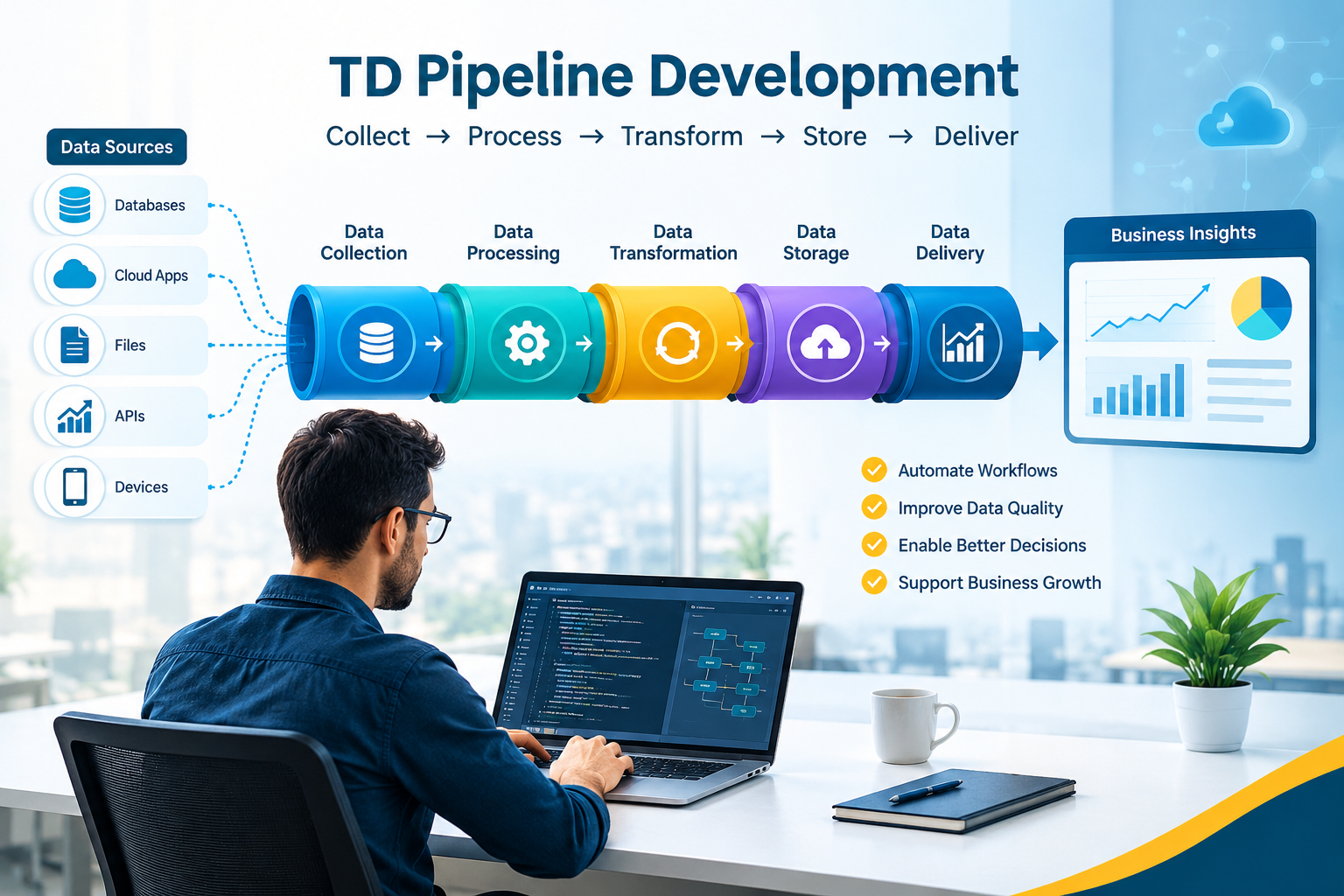
TD Pipeline Development, in the context of technical data systems, refers to designing and building automated workflows that collect, process, transform, and deliver data from different sources to specific destinations.
Think of a data pipeline as a delivery network. Information is collected from one location, checked and organized along the way, and delivered where it is needed.
For example, a business might collect information from its website, customer relationship management software, payment system, and marketing campaigns. A pipeline can bring this information together and prepare it for reporting or analysis.
A typical data pipeline includes:
- Data collection: Gathering information from different sources.
- Data processing: Cleaning and preparing the collected information.
- Data transformation: Converting data into a useful and consistent format.
- Data storage: Saving processed information in a database or data warehouse.
- Data delivery: Making information available to applications, dashboards, analysts, or AI systems.
- Monitoring: Checking whether the pipeline is working correctly.
The exact design depends on the organization’s needs, the volume of information involved, and how quickly the data must be available.
Why Is TD Pipeline Development Important?
Businesses often have plenty of data but struggle to use it effectively. Information may be scattered across different applications, stored in inconsistent formats, or updated at different times.
A properly developed pipeline helps solve these problems by creating a more organized flow of information.
1. Reduces Manual Work
Employees should not have to spend hours copying information between spreadsheets or applications when the process can be automated.
Data pipelines can handle repetitive tasks such as importing records, updating databases, and preparing reports. This allows teams to spend more time analyzing information and solving business problems.
2. Improves Data Quality
Incorrect or incomplete information can lead to poor decisions. A pipeline can include validation rules to identify missing fields, duplicate records, and unexpected values before the data reaches its destination.
Although automation cannot guarantee perfect data, it makes quality checks more consistent and easier to manage.
3. Supports Better Decision-Making
When information is organized and available on time, businesses can understand what is happening across their operations.
For instance, a sales team can compare revenue across different periods, identify popular products, and monitor customer purchasing patterns using information collected from several systems.
4. Makes Business Growth Easier
As an organization grows, its data volume and technical requirements usually increase. A pipeline designed with scalability in mind can accommodate additional sources, larger datasets, and new applications without requiring the entire system to be rebuilt.
How Does a Data Pipeline Work?
The process may look complicated at first, but the basic idea is straightforward.
Step 1: Collect Data From Different Sources
The pipeline begins by gathering information from sources such as websites, business applications, APIs, databases, and connected devices.
The data may be structured, like a spreadsheet, or unstructured, like text messages and log files.
Step 2: Clean and Validate the Data
Raw information often contains duplicate entries, missing values, or inconsistent formats.
The pipeline checks the information and applies suitable rules before moving it forward. For example, it might standardize date formats or flag customer records that are missing essential details.
Step 3: Transform and Organize Information
Next, the system converts data into a format that the receiving application can understand.
This could involve combining records, calculating totals, categorizing transactions, or joining information from different databases.
Step 4: Store or Deliver the Processed Data
Once prepared, the data can be sent to a data warehouse, database, analytics platform, or business application.
The destination depends on how the information will be used.
Step 5: Monitor Performance
A reliable pipeline needs regular monitoring. Teams should be able to identify failed jobs, delayed updates, processing errors, and unusual changes in data volume.
Monitoring helps technical teams investigate problems before they affect important business operations.
Types of Data Pipelines
Not every business needs the same pipeline. The right approach depends on the speed, complexity, and purpose of data processing.
Batch Data Pipelines
Batch pipelines process information at scheduled intervals. For example, a company might collect daily sales records and generate a consolidated report every night.
This approach works well when information does not need to be updated immediately.
Real-Time Data Pipelines
Real-time pipelines process incoming information continuously or with very low delays.
They can support use cases such as transaction monitoring, live dashboards, fraud detection, and operational alerts.
However, real-time processing often requires more complex infrastructure and monitoring.
Cloud-Based Data Pipelines
Cloud-based pipelines use cloud infrastructure and managed services to collect, process, and store information.
They can help businesses scale resources according to demand and reduce the need to maintain all processing infrastructure on-site. Costs, security, and service dependencies still need careful management.
Technologies Used in TD Pipeline Development
Building a data pipeline usually involves several technologies working together.
- Python: Useful for data processing, automation, and custom scripts.
- SQL: Helps retrieve, transform, and analyze data in relational databases.
- Apache Airflow: Supports the scheduling, orchestration, and monitoring of workflows.
- Apache Spark: Helps process large datasets across distributed computing environments.
- Cloud platforms: Services from AWS, Microsoft Azure, and Google Cloud can support data storage, processing, and integration.
- APIs: Allow applications to exchange information and connect different systems.
The best technology stack depends on the project. A small business may need only a database, a few scripts, and scheduled tasks, while a larger organization may require distributed processing and advanced orchestration.
Common Challenges in TD Pipeline Development
Developing a pipeline is not simply a matter of connecting two systems. Several practical challenges need attention.
Managing Different Data Formats
Information from different sources may use different naming conventions, structures, or formats. Clear transformation rules and data standards help make the information consistent.
Maintaining Data Security
Pipelines may process customer information, financial records, or other confidential data. Appropriate access controls, encryption, secure credentials, and retention policies are essential.
Handling Failures
A source system may become unavailable, a file may arrive late, or an API may temporarily stop responding. Retry mechanisms, error alerts, and recovery procedures help prevent small failures from becoming larger disruptions.
Controlling Costs and Performance
Processing unnecessary data or running inefficient queries can increase infrastructure costs. Regular performance reviews help identify bottlenecks and opportunities for improvement.
Best Practices for Successful Pipeline Development
A dependable pipeline begins with a clear understanding of the business problem.
Before development starts, identify where the data comes from, who will use it, and how quickly it needs to be available.
Then follow these practices:
- Start with a clear objective. Define the business outcome before choosing tools.
- Build in manageable stages. Test a small workflow before expanding it.
- Validate data at important stages. Check completeness, consistency, and accuracy.
- Automate carefully. Include error handling, retries, and notifications.
- Protect sensitive information. Apply suitable security controls throughout the pipeline.
- Document the workflow. Make it easier for team members to understand and maintain the system.
- Monitor and improve continuously. Review performance as data volume and business needs change.
These practices help create pipelines that are easier to maintain, troubleshoot, and expand.
The Future of TD Pipeline Development
Data systems continue to evolve as businesses adopt cloud computing, advanced analytics, and artificial intelligence.
AI applications depend on suitable data preparation and delivery processes. Well-designed pipelines can help supply updated information to analytical models, while validation and monitoring help teams identify problems with incoming data.
Automation is also making it easier to schedule workflows, detect failures, and manage complex processing tasks. Cloud-based systems provide additional options for handling changing workloads.
At the same time, organizations must pay attention to data privacy, governance, cost management, and reliability. New technologies are useful only when they address real business needs.
The future of pipeline development will not be about using the most complicated tools. It will be about building systems that deliver reliable information with the right balance of speed, security, flexibility, and cost.
Internal, External, and Rich Media
External links :
Rich media suggestions


Frequently Asked Questions (FAQs)
1. What is TD Pipeline Development?
TD Pipeline Development, as used in this article, refers to building automated systems that collect, clean, transform, store, and deliver data between applications and platforms.
2. Why do businesses need data pipelines?
Businesses use data pipelines to reduce manual work, improve data consistency, connect different systems, and make information available for reporting, analytics, and operational decisions.
3. Which programming language is best for data pipeline development?
Python is a popular starting point because it supports automation, data processing, and API integration. SQL is also important when working with databases.
4. What is the difference between batch and real-time pipelines?
Batch pipelines process data at scheduled intervals, while real-time pipelines handle incoming information continuously or with minimal delay.
5. Can small businesses benefit from data pipelines?
Yes. Small businesses can automate tasks such as combining sales records, updating reports, and synchronizing information between applications.
Conclusion
TD Pipeline Development helps businesses turn scattered information into a more organized and useful resource. By connecting data sources, automating repetitive processes, and improving the flow of information, pipelines support better reporting and more informed decisions.
The most effective approach is to start with a clear business need, choose suitable technologies, and build a system that can be monitored and improved over time.
Whether a company is developing a basic reporting workflow or a large-scale data platform, a reliable pipeline can provide a strong foundation for future growth.
📞 Contact: 919967940928
🌐 Visit: http://aibuzz.net
Leave a Reply