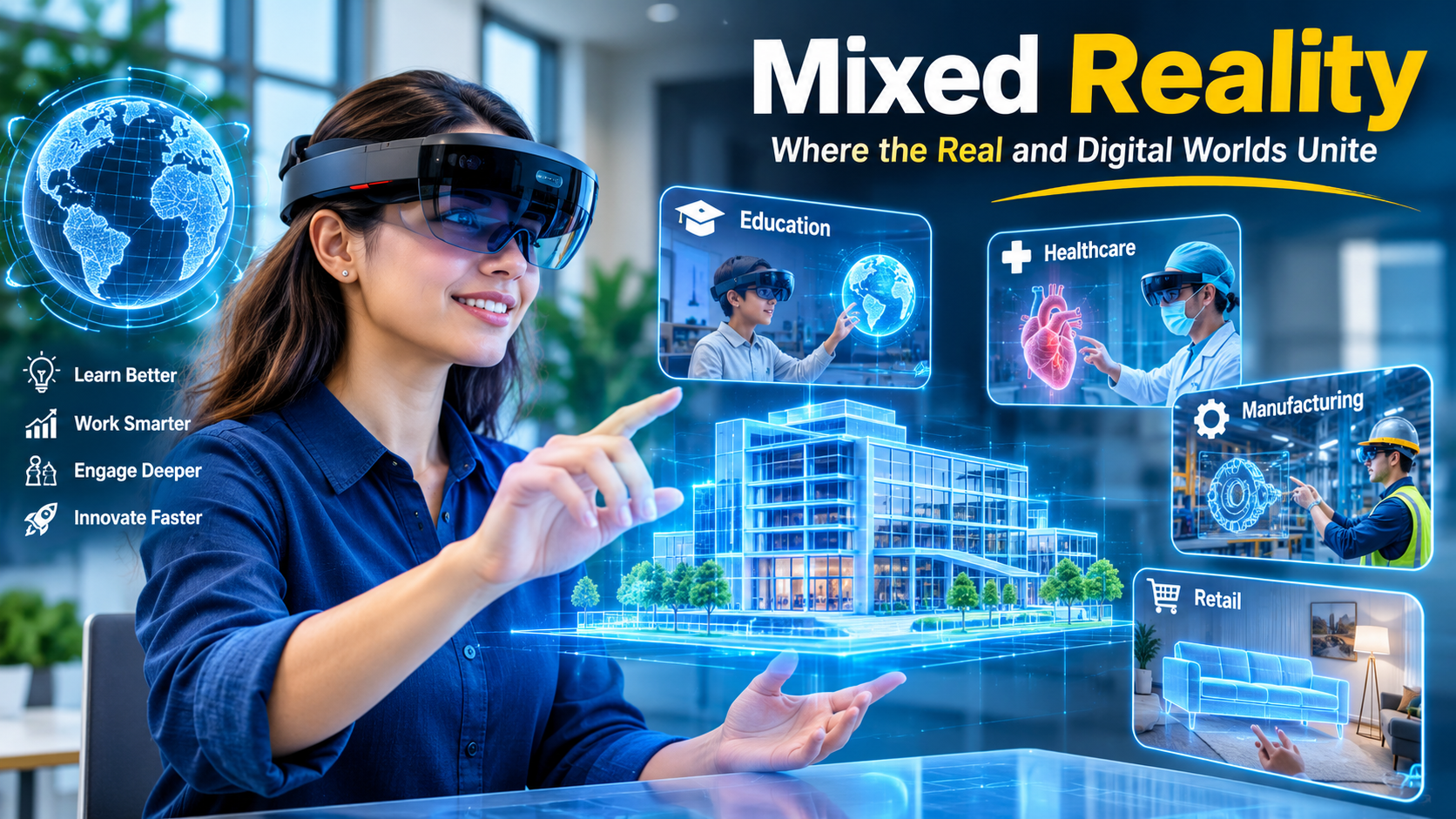
Mixed Reality (MR) is changing the way people interact with digital technology. It combines elements of the physical and virtual worlds, allowing users to experience digital objects within their real surroundings. From virtual product demonstrations to interactive classrooms and advanced industrial training, Mixed Reality is creating new opportunities for individuals and businesses.
As technology continues to develop, businesses are looking for better ways to communicate, train employees, improve productivity, and deliver engaging customer experiences. Mixed Reality makes these possibilities more practical by bringing digital information into real-world environments.
Today, Mixed Reality is becoming an important part of digital transformation. It is helping industries move beyond traditional screens and explore more interactive ways of working. In this blog, we will explore what Mixed Reality is, how it works, its major applications, benefits, challenges, and its future potential.
What Is Mixed Reality? :
Mixed Reality is a technology that combines the physical environment with digital elements, allowing both to interact in real time. It enables users to see and interact with virtual objects while remaining aware of their actual surroundings.
For example, imagine an architect standing inside an unfinished building and viewing a digital 3D model of the completed interior. The architect can examine furniture placement, wall designs, lighting, and other details without constructing the entire space first.
This is one practical example of how Mixed Reality connects digital content with the real world.
Unlike traditional digital experiences, Mixed Reality allows virtual objects to respond to physical environments. Users can interact with these objects through compatible headsets, sensors, cameras, and other devices.
How Does Mixed Reality Work? :
Mixed Reality uses a combination of hardware and software to understand the surrounding environment and position digital objects accurately.
Several technologies work together to create this experience.
1. Sensors and Cameras
Sensors and cameras capture information about the user’s surroundings. They help devices identify physical objects, surfaces, movement, and spatial information.
This allows the system to understand where digital objects should appear.
2. Spatial Mapping
Spatial mapping helps a device understand the shape and layout of a physical environment. It identifies surfaces such as floors, walls, tables, and other objects.
For example, a virtual object can appear on a real table instead of floating randomly in the room.
3. 3D Modelling and Rendering
Three-dimensional models create digital representations of products, machines, buildings, and other objects. Rendering technology makes these models appear realistic within the user’s surroundings.
4. Artificial Intelligence
Artificial Intelligence can improve Mixed Reality experiences by helping systems recognise objects, understand surroundings, and process user interactions.
When combined with AI, Mixed Reality can support more responsive and intelligent digital experiences.
5. Interactive Displays and Headsets
Mixed Reality headsets and compatible displays allow users to view digital objects alongside their physical surroundings. Depending on the device, users may interact through hand gestures, voice commands, eye tracking, or controllers.
Mixed Reality vs. Virtual Reality vs. Augmented Reality :
Although these technologies are related, they provide different experiences.
| Technology | How It Works | Example |
|---|---|---|
| Augmented Reality (AR) | Adds digital elements to the real world | Viewing virtual furniture through a smartphone |
| Virtual Reality (VR) | Creates a fully virtual environment | Exploring a virtual training facility |
| Mixed Reality (MR) | Connects physical and digital environments interactively | Interacting with a virtual machine placed in a real workspace |
The main difference is the level of interaction between digital content and the physical environment. Mixed Reality focuses on making virtual objects feel connected to the real world.
Major Applications of Mixed Reality Across Different Industries :
Mixed Reality is not limited to entertainment or gaming. It has practical applications across industries where visualisation, collaboration, and hands-on learning are important.
1. Mixed Reality in Education

Education is becoming more interactive with Mixed Reality. Instead of depending entirely on textbooks and traditional presentations, students can explore three-dimensional models and learn through practical experiences.
For example, medical students can examine a 3D human heart, understand how different organs work, and explore complex body structures in an interactive environment.
Teachers can also use Mixed Reality to explain science, geography, history, and engineering concepts more effectively.
Key benefits:
- Makes difficult subjects easier to understand.
- Encourages student participation.
- Supports interactive learning.
- Provides opportunities for practical demonstrations.
2. Mixed Reality in Healthcare

Healthcare is another industry where Mixed Reality has significant potential. Medical professionals can use immersive visualisation to study anatomy, understand medical information, and practise certain procedures in simulated environments.
For example, a medical training programme can display a detailed 3D model of the human body, helping students understand the relationship between organs and body systems.
Mixed Reality may also support medical collaboration by allowing professionals in different locations to discuss the same digital model.
However, medical applications require careful validation, patient privacy protection, and appropriate clinical oversight.
3. Mixed Reality in Manufacturing

Manufacturing companies often work with complex machines, equipment, and production processes. Mixed Reality can make these operations easier to understand and manage.
Workers can view digital instructions, equipment information, and 3D machine models while standing near the actual equipment.
For example, a technician repairing industrial machinery could follow visual instructions displayed within their working environment rather than repeatedly checking a printed manual.
This can support employee training, equipment maintenance, product development, and quality inspection.
4. Mixed Reality in Architecture and Construction

Architects and construction professionals can use Mixed Reality to visualise building designs before construction is complete.
They can place digital building models within actual spaces and examine dimensions, layouts, interiors, and structural elements.
For example, a client can explore how a new office design may look inside an existing building. Architects can also identify possible design issues earlier in the planning process.
This approach can improve communication between architects, engineers, contractors, and clients.
5. Mixed Reality in Retail and E-Commerce

Shopping experiences are becoming more visual and interactive. Mixed Reality allows customers to explore products in ways that traditional product photographs cannot always provide.
For example, customers can view a virtual sofa in their living room, examine its appearance from different angles, and understand how it fits into their available space.
Businesses can use similar experiences for furniture, home decoration, fashion accessories, and product demonstrations.
This can help customers make more informed purchasing decisions.
6. Mixed Reality in Business Training

Employee training often involves explaining complicated processes and workplace responsibilities. Mixed Reality can make training more practical through interactive simulations.
Employees can practise operating equipment, understanding safety procedures, and handling different workplace situations in controlled environments.
It can also help companies train distributed teams using shared digital environments.
Benefits of Mixed Reality for Businesses :
Mixed Reality offers several advantages when implemented for the right business requirements.
- Better visualisation: Businesses can explore complex products, designs, and information through interactive 3D models.
- Improved training: Employees can learn through practical simulations instead of relying only on theoretical instructions.
- Enhanced collaboration: Teams can discuss and examine the same digital objects, even when working from different locations.
- Customer engagement: Interactive product experiences can make brand communication more memorable.
- Faster design reviews: Digital prototypes allow teams to examine ideas before investing in physical models.
- Better access to information: Relevant digital instructions and visual information can be presented within the user’s working environment.
These benefits depend on the quality of the application, the suitability of the hardware, and how well the technology fits existing business processes.
Challenges of Mixed Reality Technology :
Despite its advantages, Mixed Reality also has challenges that businesses should consider before implementation.
1. High Development Costs
Developing Mixed Reality applications may require specialised hardware, software, 3D modelling, and experienced developers. These requirements can increase initial investment.
2. Hardware Limitations
Some devices have limitations involving battery life, display quality, processing power, comfort, and field of view. These factors can affect the overall user experience.
3. Technical Complexity
Creating realistic digital environments requires knowledge of 3D development, spatial computing, interaction design, and software integration.
4. Privacy and Data Security
Mixed Reality devices may collect information about users and their surroundings through cameras, microphones, and sensors. Businesses must implement suitable security measures and protect sensitive information.
5. User Adaptation
Employees and customers may need time to understand new devices and interaction methods. Proper training and simple interfaces are important for successful adoption.
The Future of Mixed Reality :
The future of Mixed Reality will be influenced by improvements in Artificial Intelligence, spatial computing, cloud technology, wearable devices, and real-time 3D graphics.
AI integration could make digital objects more responsive and help users interact with virtual information naturally. Better hardware may also make Mixed Reality devices lighter, more comfortable, and easier to use.
In the coming years, businesses may increasingly explore applications such as remote assistance, virtual product development, digital twins, immersive learning, and interactive customer experiences.
However, widespread adoption will depend on affordability, practical value, data protection, and the availability of useful applications.
Mixed Reality is not simply about creating impressive digital visuals. Its real value comes from solving practical problems and improving the way people interact with information.
How Aibuzz Can Help with Mixed Reality Solutions :
At Aibuzz, technology and innovation come together to help businesses explore modern digital opportunities. Mixed Reality solutions can support organisations looking to improve product visualisation, interactive experiences, digital training, and business communication.
From understanding business requirements to exploring suitable software solutions, the right technology approach can help turn innovative ideas into practical applications.
Internal Links :
Add these links within relevant paragraphs:
External Links :
Rich Media Link :

Frequently Asked Questions (FAQs) :
1. What is Mixed Reality in simple words?
Mixed Reality combines the physical and digital worlds. It allows users to see and interact with virtual objects within their real surroundings.
2. What are the main uses of Mixed Reality?
Mixed Reality is used in education, healthcare, manufacturing, architecture, retail, employee training, product design, and business collaboration.
3. What is the difference between Mixed Reality and Virtual Reality?
Virtual Reality creates a completely digital environment, while Mixed Reality combines digital objects with the physical environment and allows them to interact.
4. How does Mixed Reality help businesses?
It helps businesses improve product visualisation, employee training, collaboration, customer engagement, and design processes.
5. Does Mixed Reality require a special headset?
Not always. Some Mixed Reality experiences work through smartphones and tablets, while more advanced experiences may require specialised headsets and compatible hardware.
Conclusion :
Mixed Reality is creating new possibilities by connecting digital information with the physical world. It is changing how people learn, work, design products, communicate, and experience technology.
From interactive classrooms and healthcare training to manufacturing and retail, its applications demonstrate how digital experiences can become more practical and engaging.
Although development costs, hardware limitations, and privacy concerns remain important challenges, continued technological progress is creating opportunities for wider adoption.
For businesses, understanding Mixed Reality today can be a valuable step towards exploring the next generation of digital experiences.
📞 Contact: 919967940928
🌐 Visit: http://aibuzz.net
Leave a Reply